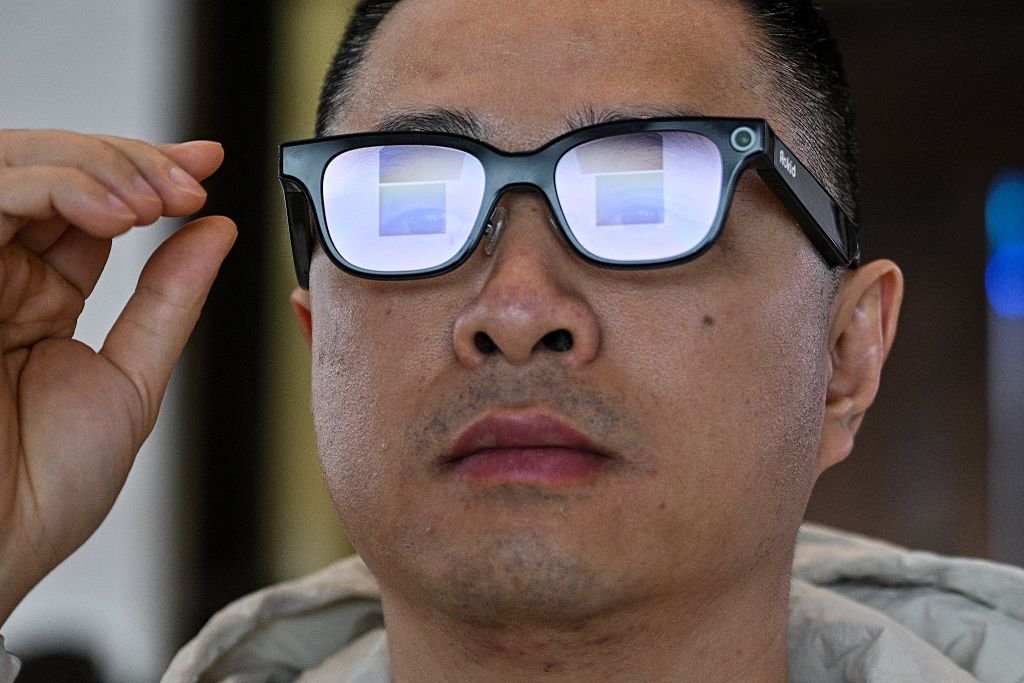

This picture taken on Nov. 13, 2025 shows a man checking a pair of Rokid glasses with display and camera using artificial intelligence (AI) and augmented reality (AR) during a presentation event in Hangzhou, in China’s eastern Zhejiang province. Hector Retamal/AFP via Getty Images
Australia’s Attorney-General Michelle Rowland has confirmed imports of smart glasses will still be allowed into the country amid growing concerns about their misuse.
Instead, she has encouraged councils and businesses to impose rules on their use in public spaces.
Rowland cited unspecified research which showed that 60 percent of surreptitious point-of-view content uploaded online could be classed as harrassment.
She said it was “important to acknowledge the serious concerns that many Australians have about these devices,” and that a ban would not work due to future variants.
“This will not be the final iteration of a wearable information processing device or other such technology,” she said, earmarking further bans on “other forms of wearable information processing devices.”
Related Stories


Responding a possible ban, Rowland also alluded to the possibility of trade retaliation.
“An import ban is a matter that would have consequences across government, including across trade, foreign affairs, and other potential legal obligations that can apply,” she said.
“We are not ruling anything out, but we are utilising what we have at our disposal right now.
“We are not in the business of playing whack-a-mole when it comes to the emergence of technologies, and we know that Australians have always been early adopters. These kinds of technologies can have legitimate uses, but we need to address those harms, and this is an opportune way of dealing with some of those matters, with privacy reforms to make them fit for the digital age right now,” Rowland said.
She said there were existing privacy and criminal laws, at both federal and state levels, that would apply to “nefarious” uses of the technology.
In Brisbane, people cannot use any devices containing a camera—including mobile phones—any of the council’s 21 public pools without the approval of staff.
“Families should be able to enjoy their local pool without worrying that someone might be secretly filming them or their children,” Brisbane Lord Mayor Adrian Schrinner said in a statement provided to The Epoch Times.
Meanwhile, Rowland said she was aware that Education Minister Jason Clare had banned the use of mobile phones in childcare centres.
The Greens are pushing for a 12-month import ban, while independent crossbenchers David Pocock and Kate Chaney have separately backed a temporary import pause while parliament works out proper legal protections, though both admit it is an imperfect stopgap measure.