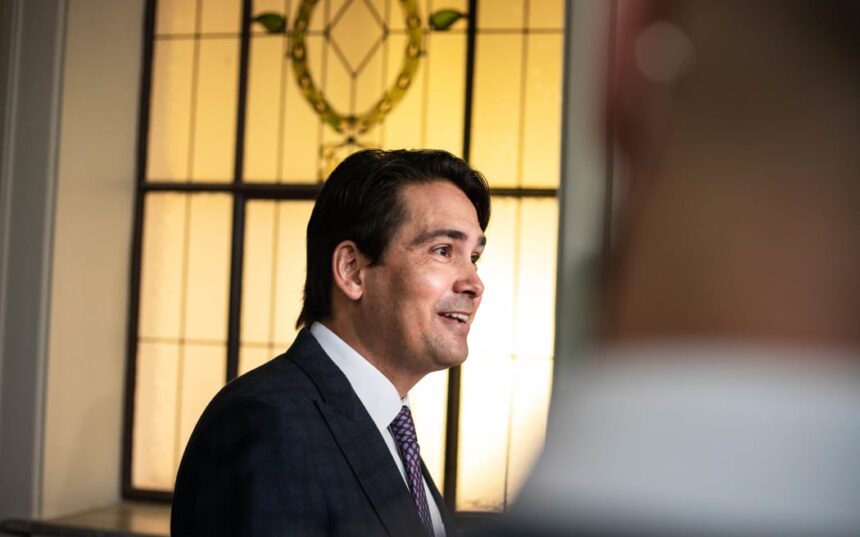

Auckland Business Chamber chief executive Simon Bridges, who campaigned for an end to the policy, said he was hopeful this was a win for small and medium businesses.
Photo:
The Auckland Business Chamber is cautiously optimistic that government promises to ban paywave and credit surcharges from card payments appear to have stalled.
In July last year, Commerce and Consumer Affairs Minister Scott Simpson moved to scrap the fees, declaring: “That pesky note or sticker on the payment machine will become a thing of the past.”
The ban was set to kick into effect no later than May 2026, and the move was heavily opposed by businesses.
However, the rethink is opposed by Consumer NZ which has long called for an outright ban on surcharges.
Prime Minister Christopher Luxon said the government was taking “a breather” on the policy.
“[It’s] still under consideration. We just want to make sure we understand all of the implications before we push the final button on it,” Luxon said.
Auckland Business Chamber chief executive Simon Bridges, who campaigned for an end to the policy, told Morning Report he was hopeful this was a win for small and medium businesses.
“We’ve been stuck between the big banks and the payments providers, the visas and mastercards and consumers, and I suppose politics. I can tell you 29 chambers all over the country reacted viscerally to this, the submissions almost to a single one opposed this strongly,” he said.
“I’ve made and I know Retail NZ has made clear to any minister who will listen our opposition to this. So, look, we don’t know for sure but we’re hopeful this is a win.”
Bridges said the problem with the bill as it stood was a very serious unintended consequences from a blanket ban.
“It’s a slogan in a sense more than it is a policy. In Australia, I understand they walked away from a very similar policy after the unintended consequences and so were there,” he said.
“I hope Scott Simpson and his colleagues will go back and either ditch this or find something more nuanced for the issues that are there.”
The move to axe surcharges followed growing public frustration at the cost and transparency of the charges; the Commerce Commission estimated New Zealanders were paying up to $150 million in surcharges each year, including $45 to $65 million in what it considered excessive charges.
Businesses pushed back, Retail New Zealand arguing every one or two and a half percent made a difference in a tough economy.
Consumer NZ urges government to push ahead
Consumer NZ had long called for an outright ban on surcharges, describing them as a “pain in the bum”.
When the move was first announced, Consumer NZ said it was a “pleasant surprise.”
It has now urged the government to push ahead.
The organisation said businesses’ costs associated with accepting card payments had reduced since December, saving businesses an estimated $90 million a year.
A recent ‘sentiment tracker’ of 1000 New Zealanders showed only 15 percent opposed the ban, while two thirds thought businesses should cover the cost of payments themselves.
“Over a quarter of New Zealanders told us they think they are rarely or never informed of surcharges ahead of payment, and more than four in ten said they’ve paid a surcharge because they couldn’t use a no-fee option,” said Consumer NZ’s campaign manager Jessica Walker.
She said an outright ban was the easiest way to fix the “mess”.
“A ban would be simple for businesses and would stop consumers from being hit with hidden or excessive surcharges. If a business chooses to pass on additional costs due to the ban, we expect those costs to be minimal.”
Retail NZ says pause makes sense
Retail NZ, which warned businesses would likely have to increase their prices elsewhere to recover the payment costs, said there had been a lot of pushback from businesses since the ban was announced.
Its chief executive Carolyn Young said she did not think the government was wanting to put forward something “so hugely unpopular” in an election year.
“It would make sense to pause it now and actually let the Commerce Commission go ahead and do their consultation, so we can really fully understand what is the next step, and what it would look like, and what is a fair way forward,” she said.
Young said the Regulatory Impact Statement on the bill had shown there was no consultation on the ban, and the bill was not as straightforward as it had seemed.
“We’re in the middle of a recession. We’ve got businesses, retailers, closing right, left, and centre. Every one or one and a half percent makes a significant difference to business.”
She said a decade ago the split between debit and credit was around 60 percent on debit, and 40 on credit, but it was now 70 percent on credit and 30 on debit.
While a small number of businesses had managed to negotiate better rates with their bank because of their size and volume, most were struggling to negotiate a lower rate.
“We recommend people go in and talk to their bank about opportunities to get a better rate and some better solutions,” she said.
‘It’s going nowhere’: Peters
The Retail Payment System (Ban on Merchant Surcharges) Amendment Bill is now languishing on the order paper, ready for be read a second time.
“It’s going nowhere,” New Zealand First leader Winston Peters told reporters on Thursday afternoon, after Luxon’s comments.
Asked if there was any disagreement between the coalition parties, Luxon said no.
“We want to take a breather and have a think and make sure that we fully understand the implications of that on all businesses,” he said.
ACT leader David Seymour said businesses could not afford it.
“The government said it would do it. We’ve listened to the very strong feedback. I’ve listened to small business people saying we get a million bucks through our card system, a 2 percent fee we have to eat would be $20,000, our small business can’t afford that, and that’s why the conversations carry on,” Seymour said.
“We are listening as a government to small business and we’ll get to a better place.”
Seymour said the surcharge ban bill had been through Select Committee, where his colleague Parmjeet Parmar suggested businesses should be able to keep surcharges if they offered a free alternative, like EFTPOS.
“Maybe that’s where we end up, who knows.”
Asked whether the ban would be in place by May as promised, Commerce and Consumer Affairs Minister Scott Simpson said he was “hopeful”.
Sign up for Ngā Pitopito Kōrero, a daily newsletter curated by our editors and delivered straight to your inbox every weekday.