

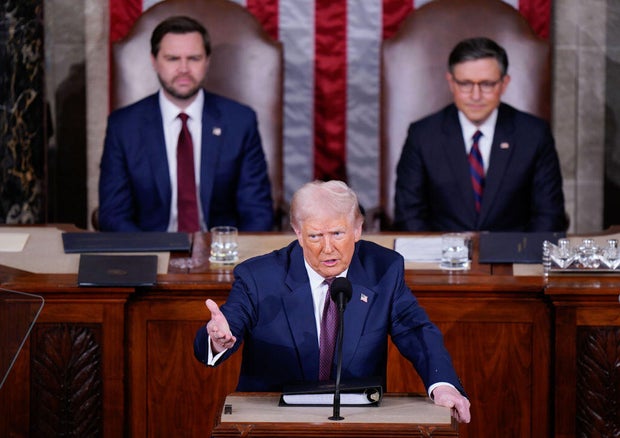
Washington — When President Trump heads to the Capitol to deliver his State of the Union address before a joint session of Congress on Tuesday night, he will be greeted by raucous applause from his fellow Republicans on a host of different policy matters.
But that reception will mask signs of discontent among some GOP lawmakers, who have become more willing to cross the president in recent months.
House Republicans have rebuked Mr. Trump in votes on tariffs, war powers and the Epstein files. And with members’ own reelection hopes beginning to clash with some politically unpopular policies coming from the White House, the number of Republicans defectors could grow as the midterm elections approach.
“He was bound to be a lame duck at some time,” said Elaine Kamarck, a senior fellow in Governance Studies at Brookings. “Now, usually it happens after the midterms.”
After the “sugar high”
The dynamic is a shift from a year ago, when Mr. Trump addressed a joint session of Congress on the heels of his return to the White House. Republicans from all factions of the conference touted a GOP mandate — and a deep sense of unity.
At the time, the GOP was “riding the wave” of the president’s electoral victory and a slew of executive orders he ordered once back in office, said Todd Belt, the director of the political management program at George Washington University. He said there was a “sugar high” among the GOP conference in the early days of Mr. Trump’s term.
Jabin Botsford/The Washington Post via Getty Images 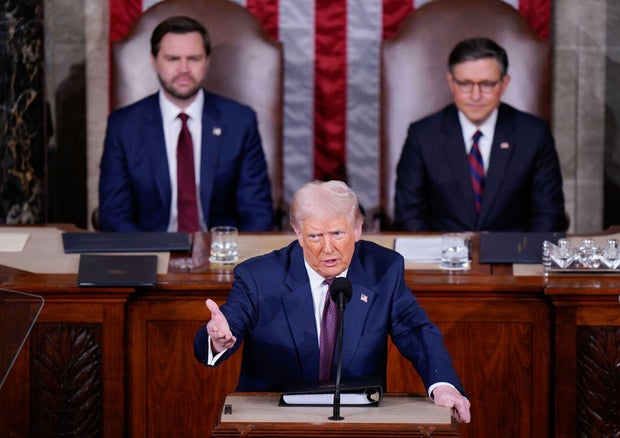
“It’s different now because we’ve had a year in and you’re seeing a break with some of the America-firsters in the MAGA movement, who have been frustrated with the fact that Donald Trump has been focusing a lot of his attention on other places than the United States,” he said.
Belt noted that some of the president’s supporters have been put off by aspects of the administration’s economic and immigration agendas, and what they see as violation of “core precepts” of constitutional principles in both areas. That has prompted some members to “exert their voices in some of these votes.”
“Sometimes those votes won’t make a difference, and it makes it easier to cast that vote as a little bit of a protest vote,” Belt said. “But for some of them, they’re seeing a weakened president in terms of his poll numbers, so it’s easier for them to speak out against him.”
The latest House GOP rebuke of the president came when six Republicans joined Democrats in voting to rescind the president’s tariffs against Canada. GOP leaders tried to prevent the vote from moving forward. Mr. Trump pledged that Republicans would “seriously suffer the consequences come Election time.”
After the Supreme Court invalidated many of Mr. Trump’s tariffs last week, Mr. Trump followed through on his threat. The president withdrew his support from one of the six GOP defectors, Rep. Jeff Hurd of Colorado, and endorsed his opponent. The president derided Hurd as “one of a small number of Legislators who have let me and our Country down.”
Mr. Trump nearly suffered another vote of disapproval in January when two Republicans supported a Democrat-led resolution to block the president from putting troops in Venezuela after the U.S. captured former Venezuela President Nicolás Maduro. Lawmakers are expected to force another vote on a war powers resolution in the coming days, this time involving Iran.
But arguably the most embarrassing defeat for Mr. Trump came in the effort to force the Justice Department to release all the files related to sex offender Jeffrey Epstein, a push that Mr. Trump strongly opposed until the last minute. Four Republicans helped force a floor vote on the issue, and all but one GOP lawmaker ultimately voted for the files’ release. The episode was also at the center of a public falling out between the president and Rep. Marjorie Taylor Greene of Georgia, once one of the president’s fiercest allies in Congress, who became a vocal detractor — and then the latest member to retire.
Mike Ricci, a former aide to House speakers John Boehner and Paul Ryan, said it’s “typical to have some restlessness” in the second year of a president’s term.
“You’ve sprinted for a year, you’ve gotten as much done as you can, and you’re staring down a midterm election where it’s entirely a referendum on you and your policies. And obviously, in a time of economic anxiety, that’s even more complicated,” Ricci told CBS News.
Ricci added that members are “more and more peeking over the horizon into what may feel to them like a vast nothingness that is life beyond Trump.”
“Some may want no part of that. Some may want to be on the front lines. But members are beginning to navigate this moment where that loyalty to him and that long-term positioning for themselves is starting to overlap,” he said.
Defying the “intimidation factor”
Though some of Mr. Trump’s priorities have been widely unpopular even among the GOP, only a handful of Republicans in recent weeks have been willing to actively go against the president. Philip Wallach, who studies congressional dysfunction at the right-leaning American Enterprise Institute, attributed the loyalty of the majority of the conference to the “intimidation factor.”
“I’d say most members still feel a pretty strong pressure to stay in line, especially until they get past their primary elections,” Wallach told CBS News. “In recent times, there really has not been a president with a party that is organized so dominantly around obedience to the personal leadership of the president.”
Those who have already distanced themselves from Mr. Trump on some issues “don’t really have much to lose in their relationship with” him, Wallach said.
Indeed, for some of the GOP defectors, the calculus is made much easier due to their decision not to seek reelection. Two of the Republicans who voted in favor of the tariff resolution, Reps. Dan Newhouse of Washington and Rep. Don Bacon of Nebraska, are retiring. Rep. Kevin Kiley of California, whose seat was targeted in California’s redistricting push, has yet to announce his plans.
When asked by CBS News whether Mr. Trump is losing his grip on House Republicans, Bacon said, “that’s not how I look at it.”
But Bacon has been unafraid to speak out when he disagrees with the president, saying the threats don’t intimidate him.
“You got to stand for what’s right despite where your party leadership is at,” Bacon told CBS News. “If you threaten me, I tend to dig my heels in.”
In private, Bacon said his Republican colleagues have criticized Mr. Trump’s tariffs and his handling of the war in Ukraine. Yet those colleagues have been hesitant to speak out or vote against the president.
“I find that in a few areas, he is asking us to do things that defy common sense or what is traditionally conservative,” Bacon said of the instances he’s broken with the president.
Bacon also recently cosponsored a constitutional amendment to limit the president’s pardon authority, saying in a statement it’s clear “the pardon authority has been abused.”
Then there’s GOP Rep. Thomas Massie of Kentucky, who’s been a main instigator in the rebellion against Mr. Trump.
Massie led the push with Democratic Rep. Ro Khanna of California to force a vote on the Epstein files, which became a huge thorn in the Trump administration’s side in the last year. Then last week, Massie announced that he and Khanna were teaming up again to force a vote on a war powers resolution to require the president to get authorization from Congress before taking military action against Iran.
The Kentucky Republican’s frequent defections from his party have drawn the president’s repeated ire and prompted a primary challenge backed by Mr. Trump. And his inclination to oppose legislation means GOP leaders, and by extension Mr. Trump, can afford little other opposition.
A narrow House GOP majority approaches the midterms
House Speaker Mike Johnson, a Louisiana Republican, is working with a one-vote margin, leaving him with little margin for error in keeping his conference united. A special election to replace Greene is set for next month, while a special election to replace Doug LaMalfa, a GOP member from California who died in January, will be held in August. Both should remain in GOP hands.
But Democrats are likely to pick up another seat in April, when a special election will be held to fill the seat left vacant by New Jersey Gov. Mikie Sherill, keeping the GOP margin on a knife’s edge.
The larger focus for Republicans will be on maintaining control of the House after November’s elections. Traditional political wisdom holds that the party controlling the White House typically loses seats in the lower chamber in the midterm elections.
For Mr. Trump and his party, Kamarck said, “at this point, it’s a matter of sort of cutting his losses.”
“Do the Democrats have a huge victory, like 30 seats, or do they get, you know, five or 10 seats?” Kamarck said. “It depends on really what the administration does. They made the right pull-back on immigration, but I don’t see them making the right moves on the economy.”
If Republicans lose control of the House, the president’s legislative agenda would likely grind to a halt, and his final two years in office could be consumed by a flurry of investigations and subpoenas from a newly empowered Democratic majority.
The prospect of languishing in the minority means vulnerable GOP members may be more inclined to rebuke the president in the coming months. More defections could be possible after the GOP primaries, when members turn an eye toward the general election without the threat of a primary challenge.
There may be more room yet for pushback against the president after he addresses the joint session of Congress on Tuesday.
“You don’t want to throw your president under the bus right before the State of the Union,” Belt said. “Things will get a little stickier afterwards.”