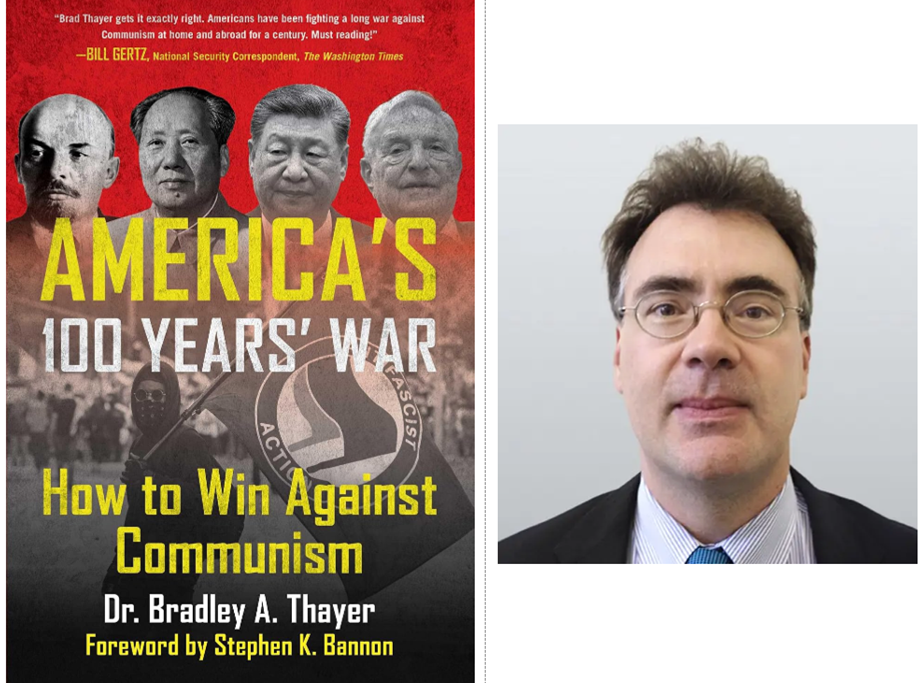
Dr. Bradley A. Thayer’s new book, “America’s 100 Years’ War: How to Win Against Communism,” shows how the United States has been locked into an ideological war with communism for over a century and how the country can be victorious over it.
The author contends that the collapse of the Soviet Union didn’t end the communist threat. Communism went underground, embedding itself in the American body politic, particularly the education system.
The recent resurgence of the Democratic Socialists of America and their takeover of the United States’s oldest political party, the Democratic Party, is evidence of its effectiveness.

Americans join Cubans in a rally near the White House on July 26, 2021. Kevin Dietsch/Getty Images
Many Failures
Thayer defines the struggle which has been going on since the emergence of a communist state in Russia in 1917. He shows how it grew, why it’s antithetical to the American way of life, and why, despite many failures, it remains attractive and powerful today. More importantly, he provides a roadmap for defeating it.
The book focuses on the Soviet Union, Leninism (the form of communism present in the Soviet Union), and the Communist International (Comintern).
There’s an extensive look at communism in China and the Chinese Communist Party (CCP). It examines Maoism and the current leader, Xi Jinping’s ideology. Thayer offers several possible scenarios for China’s future, explaining the potential each offers for conflict with the United States.
Related Stories


Thayer also examines American exceptionalism and the foundations of the American identity: the “can-do” American spirit, political liberalism, and Western civilization. He shows how they combine, making the United States an intellectual and material powerhouse.
In this context, political liberalism is the Founding Fathers’ classical liberalism; it’s the belief in limited government, equality under the law, and the idea that all are created equal before God.
Thayer explores how communists have tried to undermine America since the Bolshevik takeover of Imperial Russia. The book discusses how communist dogma in U.S. civil society through its influence in journalism and education. He also presents the role that groups like Antifa play in enforcing progressive philosophies.

The CCP has infiltrated many aspects of American society.
One chapter shows how critical race theory and its daughter ideology of Diversity, Equity, and Inclusion (DEI) was normalized. This occurred first in academia and later in general society through the influence of progressives.
He shows why these ideologies are incompatible with classical American values. A value system where one’s birth defines one’s position in society (DEI’s core belief) can’t coexist with a value system which holds that all men were created equal and endowed by God with inalienable rights. Free will and DEI predestination are irreconcilable.
The final two chapters provide a roadmap for defeating communism, winning this 100-years’ war. Thayer underscores a basic truth: Communism is unsustainable. Unless it can rob resources from outside its sphere, it will collapse under its own weight.
Illegitimate
This is why communism needs to always be on the offensive. It’s illegitimate, imposed on an unwilling population. In China, it’s a foreign import, which inherently conflicts with traditional Han culture.
Defeating communism is simple but not easy. To counter CCP expansionism, particularly economic expansion outside China, Thayer recommends stopping CCP imperialism within the United States.
The United States can block Chinese funding of American education, media, and politicians. Moreover, we must restore confidence in Western Civilization and American exceptionalism.
Thayer’s worst-case scenario of Chinese military domination is unlikely. Thayer accurately describes CCP intentions, but reality will check the CCP’s vision.
Because of the CCP’s ill-conceived and now canceled “one-child policy” and the recent “tang ping” (“lying flat,” the Chinese version of quitting quietly) movement of disillusioned Chinese youth, China is now facing demographic collapse. Its population will likely drop precipitously over the next 20 years. It’s already below that of neighboring India.
It’s difficult to pursue an expansionistic military policy without large numbers of young men to fill the military. The regime is aware of India’s growing population, which is more concerning because that neighbor is moving away from socialism toward capitalism.
This doesn’t mean the CCP won’t try. The approaching demographic cliff may drive the CCP to accelerate military efforts. It may cause them to redouble efforts to undermine the United States.
The regime could further fund indigenous socialist movements in the United States and convince young American adults to skip having children; a United States demographic collapse would balance a Chinese collapse. The next 20 years, especially the next decade, may offer more risk, not less.
Dr. Thayer’s book offers much to think about and much to do. One way to use it is as a syllabus for a middle-school course on American civics.