

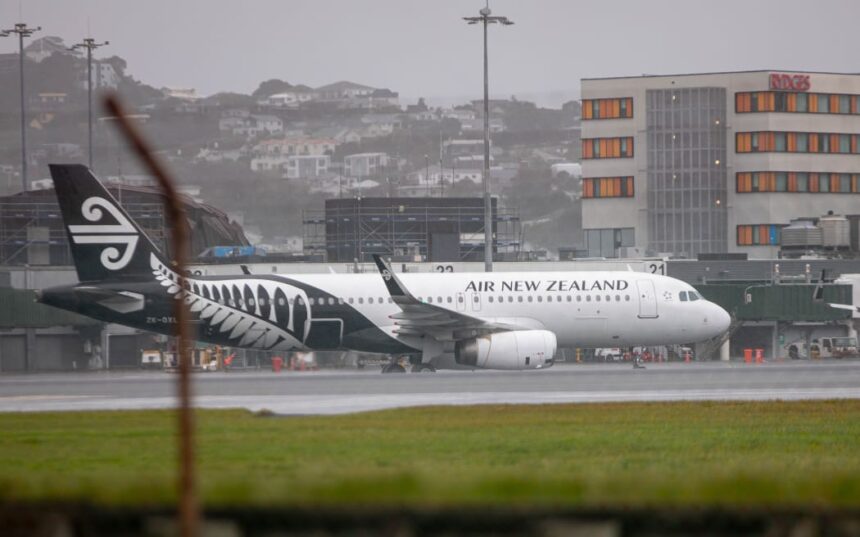

Air New Zealand cabin crews will strike on Thursday and Friday.
Photo: RNZ/ Mark Papalii
Air New Zealand says staff are working “around the clock” to minimise disruption as cabin crews go on strike Thursday and Friday.
Flight attendants working on board the airline’s wide-body long range aircraft will stop work over stalled talks on pay and conditions.
Air New Zealand said 46 flights had been cancelled ahead of the strikes.
Chief customer and digital officer, Jeremy O’Brien, said teams were working to rebook and support the nearly 9500 customers affected.
“We have done everything possible to minimise the impact, and our teams have been working around the clock to reaccommodate customers whose flights are affected.
“We are very sorry for the disruption to some customers’ travel plans. Customers have been contacted directly with rebooking options and may also choose a refund or to hold the value of their ticket as credit for travel at a later date,” O’Brien said.
The airline said it had adjusted some flight times and used alternative aircraft to protect the majority of its Tasman and Pacific services from cancellations.
Striking a last resort
E tū union’s national secretary, Rachel Mackintosh, said the strike action was “a last resort” for members frustrated by the failure to reach an agreement after nearly 10 months of negotiations.

E tū national secretary Rachel Mackintosh.
Photo: RNZ / Layla Bailey-McDowell
“The crew are – from a passenger point of view – the people who make Air New Zealand such a great airline, who keep people safe, manage crisis and are first responders. Pretty much every member of the travelling public will have seen flight crew manage difficult situations, calm people down who are anxious travellers, manage conflicts, keep every body healthy and safe.
“That’s really important work and the crew are so professional that they make it look easy but it’s actually complex and responsible work,” Mackintosh said.
She said while cabin crews received additional allowances for long hours and time away from home, the low base salary for flight attendants meant many faced problems paying rent or getting loans.
“The base pay [for flight attendants] is very low. Currently less than $60,000 a year. That is the only guaranteed income that people have and not all crew get much more than that because the extra allowances really depend on where you go and what roster you get.
“That pay level has an effect on people’s lives including that they can’t get bank loans or mortgages because that’s their only guaranteed income,” Mackintosh said.
Mackintosh said expensive additions to the airline’s assets such as a new hanger, purchasing aircraft and redesigning new uniforms flew in the face of the efforts of the people working aboard the airline’s flights who, like many others, were struggling to deal with the high cost of living back home.
Air New Zealand said it had offered to increase base salaries by a range of 4.14 percent to 6.41 percent and more pay talks were scheduled for later this month.
The airline has been approached for comment in response to E tū’s statements.
Sign up for Ngā Pitopito Kōrero, a daily newsletter curated by our editors and delivered straight to your inbox every weekday.