

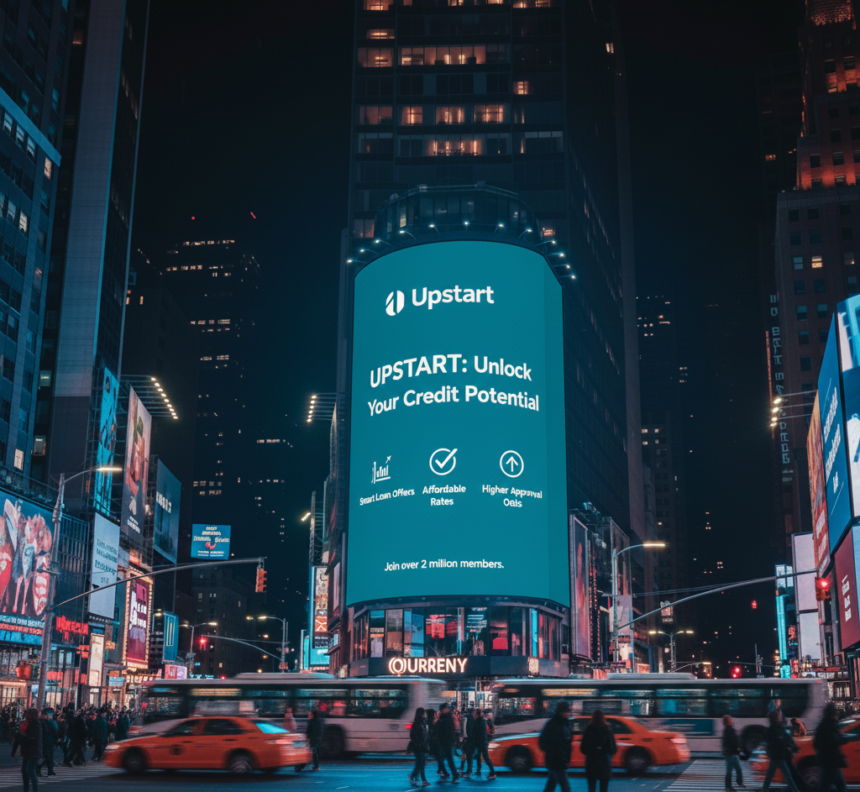
Upstart Review 2026: For decades, the process of obtaining a personal loan has been governed by a rigid, often opaque system. Traditional lenders primarily rely on the FICO credit score—a three-digit number summarizing your credit history—as the gatekeeper to financial opportunity. This system, while standardized, has significant flaws. It can overlook responsible individuals with limited credit history (“thin files”), unfairly penalize those recovering from past financial hardships, and fail to capture a holistic picture of a person’s financial health and potential. Millions of creditworthy people are denied access to affordable credit or are forced to accept higher interest rates based on this incomplete assessment.
Enter Upstart, a fintech company founded in 2012 with a radical mission: to use artificial intelligence (AI) and machine learning to build a more equitable and inclusive financial system. Upstart challenges the core assumptions of traditional lending by evaluating borrowers on more than just their credit score. This blog post will serve as your ultimate guide to understanding Upstart—how it works, its benefits and potential drawbacks, its impact on borrowers and investors, and what its rise signifies for the future of finance.
Chapter 1: What is Upstart? The Genesis of an AI Lender
Upstart Holdings, Inc. (NASDAQ: UPST) was founded by former Google employees Dave Girouard, Paul Gu, and Anna M. Counselman. The founding insight was simple: the traditional FICO-based lending model was inefficient and left too many capable people behind. They believed that by leveraging the power of machine learning models trained on vast and diverse datasets, they could more accurately predict a borrower’s true risk of default.
Unlike a bank that uses a static formula, Upstart’s platform considers thousands of data points. While it still considers credit history, it also evaluates factors such as:
-
Education: College, area of study, and academic performance.
-
Employment History: Job type, income, and professional trajectory.
-
Residency and Cost of Living: Geographic stability and local economic factors.
The core thesis is that these variables are stronger indicators of future financial responsibility than credit history alone. By approving more borrowers at lower rates for the same level of risk, Upstart aims to create a win-win: borrowers get better loan offers, and lending partners (the banks that actually fund the loans) experience lower loss rates.
Chapter 2: How the Upstart Platform Works – A Step-by-Step Look
For Borrowers:
-
Soft Credit Check & Application: You start by filling out an online form with basic personal, financial, and educational info. Upstart performs a soft credit pull that does not affect your credit score.
-
AI-Powered Evaluation: In seconds, Upstart’s AI model assesses your application against its training data. It doesn’t just give a “yes” or “no”; it calculates a specific risk profile.
-
Personalized Loan Offers: You receive one or more loan offers with precise interest rates, terms (3 or 5 years), and monthly payments. You can see your rate before choosing to proceed with a formal application.
-
Formal Application & Funding: If you accept an offer, you complete a full application, provide documentation, and undergo a hard credit inquiry. Upon final verification, funds can be deposited as fast as the next business day.
For Institutional Partners (Banks & Credit Unions):
Upstart operates as a “platform.” It does not lend its own money. Instead, it partners with banks and credit unions that use Upstart’s AI underwriting technology to originate loans. These partners benefit from automated, efficient underwriting that can scale quickly and, according to Upstart’s data, achieve lower loss rates compared to their traditional models.
For Investors:
Upstart also offers a note investing platform where individual investors can fund fractions of loans, aiming to earn returns based on the interest paid by borrowers. This creates a marketplace that supplies capital to the lending ecosystem. (Note: This involves significant risk and is not suitable for all investors.)
Chapter 3: The Pros and Cons of Using Upstart
Advantages:
-
Potential for Lower Rates for Creditworthy Individuals: Those with strong education and employment but limited credit may find better rates than elsewhere.
-
Fast, Fully Online Process: From application to funding, the process is digital and quick.
-
Transparency: See your rate without impacting your credit score initially.
-
Inclusive Approach: Designed to serve those underserved by traditional credit models.
Disadvantages and Criticisms:
-
Origination Fees: Loans can come with an origination fee (0% to 12%), which is deducted from the loan proceeds.
-
Potential for Higher APRs: For some borrowers, especially those with excellent credit, rates may be higher than those from competing lenders like credit unions or other online banks.
-
Limited Loan Types: Primarily focuses on unsecured personal loans (for debt consolidation, credit card refinancing, home improvement, etc.) and auto refinancing. It does not offer mortgages, business loans, or other products.
-
Regulatory Scrutiny: As a disruptor, Upstart faces ongoing scrutiny from regulators like the CFPB concerning fair lending practices and the potential for its AI models to inadvertently create bias.
Chapter 4: Upstart vs. The Competition
Upstart exists in a competitive landscape of fintech lenders. Here’s a brief comparison:
-
SoFi: Also targets financially responsible borrowers (often high-income professionals) but may place more emphasis on income and employment than educational data. Offers a wider suite of products (investing, banking, mortgages).
-
LendingClub: A pioneer in the peer-to-peer lending model. Its underwriting is more traditional than Upstart’s AI-driven approach, often placing heavy weight on credit history.
-
Marcus (Goldman Sachs): Focuses on borrowers with good to excellent credit. Its underwriting is traditional, and it is known for no-fee loans.
-
Traditional Banks/Credit Unions: Offer the stability of an existing relationship but often have slower, less tech-driven processes and may be less flexible for non-standard credit profiles.
Upstart’s key differentiator remains its core AI underwriting technology that seeks to evaluate a broader set of data points than any of these competitors.
Chapter 5: The Future of Upstart and AI Lending
The journey for Upstart is ongoing. Its future hinges on several factors:
-
Economic Resilience: How its AI models perform during a full economic downturn (tested during periods of rising interest rates).
-
Regulatory Evolution: Navigating and shaping the regulatory framework for AI in finance.
-
Product Expansion: Successfully moving into new verticals like auto retail lending and small business lending.
-
Continuous Model Improvement: Refining its algorithms to be more accurate, fair, and transparent.
The broader trend is clear: data-driven, AI-powered underwriting is the future of credit. Upstart has positioned itself at the forefront of this shift, challenging the 30-year dominance of the FICO score. Whether it becomes the new standard or one of several advanced models, its impact on making credit more accessible and risk assessment more precise is undeniable.
Conclusion: Is Upstart Right for You?
Upstart is not a one-size-fits-all solution. It is an excellent option to explore if:
-
You have a strong educational and employment background but a limited or fair credit history.
-
You value a completely online, fast application process.
-
You are seeking a personal loan for debt consolidation or a major expense.
You should shop around and compare offers from other lenders if:
-
You have excellent credit (you may find lower rates elsewhere).
-
You are uncomfortable with an origination fee.
-
You prefer a longstanding relationship with a local bank or credit union.
Ultimately, Upstart represents a powerful and necessary innovation in finance. By asking you to look beyond a simple credit score, it champions a more complete view of financial potential. As with any financial product, due diligence is key. Use its pre-approval tool to see your rate—without obligation—as the first step in your loan shopping journey.
Disclaimer: This article is for informational purposes only and does not constitute financial advice. Please consult with a qualified financial professional before making any loan or investment decisions.