

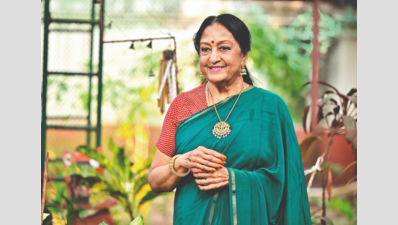
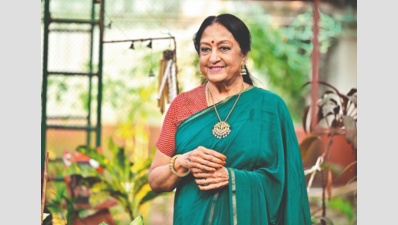
Padma Subrahmanyam, who has completed 70 years in Bharatanatyam, says she may be among the few women who dared to say no to former chief minister and matinee idol M G Ramachandran when he wanted her to play his heroine in Kalki’s ‘Sivakamiyin Sabatham’. “Every day at 6am, he would call, asking for my nod. But I never said yes. My career was, and has always been, dance,” says the 83-year-old in an interview. Excerpts:You started teaching Bharatanatyam in your early teens. How did that happen?My father, director K Subrahmanyam, who established Nrithyodaya in 1942, wanted me to give back to society what I had learned. I was 14 years old then. He took me to a dozen orphanages to select about 20 girls. Having hand-picked them, I realised how fortunate I was to have had the opportunity to impart the art. It made me understand that teaching was a learning experience.Dance apart, you dreamed of becoming a doctor.Yes, I wanted to be a surgeon. However, my father refused to get me the application form, feeling medicine was not my true path. I approached our family friend, C Subramaniam, who had served as the education minister and later as the governor of Maharashtra, hoping he would support me. Instead, he helped me recognise my real calling. He told me that while there were many competent doctors, what the country needed were dedicated dancers. In time, I did earn a doctorate in dance. I spent 10 years studying commentaries, temple inscriptions, sculptures, and difficult classical texts that demanded deep interpretation.Was it difficult to say no to MGR?He was persistent. He wanted me to act in his film ‘Sivakamiyin Sabatham’ as his leading lady, but I had no interest in movies. The project was shelved after I explained to him that dance was my calling. It wasn’t the only film offer I said no to. Satyajit Ray, Hrishikesh Mukherjee, Raj Kapoor and N T Rama Rao had also approached me, but I declined their offers. Despite my father introducing actors such as T R Rajakumari, Saroja Devi and M K Thyagaraja Bhagavathar, and my mother, Meenakshi Subrahmanyam, being a music composer and lyricist, I was not drawn to films.You did your thesis on ‘The karanas in Indian dance and sculpture’.I did my PhD at Annamalai University. My idea was to bridge the past and the future, and to create a link between the forgotten past and the theoretical and practical aspects of dance.Are you a strict teacher?I have been teaching dance since 1958. I learn from my students, and I know how to correct their mistakes. In class, I mean business and am strict about punctuality and attendance. But outside the class, I play games with them. I encourage students to watch artists of all genres. Broad-mindedness is something my father inculcated in me from childhood. I enjoy good dance in films too. I love art in any form.In 2010, you choreographed a historic performance with 1,000 dancers at Brihadeeswara Temple in Thanjavur.It was the temple’s 1,000th anniversary, and I wanted to celebrate Lord Shiva. I started planning an event, ‘Rajarajeswaram 1,000’, within a short time. It was executed with the help of my dance fraternity, ‘ABHAI’, the Association of Bharatanatyam Artists of India. All of us chose one student from their school, recorded our pieces and sent them across the globe. Former chief minister M Karunanidhi volunteered to be part of it, making food arrangements for all participants when he learned about the event. In fact, he asked if he could participate, and we performed without rehearsals.Did you wear the salangai (ankle bells) of actor Padmini for your arangetram?Yes, our family association with them dates back several decades. I was born when the sisters (Lalitha, Padmini and Ragini) were living in our house. My father was called ‘appa’ in the film industry. Our house was like a ‘chatram’, an abode for many. From Janaki Ramachandran to Padmini’s family, many lived with us at one point. When I was ready for my arangetram, it was Padmini’s mother who tied the salangai around my ankles. I am truly blessed.Your designs for the temple at Satara are much talked about. How did that happen?I designed the sculptures of the 108 karanas (codified dance movements) of Lord Shiva and Goddess Parvati in black granite for the Nataraja temple at Satara, Maharashtra, at Kanchi Mahaswami’s bidding. I was asked to freeze the movements of the karanas, which are not sculpted in the older temples of Tanjore or Chidambaram. I used the twin figures of Shiva and Parvati to bring out the animation in each movement. Twelve years after completing the design of these 108 karana figures, I discovered, by the grace of the Kanchi seer, about 50 karana sculptures in the world-renowned 9th-century AD temple complex at Prambanan in Central Java, Indonesia.In the course of your research and performances, did you find any connections between India and cultures abroad?Every time I travel abroad, I inform the Kancheepuram seer. In 1982, before my visit to Australia, he casually told me to visit the Aborigines there. To my surprise, a group referred to as the ‘Shiva tribe’ performed at a festival, singing “Rama Rama”. They held a trishul and applied sacred ash on their bodies. As soon as they wrapped up their performance, I went up to them and started speaking in Tamil. We discovered that we had nearly 50 words in common, including “muzham”(cubit) and “mutti” (knee joint).TEXT, TECHNIQUE AND TRADITION
- The dancer scores the music for most of her productions, apart from numerous individual compositions
- She was the first dancer to use a Meera bhajan, scoring it to suit the grammar of a pada varnam
- She has also composed the first Bengali varnam, set to lyrics by Salil Chowdhury
- Her creativity as a dancer and choreographer includes an expanding technique through the use of the entire body, with leaps, extended leg movements, and fast footwork to enhance rhythmic variations
- Her reconstruction of the karanas has revealed that Bharata Muni’s Natyasastra has been a common text for performing arts across India and in many parts of Southeast Asia
| The dacoit who turned out to be a fan
Several years ago, in Khajuraho, I was walking towards my performance venue when a well-built man with a large moustache picked up my vanity case, which contained my jewels. He then walked with my troupe and me to the tent. He casually spoke about a lecture in Ujjain that had been held only for a select group of scholars, so I assumed he was a regular visitor. When I asked him more about himself, he calmly declared that he was a ‘dakoo’ (dacoit) and a big fan of mine. He said that when he saw me dance, he saw Goddess Durga. He also said that he had impressed Pandit Ravi Shankar, who had conferred on him the title ‘Rasika Shiromani’. That moment stayed with me. I believe that good music and dance have the power to transform people. |