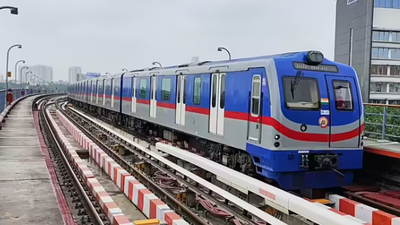
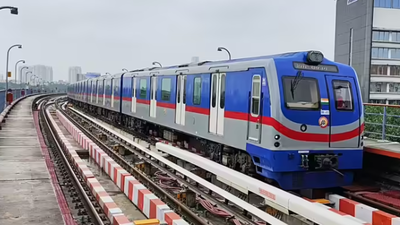
KOLKATA: If you commute regularly by Kolkata Metro’s Blue Line (North-South Metro), you no longer have to worry about getting stuck in the tunnel in case of a power failure. The Blue Line has become the country’s first metro corridor to get battery backup that will carry the trains to the next station during an outage. In such scenarios in the the past, Blue Line passengers have been forced to walk on tracks to reach the nearest station.The new Battery Energy Storage System (BESS), a set of converters that will kick into life when regular power supply fails, was launched on Wednesday — the system was set up at the substation next to Central station. “India’s first metro, which has been the city’s heartbeat since 1984, has achieved yet another feat in the form of BESS. It is the first of its kind in Indian Railways,” said Metro Railway general manager Subhransu Shekhar Misra while commissioning the system.
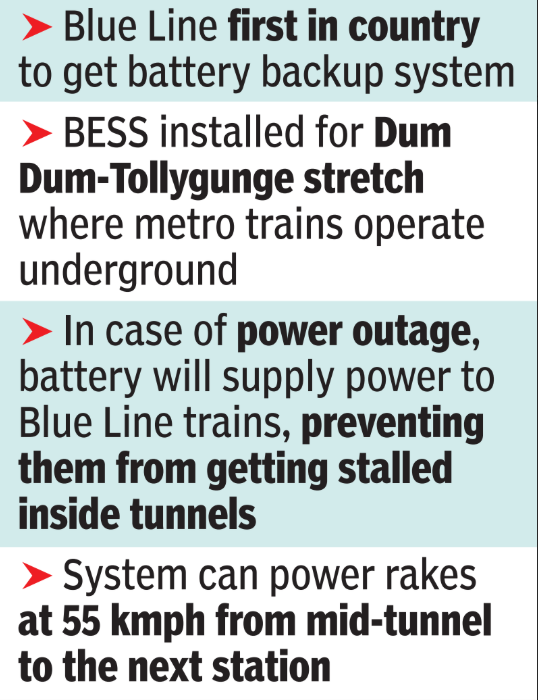
Three trials were carried out with fully loaded rakes prior to the launch. The rakes covered 20 km at 55 kmph, switching to BESS to emerge out of tunnels after power was cut off.“The last trial was successfully conducted on Sunday from Dum Dum to Netaji (Kudghat) stations though BESS is meant for the underground Dum Dum-Tollygunge stretch,” said Niranjan Nayak, MD of Delta Electronics that built the converter. “The system can cover 35 km and sequentially pull out 18 trains one by one,” he added.Batteries to help cut Metro electricity billThe 4 MW system is a combination of inverters and advanced chemistry cell (ACC) batteries, said principal chief electrical engineer Asim Majumdar. “The electricity generated can be used to haul stranded rakes from midtunnel to the next station. It is part of the National Programme on Advanced Chemistry Cell Battery Storage approved by the Union cabinet in 2021,” he added.Chief electrical engineer Jayanta Chakraborty explained BESS is designed in a way that the stored electricity can be used to haul rakes at 55 kmph. It can also supply electricity for tunnel ventilation and environment control system (AC) in underground stations. The green batteries are also expected to reduce the metro network’s energy footprint and electricity bill.Metro officials said the usual glitches that affect metro rakes are localised and can be traced to the tracks or signalling system. But BESS is designed for a failure of a much larger scale. The plan to have a backup was conceived after the July 2012 blackout following a grid collapse that paralysed the entire country.