
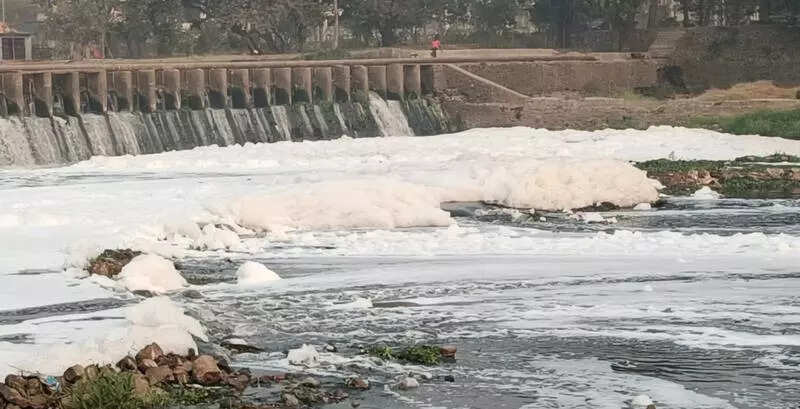
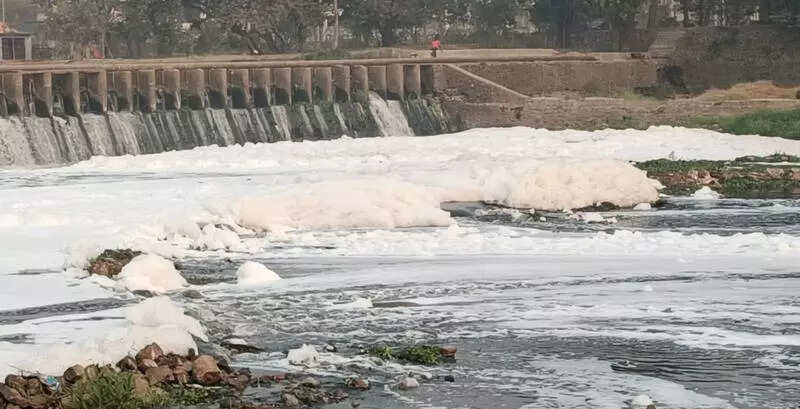
Pune: Unabated pollution in the Indrayani river has triggered fresh concerns among not just devotees in the pilgrimage town of Alandi but residents along the entire banks, particularly Pimpri Chinchwad.While Pimpri Chinchwad Municipal Corporation (PCMC) claims it has been acting on complaints of contaminated water drawn from the river under its limits, it has now also urged the Maharashtra Pollution Control Board (MPCB), Pune Metropolitan Region Development Authority (PMRDA) and Maharashtra Industrial Development Corporation (MIDC) to stop discharge of untreated effluents into the river outside its limits after a recent escalation in complaints. On Feb 13, PCMC commissioner Shravan Hardikar chaired a meeting with these authorities as well as the irrigation department. He urged the latter to maintain adequate water levels in Nighoje bund, which receives water from Andra dam on the same river. The bund is currently the source from where PCMC lifts raw water for treatment and supply to residents. “The meeting was held to discuss improving water quality following complaints from residents in Feb. We discussed corrective measures,” Hardikar told TOI. Concerns overflow The Indrayani river originates near Lonavla and travels for 105km, of which 18km lies in PCMC limits. It flows through multiple municipal councils, nagar panchayats, and 48 villages. Pollution in this river has been a flashpoint for years now, with multiple reports of toxic foam and dead fish emerging, drawing the attention of successive chief ministers. Their assurances for change, however, have not yet yielded results. In Nov last year, PCMC initiated tendering for wide-spanning Indrayani river rejuvenation works, including sewage tretment plants (STP), desilting and more. PMRDA planned a parallel rejuvenation project for the river’s rural stretches, proposing 41 STPs across villages. But results on ground are far from manifesting. A fortnight ago, residents of Moshi and Chikhali reported yellowish, foul-smelling water in taps, while some also had diarrhoea and stomach ailments. A delegation of residents met officials of PCMC’s water supply department on Feb 10 and were assured remedial steps. Similarly this month, residents of Alandi also submitted a detailed representation to the Pune district administration. They alleged that rampant discharge of untreated sewage, construction rubble, immersion waste and other pollutants are frequently dumped into the river. “It is threatening both public safety and the fragile river ecosystem, drastically degrading water quality and narrowing the natural flow,” they highlighted. “Construction activities are carried out flouting blue line regulations, leading to erosion of banks and damage to ghats. Incomplete bridge works and poor planning have resulted in financial losses without delivering usable infrastructure,” said Arjun Medankar, activist and president of Alandi Janhit Foundation. The residents believe that the situation could worsen during the monsoon, with the risk of flooding in low-lying areas. “The river is treated as a dumping ground in the name of development. Cosmetic beautification works are prioritised over scientific management and sewage treatment,” added Medankar. Earlier this month, Central Pollution Control Board (CPCB) officials also carried out a water quality inspection at multiple locations along the river. Vitthal Shinde, president of Indrayani Seva Foundation, said, “CPCB officials collected water samples from Ramdara stream in Chikhali, which we believe is responsible for 80% of pollution in the Indrayani. But we have no idea what the results were as these have not yet been made public. We have been meeting officials and politicians for years now and there is no resolution in sight.” Environmental degradation of the river, residents said, increases public health concerns, especially during peak pilgrimage periods, when thousands of devotees take a holy dip. Alandi witnesses a massive influx of pilgrims in the summer, and residents urged the administration to take corrective steps before this period. Their demands include an immediate halt to dumping, diversion of untreated sewage, restoration of banks and strict enforcement of norms. Coordination crucial According to citizens, coordinated action among civic bodies and consultation with experts are crucial. They warned that failure to act could irreversibly damage the river.The existing deterioration is evident. A survey carried out by MPCB in Oct 2025 revealed that a huge volume of untreated sewage is released into the Indrayani river at multiple locations. “Lakhs of litres of untreated sewage from municipal councils of Lonavala, Dehu and Alandi are being released into the river daily. There are some points where industrial effluents are released too. We served notices to these local bodies and also charged fines, but it did not improve the situation on ground,” a senior official of the MPCB told TOI, choosing anonymity. Manchak Jadhav, sub-regional officer of MPCB, said the issue of untreated sewage discharge by some local bodies was also discussed in the recent meeting. “PMRDA is implementing a large-scale plan to set up STPs in those areas. Once these are operational, the problem will be resolved,” he said. However, on allegations of industrial effluent discharge, he claimed there are no major industries along the stretch, but inspections would be conducted. “If any violation of pollution norms is found, appropriate action will be taken,” Jadhav added. The same water also flows into the taps of PCMC residents. A senior civic official said nearly 30% of this population depends on water from Nighoje bund on the Indrayani, while 70% gets it from the dam on the Pavana river. “Since water is drawn from Nighoje bund and not directly Andra dam, quality deteriorates when water levels dip as algae concentration rises. We requested the irrigation department during the meeting to maintain adequate discharge from the dam into the bund, and they assured cooperation,” the official said. He reasoned that during such periods, PCMC increases dosage of chemicals for purification. “The treated water is supplied for drinking purposes. At times, a higher chemical dosage may cause a temporary yellowish tinge after storage, although it is potable,” the official added. According to civic officials, the river water flows through several rural settlements between Andra dam and Nighoje bund. Now, PCMC has proposed laying a direct pipeline from Andra dam to its limits to improve water quality and reduce dependence on the river flow. While a detailed project report (DPR) for this was prepared at least a year ago, the proposal seeking transfer of land from the irrigation department has been pending for over six months, a civic official said.