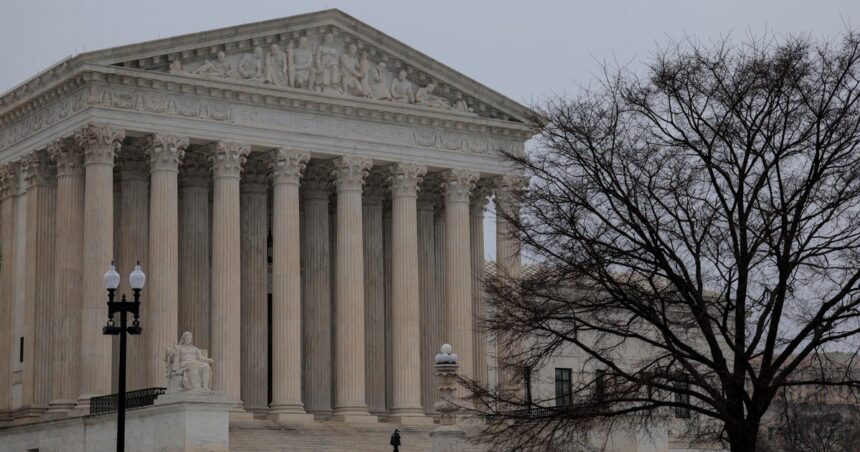
Washington — The Supreme Court on Monday agreed to take up an effort by energy companies to end a lawsuit filed in state court that seeks billions of dollars in damages for the impacts their fossil-fuel products have had on the global climate.
The decision from the Supreme Court could impact the ability of state and local governments to hold oil and gas companies accountable in state courts for the consequences of climate change. Dozens of cities and counties have filed similar cases around the country, but the justices had turned down similar disputes that have landed before them.
The court will likely hear arguments in its next term, which begins in October.
The legal battle was brought by the city of Boulder, Colorado, and Boulder County against Suncor Energy and ExxonMobil Corporation in state court in 2018. Local officials argued that the companies, which produce and sell fossil fuels, contributed to climate change, which in turn harmed Colorado.
Boulder officials alleged in their lawsuit that the “unchecked production, promotion, refining, marketing and sale of fossil fuels” around the world led to “unchecked fossil fuel use” and an increased concentration of greenhouse gases in Earth’s atmosphere, which has then warmed the planet. The effects of climate change, they said, led Boulder to experience more extreme weather events, including heat waves, wildfires, droughts and floods.
The city claimed the energy companies violated state law, in part because they altered the climate by selling fossil fuels at levels they know would “bring numerous catastrophic injuries to Colorado.” The suit sought billions of dollars in damages.
The oil and gas companies attempted to move the case to federal court. The dispute landed before the Supreme Court, which in 2023 declined to hear the case.
The energy companies then unsuccessfully sought to have the complaint dismissed in state court, arguing in part that the Clean Air Act overrides the state-law claims seeking relief for harms allegedly caused by the effects of international greenhouse-gas emissions on the global climate. The Colorado Supreme Court affirmed the district court’s decision allowing Boulder’s lawsuit to move forward last May.
In urging the Supreme Court to step in, lawyers for the energy companies argued in a filing that state and local entities are devoting “enormous resources” to litigating cases against them. They said allowing the disputes to proceed in state court could mean the industry is forced to pay billions of dollars in awards.
“In these cases, state and local governments are attempting to assert control over the Nation’s energy policies by holding energy companies liable for worldwide conduct in ways that starkly conflict with our constitutional structure, as well as the policies and priorities of the federal government,” the energy companies argued. “That flouts the Court’s precedents and basic principles of federalism.”
The Trump administration is backing ExxonMobil and Suncor Energy. Deputy Solicitor General Sarah Harris wrote in a filing that the case raises a question of “vast nationwide significance,” and warned that if Boulder’s lawsuit can proceed, every locality in the country could sue “essentially anyone in the world for contributing to global climate change.”
Boulder’s claims, Harris wrote, “seek to hold petitioners responsible for all of their fossil-fuel activities, anywhere in the world — extending the reach of Colorado common law well beyond Colorado’s territorial limits.”
Lawyers for Boulder officials argued it was too soon for the Supreme Court to intervene. They said in a filing that the city and county want the energy companies to “share a portion of the financial burden their communities must bear in coping with an altered climate brought about in part by” their conduct.
Beyond the lawsuit brought by Boulder and the surrounding county, the Supreme Court rejected an appeal from 15 energy companies last year that sought to quash lawsuits brought by Honolulu officials in Hawaii state court, which cleared the way for the case to proceed.
The high court also turned away a bid by Republican-led states to block lawsuits brought by Democrat-led states that sought to hold the energy industry liable for allegedly deceiving the public about the dangers of their fossil-fuel products.