

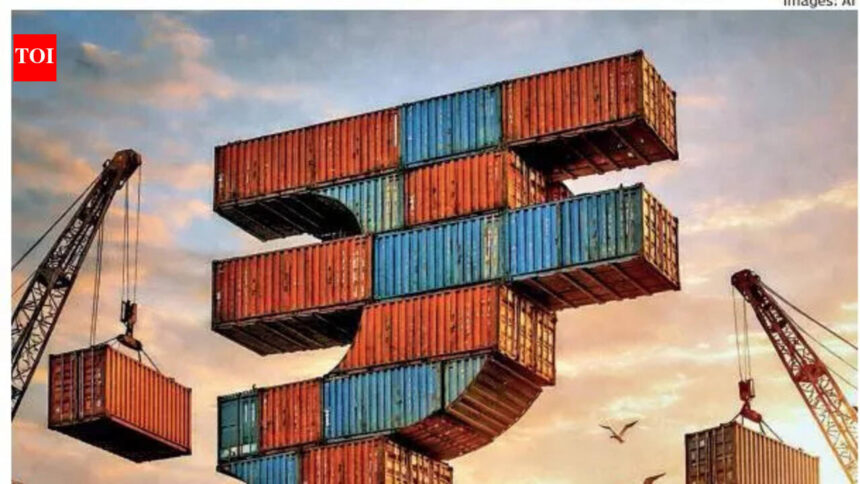
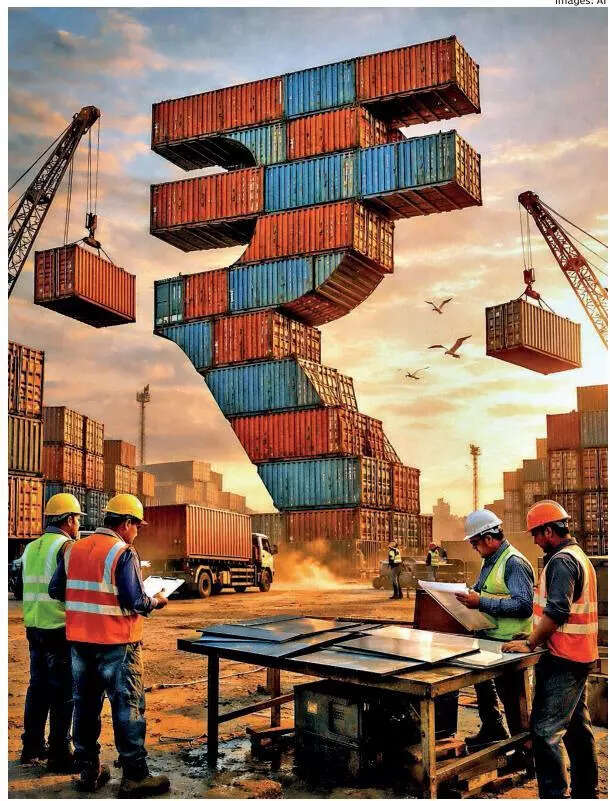
Along the ports on the coast of Gujarat, thousands of steel boxes in grids of red, blue and rust-brown move in perfect choreography, packing much more than goods – each box a silent carrier of commerce linking India’s factories to global markets.Round-the-clock 365 days, these containers — some 20 feet long and some 40 feet — are either loaded or unloaded using towering cranes onto ships which then cut through the oceans to deliver a range of goods necessary to keep the wheels of markets moving. If one ship carrying containers fails to reach a distant shore, a pharmacy shelf somewhere may stand empty of life-saving medicines, machines in a factory may fall silent for want of some key components, and somewhere a child may wait in vain for a favourite imported snack. Gujarat, often touted as India’s maritime gateway handling nearly 50% of the country’s sea-borne cargo, has bustling private ports like Adani’s Mundra, govt-run Kandla and APM Group’s Pipavav – which handle the maximum container cargo. Yet, even as these containers are an important cog in India’s trade through Gujarat’s ports, the country remains heavily dependent on imports of these boxes, China being the source of nearly 90%. To reduce the country’s dependence on shipping containers, Union finance minister Nirmala Sitharaman announced a Rs 10,000 crore Container Manufacturing Assistance Scheme (CMAS) to create a globally competitive, self-reliant ecosystem and reduce dependence on imports. The five-year plan aims for an annual domestic capacity of 1 million TEUs (Twenty-foot Equivalent Units), supporting 3,000 direct and 50,000+ indirect jobs. The move is aimed at correcting a structural weakness exposed during the post-pandemic trade rebound, when Indian exporters faced an acute shortage of containers. Freight rates soared, shipments were delayed, and businesses struggled to secure available boxes. The crisis highlighted India’s overwhelming reliance on China, which supplies over 95% of the world’s shipping containers, and effectively holds near-monopoly in the segment. Within India, Gujarat stands out as a natural contender to anchor this renewed push. With two of the country’s largest commercial ports — Mundra and Kandla — and a long-established reputation as a manufacturing powerhouse, the state possesses both logistical and industrial advantages. Gujarat handles a substantial share of India’s cargo throughput and has a strong base in steel processing, fabrication, engineering and export-oriented industries, all of which are critical inputs for container manufacturing. This is not a new opportunity. In the immediate aftermath of Covid-related disruptions, several companies based in Ahmedabad, Bhavnagar, Kutch and Rajkot entered the container manufacturing space, encouraged by govt support and the supply gap. There was rationale behind this: rising exports, port proximity, and the prospect of import substitution. However, the initial wave was broken by harsh commercial realities. The core challenge has been cost competitiveness. Chinese manufacturers operate at enormous scale, supported by integrated supply chains and consistent global demand. Indian entrants, by contrast, were building operations from scratch, without assured volumes or ecosystem support. Malara Shipping Pvt Ltd, based in Gandhidham, eventually halted manufacturing after failing to compete with Chinese prices. The company has since tied up with a Chinese supplier and now imports and resells containers in the domestic market. In Rajkot, Jubilant Containers began production in 2023 and manufactured around 2,000 specialized containers for international shipping lines. Yet the pricing gap proved unsustainable. Its promoter, Vatsal Baldaniya, said production costs ranged between $2,500-$2,600 per container, while comparable Chinese units were available at about $1,700. The company ultimately shifted focus to domestic buyers. At the heart of the disadvantage lies steelNearly 60% of a container’s cost is attributed to steel, and roughly three-quarters of that is corten steel — a corrosion-resistant grade essential for maritime use. Manufacturers require specific grades and dimensions to meet global standards. Indian steel producers often demand bulk orders for producing a particular size, volumes which smaller container manufacturers cannot easily absorb. Moreover, these specialized sizes are not readily stocked and require advance orders. While importing corten steel from China remains an alternative, it negates the cost advantage and weakens the case for a fully indigenous value chain. Industry experts maintain that the solution goes beyond subsidies. What is needed is a coordinated ecosystem — reliable access to corten steel at viable prices, cluster-based development, shared testing facilities, technology partnerships and export support. Without these structural enablers, scaling up to global standards remains difficult in a capital-intensive and margin-sensitive industry. For Gujarat, the FM’s policy reset presents a second opportunity. With port connectivity, industrial depth and entrepreneurial capacity, the state could position itself as India’s container manufacturing hub — provided structural cost disadvantages are addressed. The next phase will determine whether India can translate budgetary intent into sustained industrial capability. If raw material constraints, financing gaps and scale challenges are resolved, Gujarat could leverage its maritime strength and manufacturing base to capture a share in a market long dominated by China. If not, the renewed push risks repeating the experience of the first wave — high ambitions tempered by hard economics.