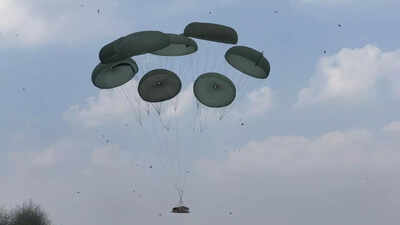
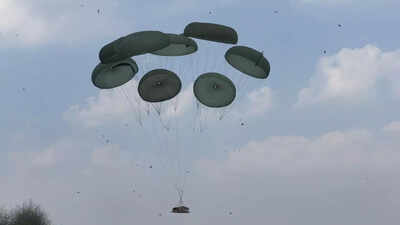
The Indian Army has successfully tested a new indigenous system designed to air-drop heavy military vehicles and equipment into remote areas. The system, known as the Advance 28-ft Heavy Drop System – 20T (Type V), was recently validated during trials conducted at the Mahajan Field Firing Ranges on February 17, 2026.The system developed by Airbornics Defence & Space, has been built in partnership with DRDO through its Aerial Delivery Research and Development Establishment. The project is part of the broader push for indigenous defence manufacturing under the Make in India initiative.
How does it work?
The heavy drop system is designed to deploy large cargo and mechanised military platforms from transport aircraft. It can handle payloads of up to 20 tonnes and is compatible with heavy-lift aircraft such as the Lockheed Martin C-130J Super Hercules and the Boeing C-17 Globemaster III.The system includes a newly developed 28-foot platform and parachute setup. This configuration uses a pack of two 28-foot extractor parachutes along with a four-point link system, allowing heavy loads to be safely pulled out of aircraft and lowered to the ground in a controlled manner.
Unlike previous tests, the latest trial involved dropping an actual armoured vehicle weighing around 15 tonnes. The vehicle used was a BMP armoured personnel carrier, and the test was carried out under near-realistic operational conditions. The twin extractor system was used to manage the heavier load and ensure stable deployment.It allows mechanised platforms to be deployed in high-altitude regions and remote areas where road access is limited or slow. This could help forces respond faster during operations.The validation also demonstrated that heavy combat platforms can be deployed from different classes of transport aircraft.