Ahmedabad: Without a linguist’s help, AI’s infinite power will be wasted on pronouncing “refuse” — “REF-yoos” is a noun meaning rubbish, while re-FYOOZ is a verb meaning to decline or reject.Yet linguistics had been written off long ago as a discipline of the past offering no career future. The AI revolution is writing a new prompt: “How can universities revitalize linguistics so that more experts can refine language models for the coming tech wave?”
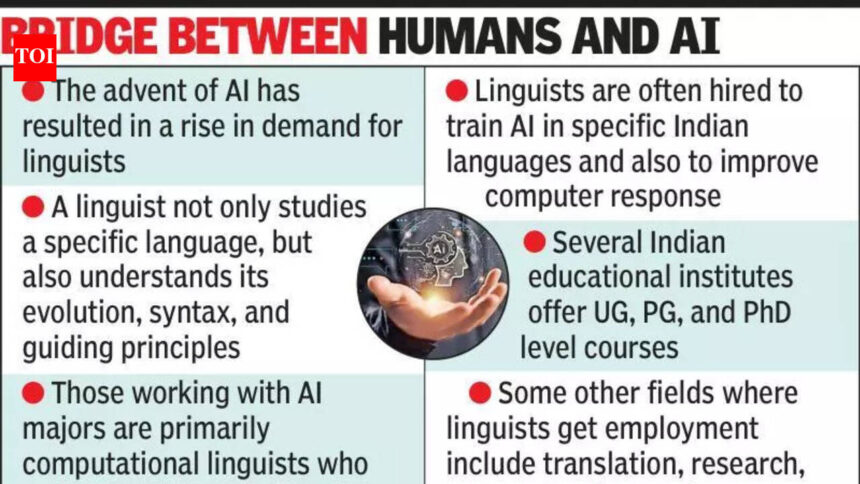
The response must be delivered urgently because the linguistics departments of Gujarat University and MS University of Baroda currently have only five and 15 students, respectively.Linguists are in critically short supply when the demand for them is desperate.“Students are not aware of the immense potential that this discipline holds,” said Dr Mona Parakh, assistant professor at MSU’s department of linguistics. “There is a huge demand for linguistics and every year, we get inquiries from institutes based in Bengaluru, Hyderabad, and other metros which need experts in this discipline.”Parakh said, “In fact, the demand for Gujarati linguists is also on the rise, but there aren’t enough trained professionals.”Academics deeply versed in the linguistics story said that the awareness deficiency is only one aspect of the current crisis. They said that linguistics is not recognized for govt jobs at either the school or college level. For the job of a teacher, the preferred qualification is often an MA in English, Hindi, or Gujarati.In the recently concluded AI Impact Summit in New Delhi, several Indian innovators presented products catering to Indian users. Central to these projects are Large Language Models (LLMs) relying on Hindi, Gujarati, and Telugu, and other official Indian languages.As Indian languages assume unprecedented prominence at the confluence of tech and cultural currents, a new class of jobs for linguists has been created.Some linguists are working closely with computer scientists to train LLMs in Indian languages. But at this crucial point, the two public Gujarat universities offering the linguistics courses are not attracting many candidates.“Most vacancies every year are for English teachers. But a candidate with a BA, an MA, or even a PhD in linguistics is not considered eligible for those posts,” an educationist in Vadodara said. As a result, students see little incentive in opting for the subject.At GU, the MA (linguistics) course has 75 seats for which the first-year programme has four students and the second has one. The last permanent faculty member retired about five years ago, and two faculty members work on contract, said GU officials.At MSU, only 11 students opted for the undergraduate course in linguistics against 30 seats and only four students chose the postgraduate course which has 40 seats.Dr Purvi Mehta, an English expert working with the state government’s higher education department, is also associated with the International Institute of Information Technology, Hyderabad, as a Gujarati linguist.Mehta said that she has been working with Gujarati linguists for international tech giants over the past few years, and the effort has formed the backbone of several LLMs today.“But even after all these years, we have to explain the difference between language and linguistics not only to students but also to recruiters,” Mehta said. “If language is a body, linguistics can be compared to the skeleton, forming the basis for a language to function.”Professor Jagdish Joshi, in-charge head of the department of linguistics at GU, said that the condition of the linguistics course could be attributed to the law of demand and supply that predated the AI era.However, a sliver of hope is being seen. Those interested in language and computational science are finding their calling at major tech companies. Shachi Sejpal, currently working as a Gujarati linguist with Sarvam AI, is a linguistics graduate from Deccan College.“The field of AI is developing swiftly, and I believe there will be high demand for linguists — especially those who understand computational linguistics,” Sejpal said. “Language is about patterns, and computers are adept at it.”As for humans, their specialty lies in grasping the cultural nuances that drive the patterns.