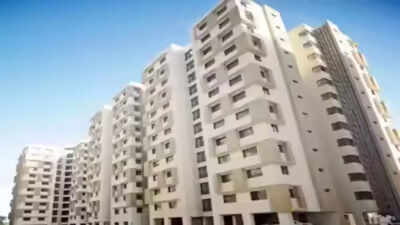
BENGALURU : In an indicator of strong housing demand fuelled by employment growth, especially in Bengaluru, Karnataka continues to see large housing demand with nearly 8.7 lakh residential units covering 7,000-lakh-sqft carpet area in the pipeline.The state ranks fourth nationally in terms of residential units across 4,452 projects, according to projects registered with Real Estate Regulatory Authority (Rera).Experts and industry observers said the high residential unit count and expanding carpet area show more buyers are entering the formal market and are opting for slightly larger homes afterCovid-19. Future growth will hinge on improving ease-ofdoing business, speeding up approvals, and ensuring better coordination among govt agencies, they added.
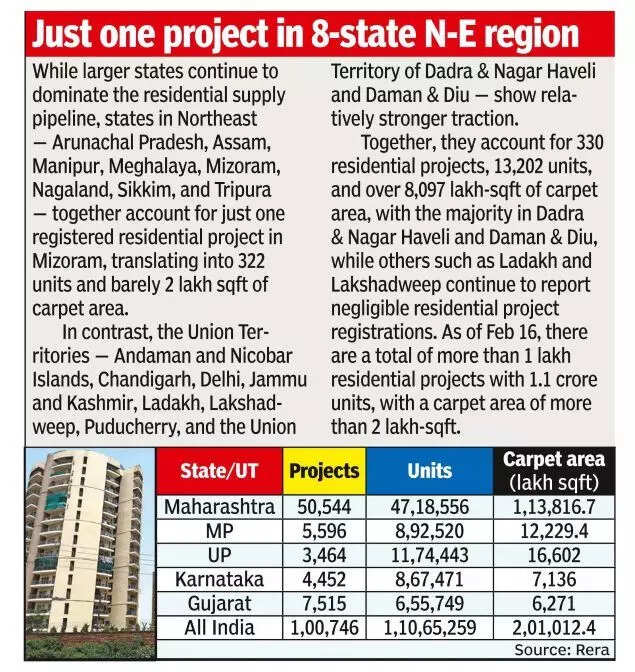
One project in 8-state N-E region
Ramachandra CH, joint secretary, Confederation of Real Estate Developers’ Associations of India (Credai) national chapter, told TOI : “Demand remains strong because money flow from industrial and infrastructure growth eventually moves into housing. However, project timelines of 4-6 can still be affected by factors such as worker shortages, market conditions and delays in utilities and approvals.”He a dded growth is driven by connectivity — like ORR in Bengaluru, Hyderabad, and Mumbai — and rising demand from Tier-2 and Tier-3 cities. Bhaskar T Nagendrappa, president, Credai-Karnataka chapter, said the strong position is driven by Bengaluru’s tech ecosystem, favourable weather and strong connectivity.“While Bengaluru remains the largest apartment market, tier-2 cities such as Mangaluru, Mysuru, Kalaburagi, and Belagavi are also seeing growing acceptance of apartment living, even as plotted developments dominate elsewhere. Post Covid, buyersare clearly opting for slightly larger homes,” he said. Builder associations said across India, residential real estate growth is driven largely by urbanisation, employment generation, and rising purchasing capacity.“Maharashtra — beyondMumbai, Thane and Pune — shows strong demand, and Karnataka is seeing a similar trend in Mysuru and Mangaluru. The state must boost employment in these cities, as apartment living is now common in smaller urban centres,” Ramachandra said.