
Any Irish victory over England on their home patch is one to relish but this one at the midway point of the 2026 Guinness Six Nations is worthy of so much more celebration given the journey Andy Farrell’s squad took to get to this point.
As the head coach reflected on this record win, the highest margin of victory by any visiting championship rival, he would have been forgiven for saying “I told you so” to silence the army of doubters who questioned his players’ ability to dig their way out of trouble following recent setbacks against the game’s superpowers.
Yet Farrell chose not to, instead declaring the heavy defeats to France (twice), New Zealand and South Africa in the last 12 months had not been tough days to endure but opportunities for growth as he continues his preparations for his second World Cup campaign at the helm, in Australia next year.
With 18 months to go, this was a statement win delivered with a performance for the ages; a throwback to the heights of Farrell’s golden period in charge between 2022-23 but executed with a new-look team displaying the same very high standards that made Keith Earls, Cian Healy, Conor Murray, Peter O’Mahony and Johnny Sexton Irish legends.
For all the talk of the world-class talent that has left the building through retirement and the rising age profile of the ones who have soldiered on, there was a freshness to this five-try hammering of England and it coursed through Ireland’s matchday 23.
There was the energy and tempo brought by scrum-half Jamison Gibson-Park in a near perfect performance, the mature game management of fly-half Jack Crowley and the spark provided by wings Rob Baloucoune and Tommy O’Brien. There was the hard-running industry and ball in hand skills of centre Stuart McCloskey and the return to form of Ireland’s power forwards led by captain Caelan Doris, one of several players whose contributions to the cause were their best for some time.
The back five of the pack was particularly impressive in the physical intensity they brought to the party, James Ryan’s targeting of English boy superstar Henry Pollock in the first minute an early indication of Irish dominance as the lock delivered a memorable welcome to the home No.8 on his first Test start, pinning him to the turf for longer than was required with obvious zeal.
Second-row partner Joe McCarthy was back to his disruptive best and the work rate of Doris and fellow back-rowers Tadhg Beirne and Josh van der Flier was immense as Ireland snuffed out England’s early pressure.
A 22-0 lead built inside 30 minutes through tries from Gibson-Park, Baloucoune and O’Brien, an early replacement for injured starter James Lowe, and the confident goal-kicking of Crowley made for a stunning start that left the majority of the 81,956 crowd shellshocked, English supporters even cheering ironically when their number 10 George Ford finally found touch after two errant kicks denied his side an attacking platform.
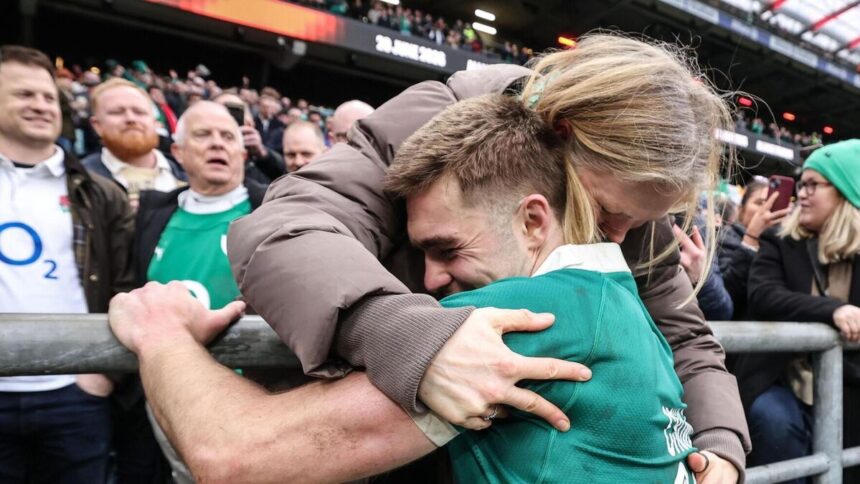
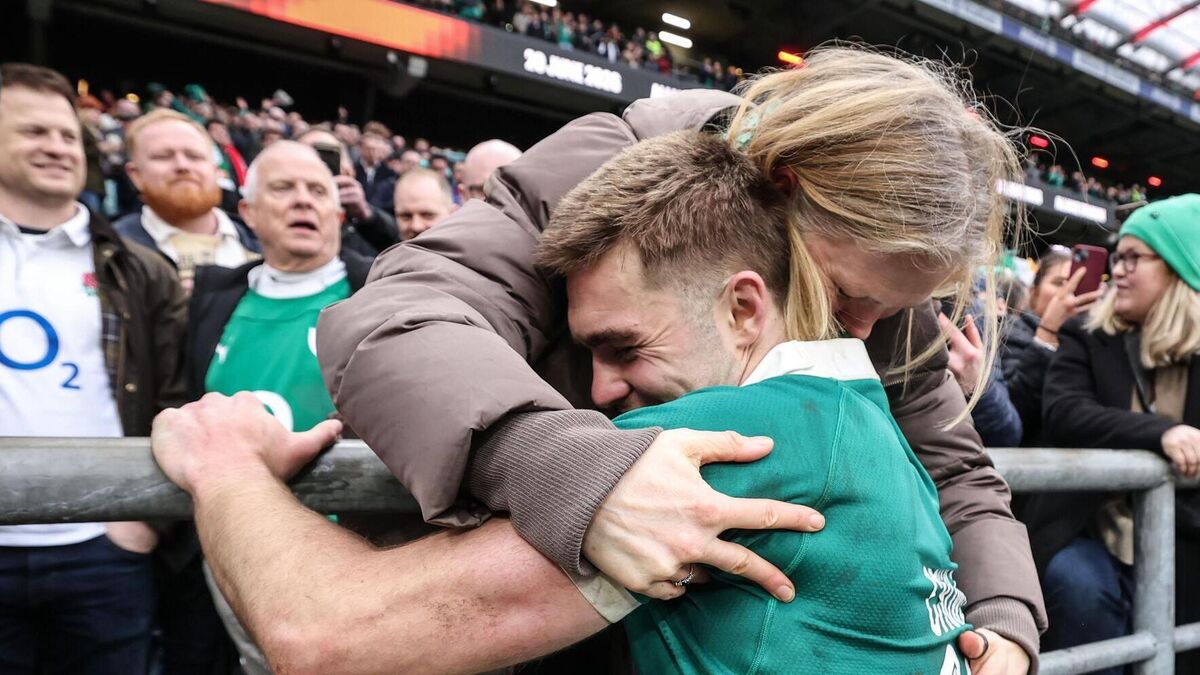
That the eerie hush inside Twickenham was filled with the strains of The Fields of Athenry sung with gusto by a huge contingent of perhaps 20,000 Irish supporters only added to the discomfort of the home support and that will have been shared in the English coaches’ box, their neighbours led by an exuberant Farrell punching the air in delight at every opportunity in a pointed reaction to the habit of Steve Borthwick’s side to celebrate any on-field win, even as minor as an opposition knock-on, as if they have won a title.
It was one of those days, England’s scores through Fraser Dingwall just before half-time, and Ollie Lawrence and Sam Underhill in the second half rendered meaningless by Irish replies, a Dan Sheehan try on 42 minutes bringing up the bonus point, two impactful penalties from Crowley adding further scoreboard pressure and then Osborne’s try and the fly-half’s fourth conversion putting Ireland into a comfort zone rarely experienced at Twickenham.
It was all the more remarkable given its proximity to the opening night of the championship when Ireland were taken to the cleaners by France in Paris and Farrell was delighted his players had learned the lessons from that 36-14 mauling away from home.
Praising all 32 players who had travelled to south-west London, Farrell said: “Some of those lads, it’s the first time that they’ve been in this stadium, so the example that we need to set to those type of players to be able to show them the way forward of what international rugby is all about and how you attack it or how you don’t, probably in the first performance against France, is the difference at the top level.
“Because we believe in the plan and we believe in the players and we’ve got good coaches and good staff and all that, but that’s not going to win you games.
“When it matters, you’ve got to get over yourself and free yourself up and go and attack the game. And, you know, we’re a well-organised team, but our unstructured stuff was pretty impressive, which shows that we were in a good enough place mentally to go and let loose today.”
Asked how he got his squad to the point where the shackles could come off and players got out of their own way, the Ireland boss said: “From showing them the lesson that (they were) in their own way and therefore got held back.
“One of the signs of that is you see people being lethargic or down when an error happens. When you’re playing nice and free, you don’t care what’s gone on in the past. There’s no distractions.
“You’re just chasing everything down and you’re committed to being in it. It wasn’t perfect tonight, but it felt like that because we were committed.”
Farrell’s man-management skills and emotional intelligence are renowned but his reputation for pushing the right buttons in his players will soar even higher after this masterclass, not least in the senior players who stood up when it mattered.
“Caelan back to his best, Joe McCarthy was outstanding. Josh was immense in that first half, wasn’t he? You know, with his line running and stuff like that.
“They know they’ve a responsibility. We said before the game, big-game players turn up and make big-team performances happen.
“They set great examples, but for the lads that I just mentioned, for Rob Baloucoune to come here and do that, you know you’re on for a good day when he’s got a poach, a turnover ball…
“Just his belief to take people on, and for Stu to dominate at this type of level, it was a joy to see.”
F Steward (M Smith, 39); T Freeman, O Lawrence, F Dingwall, H Arundell; G Ford, A Mitchell (J van Poortvliet, 25); E Genge (B Rodd, 51), L Cowan-Dickie (J George, 29), J Heyes (T Davison, 72); M Itoje – captain (A Coles, ), O Chessum; T Curry (G Pepper, 51), B Earl (S Underhill, 71), H Pollock.
F Steward 28-38, H Pollock 42-52.
J Osborne; R Baloucoune, G Ringrose (C Frawley, 55), S McCloskey, J Lowe (T O’Brien, 18); J Crowley, J Gibson-Park (C Casey, 71); J Loughman (T O’Toole, 46), D Sheehan, T Furlong (F Bealham, 46); J McCarthy (C Prendergast, 63), J Ryan; T Beirne, J van der Flier (N Timoney, 48), C Doris – captain.
J Osborne 54-64.
Andrea Piardi (Italy), replaced (inj) by Pierre Brousset (France), 29 mins.