

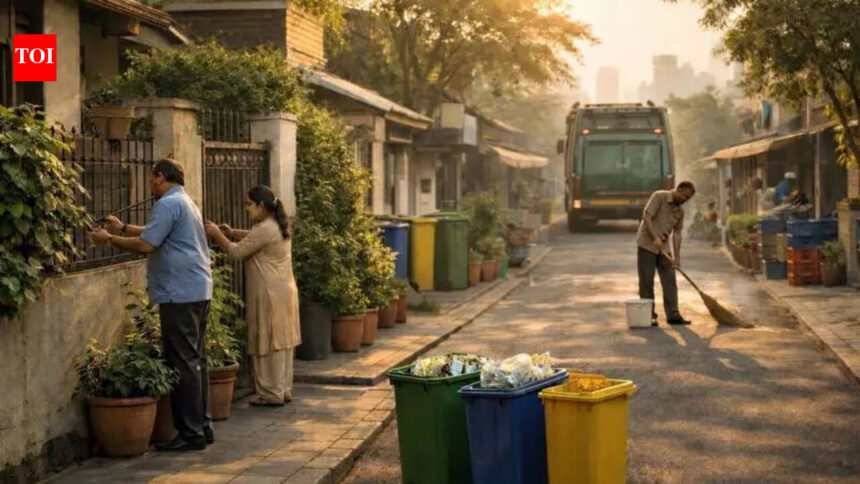
Ahmedabad: With the 2030 Commonwealth Games on the horizon, Ahmedabad Municipal Corporation (AMC) is drafting a sweeping cleanliness policy that will require housing societies, bungalows, and commercial establishments to take direct responsibility for keeping the areas immediately surrounding their properties clean.Municipal commissioner Banchha Nidhi Pani unveiled the initiative at a special session titled ‘Getting Ready for the Games 2030′, held on Saturday at the AmdavadNXT city mobility exhibition at Riverfront House. While the AMC currently provides door-to-door waste collection, Pani said the burden of a cleaner city cannot rest solely on the civic body and that property owners must step up. “We have just begun drafting a policy called ‘Keep Your Front Yard and Backyard Clean’, and it is in its infancy,” Pani said. “We follow a process, and it will be prepared after extensive consultations and by taking into confidence all stakeholders — citizens of this city, housing societies, and commercial establishments.” The policy, he said, will be modelled on standards in developed nations and “is essential for improving the city’s overall air quality and environment.” He stressed that “becoming Games-ready” requires a “virtuous partnership” between the govt and citizens. However, a senior AMC official involved in drafting the policy said implementation will “take at least three years,” following a phased awareness drive and rounds of stakeholder consultation. A dedicated standard operating procedure will also be established before the policy takes effect. Only after completing that process will AMC move to mandate compliance. Residents who fail to maintain their frontages and backyards clean will face intervention from the corporation. According to officials, the timeline from draft to full implementation is expected to extend to approximately the end of 2028. “A fine structure will also be put in place, but that will happen after public consultation,” the official said, adding that the bylaw framework to support such fines already exists. The approach mirrors practices in other parts of the world. In the US, most municipalities legally require clean yards, vegetation upkeep, and the removal of trash to prevent unsafe or unsanitary conditions. European cities similarly enforce strict rules governing fencing, boundaries, and vegetation to maintain neighbourhood aesthetics and prevent disputes. Pani pointed to Ahmedabad’s existing record as motivation. “As the current cleanest city in India among large populations, the city’s success depends on citizens contributing to solid and liquid waste management to create a world-class aesthetic for international visitors,” he said.