
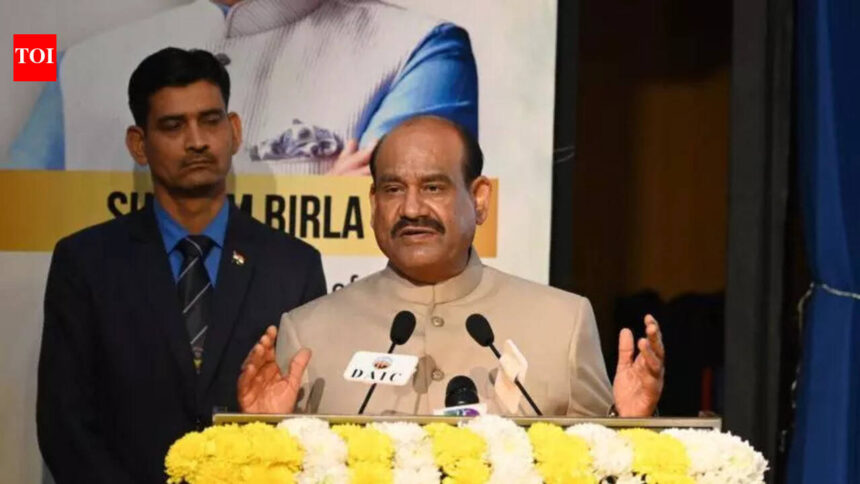
New Delhi: Clarity in legislative drafting and greater transparency in elections are essential to strengthening India’s democratic framework, Lok Sabha Speaker Om Birla and Union law minister Arjun Ram Meghwal said on Friday. They were speaking at the launch of three new academic programmes by OP Jindal Global University, addressing students, teachers and legal professionals in central Delhi. Birla underscored the importance of clear drafting in reducing judicial intervention. The more precise a law and its definitions are, he said, the fewer the ambiguities that require interpretation by courts. “When we are the world’s largest democracy and looking at current and future needs, these master’s degree courses will help improve our democracy. They will prepare young people to contribute to the political, democratic, technological and literacy spheres. Since 1952, 18 Lok Sabha elections have been held, and India remains the only country where elections are conducted in a transparent manner,” he said. Meghwal emphasised that clear and unambiguous drafting reduces litigation and eases the burden on courts. “In legislative language, even a single word can carry different meanings. Every word in the Constitution has meaning; every concept has significance. Legislative drafting is extremely important. When a ministry prepares a Bill, it undergoes legal vetting and careful drafting. There is a full institutional mechanism to ensure clarity and precision,” he said. The university launched three one-year postgraduate programmes: an MA in Legislative Drafting, an MA in Electoral Analysis and Management, and an MA in Political Communication. Solicitor General Tushar Mehta, the guest of honour, welcomed the initiative. Calling legislative drafting “a science, mathematics and an art”, he said precise language determines how laws operate. He noted that the difference between “may” and “shall” can decide whether a provision is mandatory or directory, and even punctuation can alter the intent and impact of a statute.