Mehandipur Balaji to Khatu Shyam: For millions of devotees across India and the world, the sacred lands of Rajasthan hold a special spiritual significance. Two of the most powerful and revered shrines in the state are the Mehandipur Balaji Temple, famous for its miraculous healing and powerful deity, Lord Hanuman in his child form (Balaji), and the Shree Khatu Shyam Ji Temple, the sacred abode of the deity Barbarika, venerated as Shyam Baba, the beloved friend of Lord Krishna.
It is an incredibly common and fulfilling pilgrimage to visit both temples in a single trip. The journey between these two spiritual powerhouses is not just a physical distance to be covered; it is a transition between two distinct yet equally potent divine energies. This guide is designed to be your ultimate resource for planning that sacred journey. We will delve deep into the precise distance, the best routes, travel options, and everything you need to know for a safe, smooth, and spiritually uplifting yatra from Mehandipur Balaji to Khatu Shyam Ji.
Whether you are traveling by your own car, hiring a taxi, or opting for a bus, understanding the logistics is the first step. The most common question we hear is: “What is the exact distance?” Let’s start with the fundamentals.
Chapter 1: The Core Numbers – Distance and Travel Time
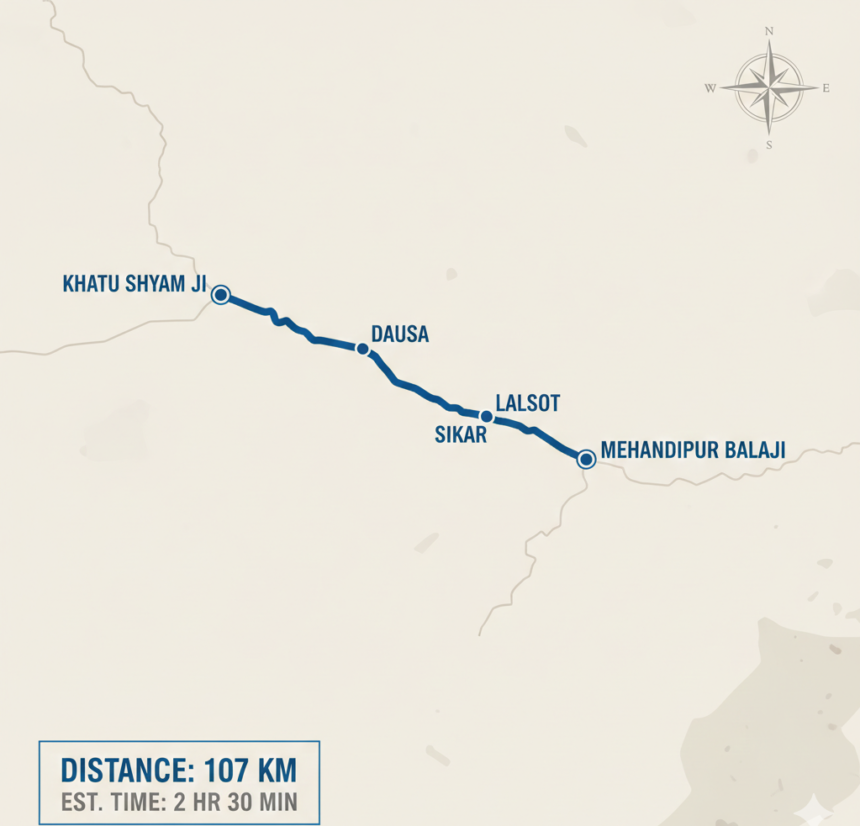
According to standard road measurements, the driving distance between Mehandipur Balaji Mandir and Khatu Shyam Ji Ka Mandir is approximately 107 kilometers (or about 66.5 miles) . Under normal traffic and road conditions, this journey typically takes around 1 hour and 54 minutes to 2 hours and 15 minutes by car.
This relatively short travel time makes it ideal for devotees who wish to perform darshan at both temples on consecutive days, or even on the same day with an early start. However, travel time can vary based on the route taken, the type of vehicle, and the prevalent traffic conditions, especially as you approach the temple towns.
Distance Summary Table:
| Detail | Information |
|---|---|
| Origin | Mehandipur Balaji Mandir, Dausa district, Rajasthan |
| Destination | Khatu Shyam Ji Mandir, Sikar district, Rajasthan |
| Driving Distance | ~107 km |
| Driving Time (Car) | ~1 hr 54 mins – 2 hrs 15 mins |
| By Bus | ~2 hrs 30 mins – 3 hrs (depending on stops) |
Now that we have the basic numbers, let’s explore the journey itself in detail.
Chapter 2: The Sacred Route – A Step-by-Step Road Map
The route from Mehandipur Balaji to Khatu Shyam Ji is predominantly via the state highways of Rajasthan, offering a mix of highway driving and glimpses of rural life. Here is the most common and recommended route, which we suggest you use on your GPS.
The Recommended Route (via SH-25A and SH-8):
-
Start Point: Mehandipur Balaji Temple. Head northwest on the main road leading out of the temple complex, connecting to the Dausa-Lalsot Road.
-
First Leg (Mehandipur to Lalsot): Drive towards the town of Lalsot. This section is a mix of temple town roads and a well-laid highway. Lalsot is a significant market town and a crucial junction in this region. Distance: ~35 km, Time: ~40 mins.
-
Second Leg (Lalsot to Sikar Bypass): From Lalsot, continue on State Highway 25A (SH-25A) towards Sikar. The landscape will open up into the typical semi-arid terrain of Rajasthan. The roads are generally in good condition, but you might encounter slow-moving traffic like tractors, so drive with caution. You will bypass the main city of Sikar on the newly developed bypass road, which helps you avoid city traffic. Distance: ~60 km, Time: ~1 hr.
-
Final Leg (Sikar Bypass to Khatu Shyam Ji): From the Sikar Bypass, take the road connecting to Ringas and then follow the signboards for Khatu Shyam Ji. This final stretch is well-traveled by pilgrims and leads you directly to the bustling town surrounding the grand temple. *Distance: ~12 km, Time: ~15-20 mins.*
Alternative Route (via Dausa and Ringas):
Some travelers might prefer going via Dausa (if coming from a different direction) and then towards Ringas. However, the route via Lalsot is considered the most direct and shortest.
Chapter 3: Choosing Your Pilgrimage Vehicle – Travel Options
Depending on your budget, group size, and comfort level, you have several options to travel between these two holy sites.
1. By Private Car or Taxi (The Most Convenient Option)
This is the preferred mode for most pilgrims, especially families and small groups. Renting a private taxi from either temple town or from a nearby city like Jaipur offers the ultimate flexibility.
-
Pros: You can stop for chai or food at your leisure, control the AC, and travel at your own pace. You also have the freedom to visit other small shrines along the way.
-
Cost: The cost for a one-way taxi can range from INR 2,500 to INR 4,000, depending on the car type and negotiation. A round trip with a waiting period for darshan at both temples will be higher.
-
Tip: Pre-book a reliable cab service from a verified operator. Many services in Jaipur specialize in pilgrimage tours covering both temples in one or two days.
2. By Bus (The Budget-Friendly Option)
While not as direct as a car, bus services are available and are a lifeline for solo travelers or those on a tight budget.
-
State Transport (RSRTC): Rajasthan State Road Transport Corporation (RSRTC) runs regular buses from major cities to both Sikar and Dausa. You might need to take a bus from Mehandipur (or the nearest town Dausa) to Sikar, and then a local bus or taxi from Sikar to Khatu Shyam Ji.
-
Private Buses: Several private operators run deluxe and Volvo buses on the Jaipur-Sikar route. You could potentially take a bus to a central point and then hire local transport.
-
Pros: Very economical.
-
Cons: Time-consuming, requires changes, less comfortable, and not ideal if you are carrying heavy luggage or Prasad.
3. By Two-Wheeler (For the Adventurous Devotee)
For the young and the restless, a motorcycle or scooter ride through the Rajasthani countryside can be a memorable experience. The roads are generally bike-friendly. However, carry ample water, wear protective gear, and be wary of stray animals and trucks.
Chapter 4: Where Two Divinities Meet – A Spiritual & Mythological Context
Understanding the spiritual significance of each destination enriches the journey. Your trip is a pilgrimage connecting two powerful streams of Hindu faith.
Mehandipur Balaji: The Abode of the Fierce Protector
Situated in the Dausa district, the Mehandipur Balaji temple is not for the faint-hearted. The presiding deity is Balaji (Lord Hanuman), but the temple is uniquely famous for rituals to exorcise evil spirits and negative energies. Devotees believe that Lord Hanuman in this form is a fierce protector who cures people afflicted by ghosts, demons, and black magic (known locally as pret-atma). The atmosphere here is intense, filled with the sounds of drums, chanting, and the experiences of those seeking liberation from spiritual ailments. It’s a place of raw, powerful faith.
Khatu Shyam Ji: The Abode of the Compassionate God
In contrast, about 100 km away in the Sikar district lies Khatu Shyam Ji, an oasis of peace and devotion. The deity here is Shyam Baba, an incarnation of Barbarika, the grandson of Bhima (from the Mahabharata). Lord Krishna blessed Barbarika that he would be worshipped in the Kali Yuga by his own name (Shyam). The atmosphere here is one of profound grace, love, and fulfillment of wishes. Devotees come to tie sacred threads (dhaaga) seeking blessings for jobs, marriage, children, and prosperity. The temple’s white marble structure, especially during the grand festivals of Phalgun Mela, is a sight to behold.
Traveling from the intense energy of Balaji to the serene grace of Shyam Ji is a journey that balances the soul, offering both protection and the fulfillment of desires.
Chapter 5: Best Time to Undertake the Yatra
While the temples are open year-round, the climatic conditions of Rajasthan play a huge role in the comfort of your journey.
-
Winter (October to March): This is, by far, the best time for the trip. The weather is pleasant and cool, making travel comfortable. The famous Khatu Shyam Ji Fair (Phalgun Mela) usually falls in February-March, which is an extraordinary time to visit, though the crowds are massive.
-
Summer (April to June): Rajasthan summers are extremely hot, with temperatures soaring above 40°C (104°F). The road journey can be taxing, and the marble floors of the Khatu Shyam temple can become scorching. If you must travel, do so in an air-conditioned vehicle and start your journey very early in the morning.
-
Monsoon (July to September): The landscape turns lush and green, offering a different kind of beauty. However, roads can sometimes be slippery, and you may encounter waterlogging in low-lying areas. It’s generally a good time, but always check the weather forecast.
Chapter 6: Detailed Guide to Khatu Shyam Ji Temple
Once you arrive at your destination, you step into one of North India’s most important pilgrimage hubs.
Temple Highlights:
-
The Main Deity: The idol of Shyam Baba is made of rare stone and is adorned with a magnificent sirpayna (crest) and a mukut (crown) studded with precious stones.
-
The Shyam Kund: Before entering the main temple, devotees often take a holy dip or wash their hands and face at the Shyam Kund, a sacred tank believed to have been built where Barbarika’s head was placed.
-
Darshan and Aarti: The temple conducts several aartis daily. The morning Mangla Aarti and the evening Sandhya Aarti are the most popular and spiritually uplifting.
Accommodation Near Khatu Shyam Ji:
The town has numerous options for pilgrims to stay, ranging from budget-friendly Dharamshalas (charitable rest houses) to comfortable private hotels.
-
Dharamshalas: These are the most economical option, run by various trusts. They are basic but clean. Booking in advance is advisable during festival times.
-
Private Hotels: There are several hotels offering rooms with modern amenities like AC, attached bathrooms, and vegetarian food. Some popular ones include Shyam Palace, Shubham Hotel, and various others near the temple complex.
-
RSRTC Tourist Bungalow: A reliable mid-range option for those who prefer government-run accommodations.
Chapter 7: Detailed Guide to Mehandipur Balaji Temple
Before you depart from Mehandipur, or if you are starting your journey from there, here are key things to know.
Temple Highlights:
-
The Deities: The main shrine houses Lord Balaji (Hanuman). Alongside, there are shrines for Pret Raj (King of Spirits) and Bhairav, who are instrumental in the healing rituals.
-
The Unique Rituals: You will witness priests performing puja for devotees who are believed to be possessed. The process involves using holy ash, lemons, and mantras. It is advised to observe respectfully from a distance unless you are part of the ritual.
-
Prasad: The main Prasad here is Batasha (a type of sugar candy) and Nariyal (coconut).
Accommodation Near Mehandipur Balaji:
Similar to Khatu Shyam, Mehandipur has a thriving ecosystem of pilgrim lodging.
-
Trust Guest Houses: Several trusts run by the temple committee offer clean and affordable rooms.
-
Private Lodges and Hotels: Many private options are available near the temple complex, catering to all budgets. It is wise to book ahead during weekends and Tuesdays, which are particularly busy days at the temple.
Chapter 8: Expert Tips for a Smooth Journey (Do’s and Don’ts)
To ensure your pilgrimage is spiritually fulfilling and free of hassle, keep these expert tips in mind.
Do’s:
-
Start Early: Leave Mehandipur Balaji by 7:00-8:00 AM to avoid the afternoon heat and reach Khatu Shyam Ji in time for a relaxed darshan.
-
Carry Essentials: Keep cash (both temples have digital payments, but small shops and offerings often require cash), a water bottle, and some light snacks for the road.
-
Dress Modestly: As a mark of respect, wear traditional or modest clothing that covers your shoulders and knees.
-
Check Vehicle Health: If driving yourself, ensure your car’s coolant, tire pressure, and AC are in top condition, given the Rajasthan heat.
-
Book Accommodation in Advance: Especially if traveling during the winter season or near major festivals like Holi (Phalgun Mela) or Sunday/Tuesday (both considered auspicious).
Don’ts:
-
Don’t Carry Non-Veg/Alcohol: The entire region is a strict vegetarian zone. Do not carry or consume any non-vegetarian food or alcohol, even in your private vehicle.
-
Don’t Engage with Unverified Touts: At both temples, official guides are available. Be cautious of unofficial touts offering “special darshan” for a fee. All darshan lines are free, with paid VIP passes available only at official counters.
-
Don’t Ignore Local Customs: At Mehandipur, be sensitive and quiet while rituals for the afflicted are taking place. At Khatu Shyam, respect the queue system.
-
Don’t Rely Solely on GPS: While GPS is excellent, road conditions or diversions can occur. It’s always helpful to ask locals or follow signboards.
Chapter 9: Expanding Your Pilgrimage – Combining Other Destinations
Many devotees choose to combine this route with other nearby attractions to make the most of their trip to Rajasthan.
-
Jaipur, the Pink City: Since both temples are within 100-150 km of Jaipur, many pilgrims fly into Jaipur and use it as a base. You can visit Mehandipur Balaji one day, return to Jaipur, and then head to Khatu Shyam Ji the next. Alternatively, you can visit the Amer Fort or City Palace in Jaipur.
-
Salasar Balaji: Another major pilgrimage site, Salasar Balaji (dedicated to Lord Hanuman), is located about 150 km from Khatu Shyam Ji. A common extended circuit is Mehandipur Balaji -> Jaipur -> Khatu Shyam Ji -> Salasar Balaji.
-
Jeen Mata Mandir: Located near Sikar, the Jeen Mata Mandir is another powerful Shaktipeeth that can be visited on the way or as a detour from the main route.
Chapter 10: Frequently Asked Questions (FAQ)
Q: What is the exact distance between Mehandipur Balaji and Khatu Shyam Ji?
A: The exact driving distance is approximately 107 kilometers.
Q: How long does it take to travel from Mehandipur Balaji to Khatu Shyam Ji by car?
A: It typically takes about 1 hour and 54 minutes to 2 hours and 15 minutes, depending on traffic and road conditions.
Q: Is it possible to visit both temples in one day?
A: Yes, it is possible but requires an extremely early start from Mehandipur. You would need to complete your darshan at Balaji by 7-8 AM, drive for 2 hours to Khatu Shyam, and arrive by 10-11 AM. While doable, it can be rushed and tiring. A two-day trip is highly recommended for a relaxed and peaceful experience.
Q: Are there direct buses from Mehandipur Balaji to Khatu Shyam Ji?
A: Direct buses are rare. The more common practice is to take a bus from Dausa (near Mehandipur) to Sikar, and then take a local taxi or bus from Sikar to Khatu Shyam Ji.
Q: What is the road condition like on this route?
A: The roads are generally good. They are mostly two-lane state highways (SH-25A, SH-8) which are well-maintained. However, you should be prepared for occasional stretches with slow-moving traffic like tractors, trucks, and livestock.
Q: Which cities are located between Mehandipur Balaji and Khatu Shyam Ji?
A: The primary towns on this route are Lalsot and you will also bypass the city of Sikar.
Conclusion: A Yatra to Remember
The journey from the powerful precincts of Mehandipur Balaji to the peaceful grace of Khatu Shyam Ji is more than just a road trip; it is a passage through the heart of Rajasthani faith. At just 107 kilometers, it is a manageable and rewarding pilgrimage that offers a profound glimpse into the diverse spiritual fabric of India.
We hope this comprehensive guide helps you plan every detail of your yatra, ensuring that your focus remains on the divine, while the logistics are taken care of. May Balaji protect you on your journey, and may Shyam Baba fulfill all your wishes.
Jai Balaji! Jai Shyam Baba!
Recommended External Links (for SEO & Authority)
To boost the SEO value and provide readers with additional resources, I suggest linking out to these high-authority websites:
-
Rajasthan Tourism Official Website: Link to the official page for the Sikar district or pilgrimage tourism. This provides government-backed information to your readers.
https://www.tourism.rajasthan.gov.in/ -
A reliable weather forecasting site (e.g., AccuWeather): Link to the weather page for Sikar or Khatu Shyam Ji. This is a practical and useful outbound link for travelers.
https://www.accuweather.com/ -
A popular travel blog or forum (e.g., TripAdvisor): Link to the TripAdvisor page for Khatu Shyam Ji temple for user reviews and real traveler experiences.
https://www.tripadvisor.in/