

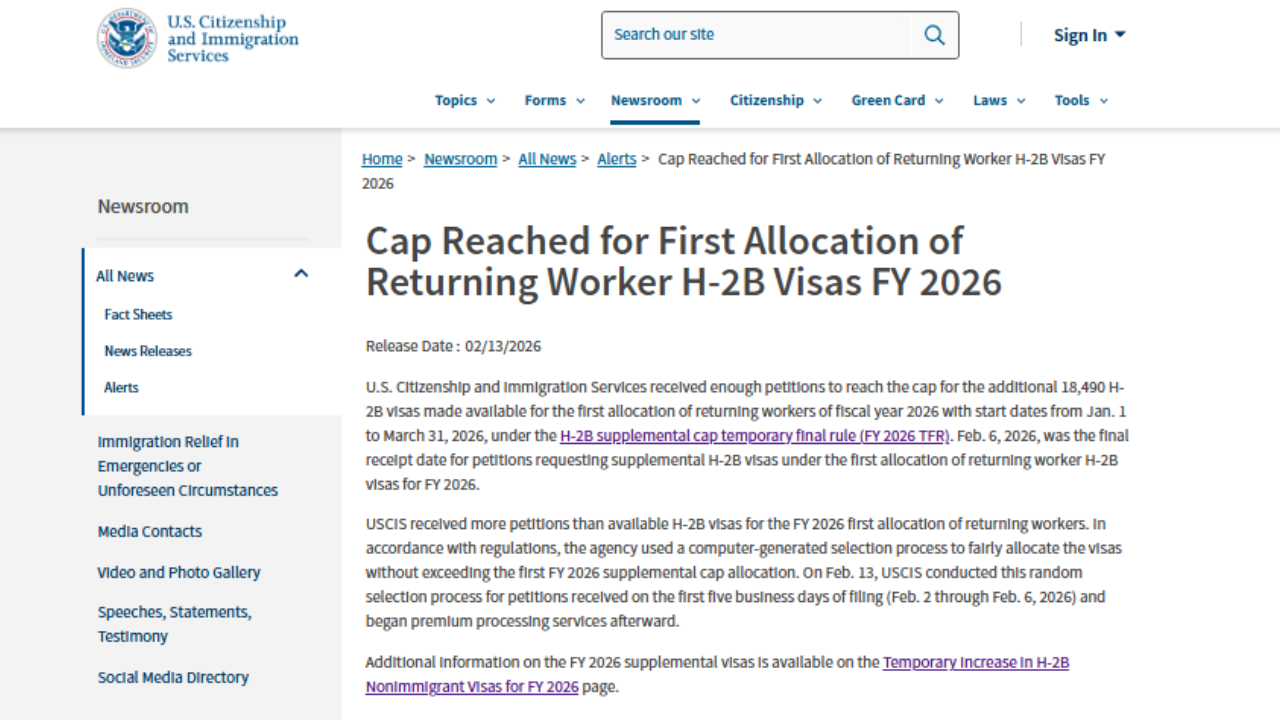
US Citizenship and Immigration Services (USCIS) has announced that it has received enough petitions to reach the cap for the first allocation of supplemental H-2B visas for fiscal year (FY) 2026. The allocation covers 18,490 additional visas reserved specifically for returning workers with employment start dates between January 1 and March 31, 2026. According to USCIS, February 6, 2026, was the final receipt date for petitions requesting supplemental H-2B visas under this first allocation. The agency confirmed it received more petitions than available visas during the initial filing window. To manage the excess demand, USCIS conducted a computer-generated random selection process on February 13, 2026. The lottery included petitions received from February 2 through February 6, the first five business days of filing. Petitions that were not selected will be rejected and returned along with their filing fees.
Understanding the H-2B cap structure
The H-2B visa program allows US employers to hire foreign nationals for temporary nonagricultural jobs when there are not enough qualified US workers available. Industries that frequently rely on the program include landscaping, hospitality, seafood processing, ski resorts, construction, and other seasonal businesses.Congress has set the statutory H-2B cap at 66,000 visas per fiscal year. These are divided into two halves: 33,000 visas for work beginning on October 1 and ending on March 31 33,000 visas for work beginning on April 1 and ending on September 30 On January 30, 2026, the Department of Homeland Security (DHS) and the Department of Labor (DOL) released a temporary final regulation in response to the lack of workers in the seasonal industries.Read more: 5 reasons why you must plan a trip to Pushkar in MarchThe rule makes available an additional 64,716 supplemental H-2B visas for FY 2026 beyond the statutory cap. The 64,716 supplemental visas are divided into three allocations: First allocation: 18,490 visas reserved for returning workers, covering start dates January 1 through March 31, 2026. This allocation has now been reached. Second allocation: 27,736 visas, plus any unused numbers from the first allocation, reserved for returning workers with start dates April 1 through April 30, 2026. Third allocation: 18,490 visas, plus any unused numbers from the earlier allocations, are open to all eligible workers (not limited to returning workers), for start dates May 1 through September 30, 2026. Returning workers are defined as individuals who were issued H-2B visas or held H-2B status in FY 2023, FY 2024, or FY 2025. The returning worker requirement applies to the first and second allocations but does not apply to the third allocation.Read more: “They can’t take no for an answer,” Foreign tourist shares his Agra expreince and why it is a lesson for everyone
Filing timeline for remaining allocations
Employers seeking workers with April 1–April 30, 2026 start dates may file under the second allocation no earlier than 15 days after USCIS announces that the second half of the statutory H-2B cap has been reached. For the third allocation, covering May 1–September 30, 2026 start dates, employers may file petitions no earlier than 45 days after the second half cap announcement and no later than September 15, 2026. USCIS will stop accepting petitions under the temporary final rule after September 15, 2026. The agency has also stated that it will deny all petitions pending under the supplemental rule that are not approved by October 1, 2026. Filing fees will not be refunded in such cases. Petitions requesting employment start dates after September 30, 2026, will count toward the first half of the statutory FY 2027 H-2B cap. With two supplemental allocations still available, timely filing will be critical for businesses that depend on temporary workers to maintain seasonal operations.