
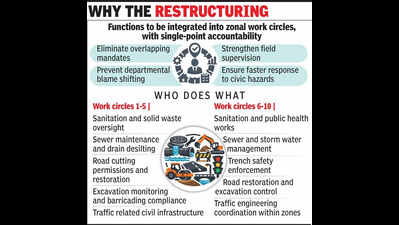
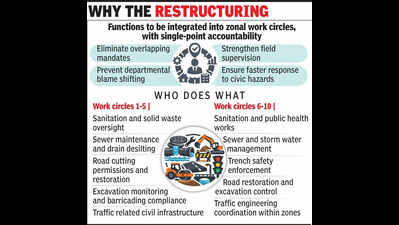
Noida: Noida Authority will integrate the functions of its separate public health and traffic wings and transfer their responsibilities to zonal work circles. Officials said the move aimed to address accountability gaps and prevent departments from shifting responsibility.The restructuring follows the death of 27-year-old techie Yuvraj Mehta, who drowned after his car plunged into a flooded ditch in Sector 150.The incident sparked public outrage and renewed questions over barricading, excavation safety and monitoring lapses. Residents said the trench was left exposed without warning signs, lighting or protective covers. The Authority later ordered an internal review into supervision and compliance failures.Under the revised arrangement, there will be no separate public health department or Noida Traffic Cell. Their functions will now be handled by individual work circles. Clusters of work circles were placed under two general managers (Civil). Work circles 1-5 will be headed by GM SP Singh, while work circles 6-10 will be overseen by GM AK Arora.Singh, who earlier handled the traffic cell and public health functions in addition to civic works across work circles 1-10, will now supervise sanitation, sewer maintenance, drain cleaning, excavation monitoring, road restoration, and traffic-related civil work within his designated jurisdiction.Arora will exercise similar consolidated authority in his respective zones. Senior managers and project staff will report directly within the work circle hierarchy, establishing single-point accountability at the GM-level.Created in 2012, the traffic cell had functioned independently of the civil department and was responsible for traffic planning, junction design, signage, signal coordination, and liaison with the traffic police. It was headed by a GM-level officer. Similarly, the public health department, also led by a GM, managed sanitation, solid waste oversight, sewer systems, and waterlogging mitigation.Officials said over the years, the bifurcated structure resulted in overlapping mandates. In cases involving dug-up roads, incomplete trench restoration, or drains affecting vehicular movement, files often moved between departments. This led to delays and blurred accountability, particularly in emergency situations. By dissolving the standalone cells and integrating their functions into the work circle framework, the authority aimed to eliminate ambiguity in decision-making, officials said. Each GM will now be directly accountable for road-cutting permissions, trench safety compliance, drain desilting, sewer upkeep, and traffic-related infrastructure within their assigned zones.Senior officials said that stricter monitoring of excavation sites, mandatory barricading protocols, enhanced inspection schedules, and periodic safety audits will be enforced to prevent any incidents similar to the Sector 150 case in the future. The objective is to streamline governance, strengthen field-level supervision, and ensure a quicker response to civic hazards across the city, officials added.