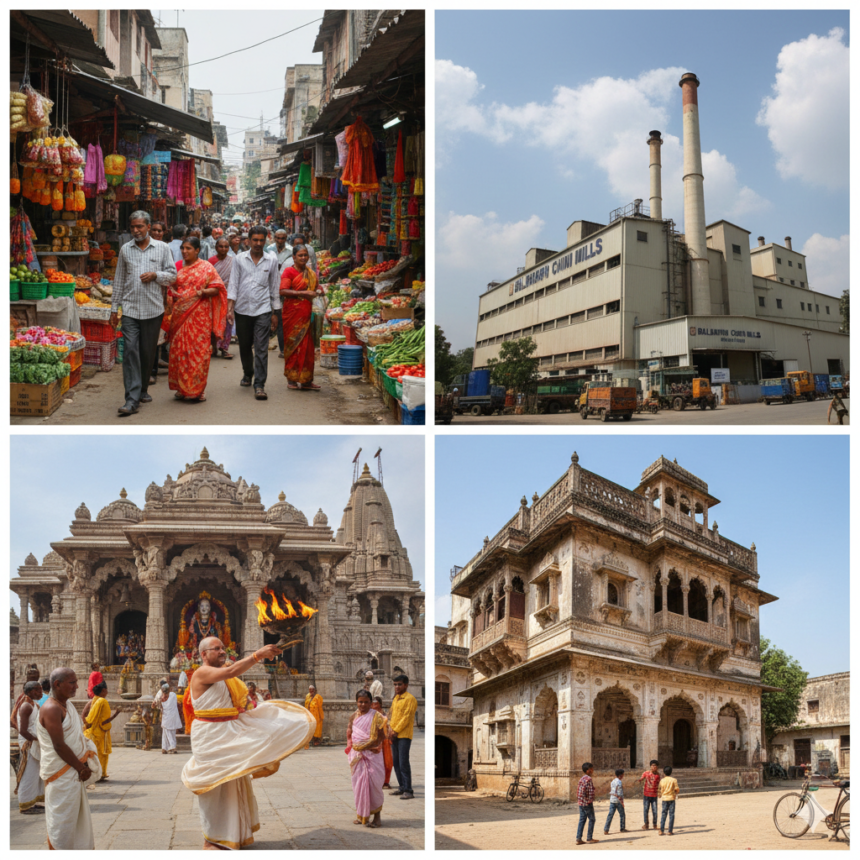
Nestled in the Terai region of Uttar Pradesh, Balrampur is a city that often surprises travelers and history enthusiasts. While it is now known for its sugar mills and as a gateway to the Katasraj Temple and the Chambal region, the Balrampur history is a tapestry woven with threads of royal patronage, architectural grandeur, and deep religious significance. For over five centuries, this land was not just a district but a powerful kingdom that played a pivotal role in the cultural and political landscape of the Avadh region.
Unlike many other princely states that were Hindu kingdoms, the history of the Balrampur estate is intrinsically linked to a powerful Shia Muslim dynasty that claimed descent from the Prophet Muhammad. Their story is one of loyalty, rebellion, resilience, and cultural synthesis. In this deep dive into Balrampur history, we will walk through the centuries, exploring the origins of the state, its most famous rulers, the architectural marvels they left behind, and how this royal city transformed into the modern district headquarters it is today.
The Origins: A Dynasty from the West
The seeds of Balrampur history were sown in the 16th century. The founder of this dynasty was Husain Khan, a nobleman of the Barha tribe of Sayyids (those claiming descent from the Prophet). The Barha Sayyids were renowned for their martial prowess and held significant influence in the courts of the Mughal emperors, particularly under Akbar.
Legend has it that Husain Khan came to the region either on a military expedition or was granted a jagir (land grant) by the Mughal court. The area, then part of the larger Avadh region, was a dense and rugged terrain. Husain Khan established his authority and founded the town of Balrampur. The name itself is believed to be derived from Bali Ram, a local Hindu chieftain who either submitted to Husain Khan or was defeated by him. Another theory suggests it was named after a local leader, Ram. Regardless, the dynasty he established would rule for over 400 years, marking the beginning of a unique chapter in Balrampur history.
The Golden Era: The Rise of the Shia State
The real consolidation of power and the golden period of Balrampur history began in the 18th century, a time of great flux in India as the Mughal Empire began to decline. The Nawabs of Avadh, who were also of Persian origin and Shia Muslims, rose to become one of the most powerful forces in North India. The rulers of Balrampur skillfully navigated this changing political landscape, aligning themselves closely with the Nawabs in Lucknow.
It was during this period that Balrampur transformed from a simple jagir into a powerful, semi-autonomous state. The rulers adopted the title of “Raja,” a fascinating blend of Hindu and Muslim traditions, reflecting the syncretic culture of the region. They maintained a well-trained army and a sophisticated administrative system. Their loyalty to the Nawabs of Avadh was rewarded with greater autonomy and prestige.
The Royal Family: Pillars of Power and Culture
The history of Balrampur is inseparable from its royal family. The rulers were not just political leaders but also patrons of art, culture, and architecture. They were deeply religious Shia Muslims, and their faith influenced many of the public works they undertook.
-
Raja Saghir Ahmad Ali Khan (Late 19th Century): He was a contemporary of the British Raj and was known for his administrative acumen. He was one of the first to realize the importance of modern education and established several schools in the region.
-
Raja Pateshri Dutt Singh: A name that resonates in the region, he was a great builder and philanthropist. Many of the old structures in Balrampur, including temples and dharamshalas, owe their existence to him, showcasing the dynasty’s respect for all faiths. This is a crucial aspect of Balrampur history—its secular outlook.
-
Maharaja Digvijay Singh (20th Century): The last formally ruling Maharaja before independence, he was a visionary leader. He played a key role in establishing the sugar industry, which remains the backbone of Balrampur’s economy today. He was also a noted sportsman and politician, serving in the Uttar Pradesh Legislative Assembly. His lineage continues to be influential in the region’s politics and social circles. To understand more about the evolution of princely states in India during this period, you can read this article from The British Museum’s resource on Princely States (External Link 1).
Architectural Marvels: A Testament to a Glorious Past
The most visible legacy of Balrampur history is its stunning architecture. The city is dotted with palaces, imambaras, mosques, and temples, each telling a story of a bygone era.
-
The Balrampur Fort (Qila): While much of it is in ruins now, the old fort stands as a silent sentinel to the city’s past. Its massive walls and gateways evoke a sense of the power and grandeur the rulers once wielded.
-
The Royal Palace (Raj Mahal): Unlike the fort, parts of the royal palace are still in use. It is a magnificent example of Awadhi architecture, with sprawling lawns, intricate chandeliers, vintage cars, and halls filled with portraits of the royal family. The blend of European and Mughal styles is evident in its design.
-
Imambaras: Following the Shia tradition of Lucknow, the rulers of Balrampur built several Imambaras. These are not just religious buildings but also centers of art and community gathering, especially during the month of Muharram. They house beautiful tazias (replicas of the tombs of Imam Hussain) and are adorned with exquisite calligraphy and mirror work.
-
Katasraj Temple: Although not built by the Balrampur royals, this ancient Hindu temple complex, dedicated to Lord Shiva, is an integral part of the region’s geography and history. It is believed to be the site where the demon king Ravana worshipped Shiva. The temple’s serene location amidst the hills makes it a must-visit. The royal family always protected such sites, contributing to the harmonious fabric of Balrampur history.
The British Era and the Struggle for Independence
The relationship between the rulers of Balrampur and the British East India Company was complex. During the Indian Rebellion of 1857, the Raja of Balrampur, like many rulers in Avadh, initially sided with the rebels against the British. This was a pivotal moment in Balrampur history. The state was a key center of resistance.
However, after the rebellion was brutally crushed by the British, the Raja was forced to surrender. His territories were confiscated, and he had to pay a heavy fine. The British, in their classic “divide and rule” policy, later restored the estate to the Raja but with reduced powers. The rulers became loyal feudatories of the British Crown, focusing on the administration of their state and the welfare of their subjects.
During the 20th century, the national movement for independence gained momentum. The people of Balrampur actively participated in the Non-Cooperation Movement and the Quit India Movement. The royal family, while maintaining its loyalty to the British, also harbored nationalist sympathies. This dual role is a fascinating aspect of the history of Balrampur. To understand the broader context of the 1857 rebellion in the Avadh region, you can refer to this detailed analysis by Encyclopedia Britannica on the Indian Mutiny (External Link 2).
Post-Independence: Integration and Transformation
With India’s independence in 1947, the princely state of Balrampur was merged into the Union of India. This marked the end of its political sovereignty but not its cultural influence. The last ruler, Maharaja Digvijay Singh, signed the Instrument of Accession, and the state became part of the newly formed Uttar Pradesh.
This period of transition is a crucial chapter in Balrampur history. The zamindari system was abolished, and the large estates of the royal family were broken up. However, the family adapted to the new reality. They diversified their investments, most notably into the sugar industry. The Balrampur Chini Mills Ltd. (BCML) became one of the largest sugar producers in India, turning the city into an industrial hub.
The royal family also transitioned into politics and public life. The palaces were partially opened to the public, and the family continues to be respected for its historical role and philanthropic activities.
Balrampur Today: A Living Museum
Modern Balrampur is a fascinating blend of the ancient and the modern. Driving through its streets, you can see auto-rickshaws zipping past grand, crumbling gateways. The hum of sugar mills mingles with the call to prayer from mosques and the ringing of bells from temples.
-
Cultural Melting Pot: The Balrampur history has created a unique culture where Hindu and Muslim traditions coexist harmoniously. Festivals like Diwali, Eid, and Muharram are celebrated with equal fervor. The city’s cuisine is a delicious blend of Awadhi and Bhojpuri flavors.
-
Tourism Potential: Balrampur is slowly waking up to its tourism potential. The Katasraj Temple attracts a steady stream of pilgrims. The royal palaces and Imambaras are of great interest to heritage lovers. The nearby Chambal Wildlife Sanctuary adds an eco-tourism dimension.
-
Economic Hub: With its thriving sugar industry, Balrampur is one of the more economically active districts in Purvanchal. It serves as a major trading center for the surrounding agricultural areas.
Key Attractions for the History Buff
If you are planning a trip to delve into Balrampur history, here are the must-visit places:
-
Raj Mahal (Royal Palace): Get a glimpse into the royal lifestyle. While you may not be able to enter all areas, the exterior and the permitted sections are awe-inspiring.
-
The Old Imambaras: Visit the main Imambara during Muharram to witness a profound display of faith and culture. At other times, you can admire the architecture.
-
Balrampur Fort (Qila): Explore the ruins of the old fort. It’s a great place for photography and to imagine the city’s medieval past.
-
Jama Masjid: A beautiful mosque built by the royal family, showcasing classic Mughal architecture.
-
Katasraj Temple: A short drive from the city center, this ancient temple complex is a must for its spiritual atmosphere and archaeological importance.
-
Local Bazaars: The markets around the city center are full of local handicrafts, textiles, and, of course, delicious sweets. You might find some remnants of the royal era in antique shops.
The Enduring Legacy
The history of Balrampur is not just a story of kings and battles. It is a story of cultural synthesis, of resilience in the face of political change, and of a legacy that continues to shape the identity of a region. The royal family, though no longer in power, remains an integral part of the city’s fabric. Their names adorn schools, hospitals, and public buildings.
Balrampur stands as a testament to the fact that history is not just confined to textbooks. It lives on in the stones of its buildings, in the traditions of its people, and in the pride they take in their heritage. From a small jagir in the 16th century to a powerful Shia state under the Nawabs, from a rebel stronghold in 1857 to an industrial hub in independent India, the journey of Balrampur is a microcosm of the larger Indian story.
For anyone interested in the rich, layered, and often surprising history of North India, a visit to Balrampur is an enriching experience. It is a place where the past is not a foreign country but a living, breathing part of the present. To explore more about the cultural heritage of other former princely states in Uttar Pradesh, you might find this resource from the Uttar Pradesh Tourism Department (External Link 3) very helpful.
Conclusion
As the sun sets over the domes of its Imambaras and the gates of its old palace, Balrampur offers a silent narrative of a glorious past. The keyword “balrampur-history” unlocks a treasure trove of stories waiting to be discovered. It is a city that deserves to be on the map of every history lover traveling through the heart of India’s Hindi heartland. So, the next time you plan a trip, take the road less traveled and let the echoes of Balrampur’s royal past guide your way.