
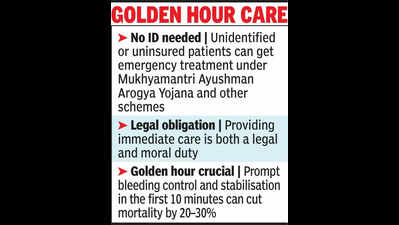
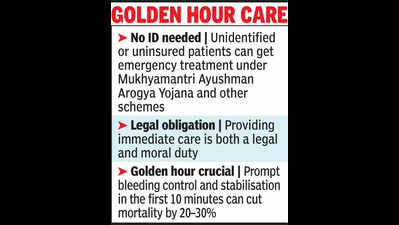
Jaipur: The medical education department Thursday directed that emergency treatment must not be delayed for administrative procedures or medico-legal formalities, instructing govt hospitals attached to medical colleges to begin care immediately and complete documentation after stabilisation.In medico-legal cases (MLC) such as road accidents, assault and poisoning, hospitals have been told to inform the police, but not to wait for police arrival before starting treatment. The department said first aid, resuscitation and stabilisation must begin without delay, especially during the “golden hour” in life-threatening emergencies.
The order covers critical conditions including accidents, trauma and polytrauma, burns, heart attacks, snake and animal bites, obstetric emergencies, poisoning, unconsciousness and similar presentations. It cites the Supreme Court’s ruling in Parmanand Katara vs Union of India (1989), which held that saving life through prompt emergency care is the primary duty of medical professionals and institutions. The medical education department said no patient can be refused or made to wait due to payment issues, registration requirements, police reporting, identity verification or any other administrative formality. The directions reiterate that Article 21 of the Constitution prioritises protection of life, and that emergency care must be initiated immediately for all patients, including those from other states or countries and those without identity documents. In line with Indian Public Health Standards and Ministry of Health guidance, hospitals and medical colleges have been asked to maintain 24×7 emergency services, a triage system including a radiological zone, and arrangements for immediate treatment, following the principle of “treat first, document and bill later.” Advance payment and prior registration are not to be insisted upon in emergencies. Patients with listed life-threatening conditions and unconscious patients are to be triaged to the red zone and managed under a “zero delay” concept, with hospitals ensuring that referrals and administrative steps do not slow care during the golden hour. For survivors of sexual violence, the guidelines specify free treatment, confidentiality and care in the presence of a female attendant. Copies of the Parmanand Katara judgment, the current order and relevant IPHS guidelines have been made available to doctors, nurses and emergency staff. The department also mandated regular training and sensitisation sessions, and asked hospitals to display a Citizen’s Charter or posters outlining emergency care rights and procedures. Department heads and emergency and trauma in-charges have been told to create internal mechanisms to prevent misuse of the provisions by non-emergency cases.