

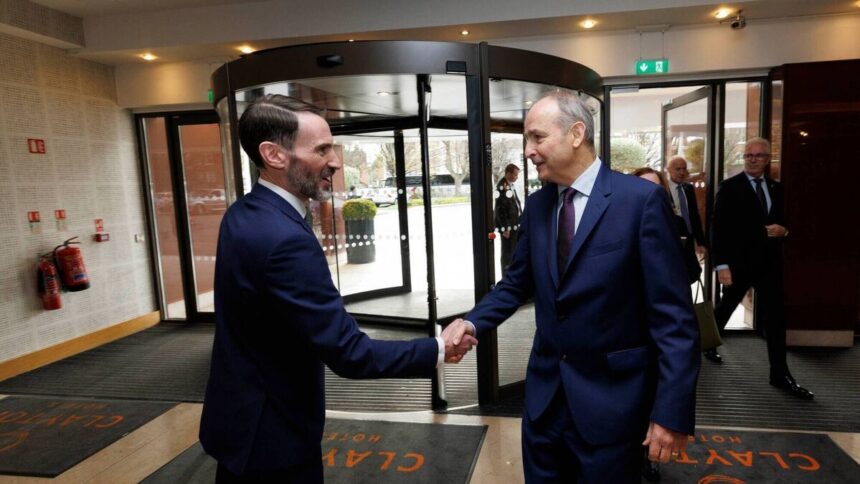
Ireland’s long-standing relationship with American multinationals is set to grow and thrive in 2026. Despite global turbulence and concerns around tariffs, Paul Sweetman, CEO of the American Chamber of Commerce Ireland, said there remains a “prevailing optimism that a new era of growth for Ireland is within reach.”
US companies now employ 245,000 people in Ireland, up from 210,000 last year — a significant 16% increase in a single year. “This growth really reflects a long-term commitment rather than short-term decisions about the quality of the competitive advantages that we have here in Ireland – with number one being talent and skills.”
An American Chamber survey conducted in November 2025 found that the US multinational community continues to view Ireland as an important location for strategic investment, and optimism remains high for the future of their businesses in Ireland. Over 4 out of 5 member companies said their corporate headquarters continues to have a positive view of Ireland as an investment or growth location based on their company’s experience here over the last year. The American Chamber represents almost 1,000 US firms with bases in Ireland, totalling an estimated €40bn annual input into the Irish economy.
“2025 has been a significant year, with members having faced the uncertainty and real challenges posed by geopolitics, trade and tariffs,” said Mr Sweetman. “Much effort has been spent in dealing with these issues and we in AmCham have been side by side with our members in navigating this difficult path. However, over the course of 2025, a real sense of optimism has emerged. Our members are ready to grow their footprint and impact in Ireland.”
To underline this point, he added that “almost 70% of respondents to a recent AmCham survey said their corporate headquarters plan to invest and expand in Ireland over the next five years. That is a significant proportion of companies that see the potential growth in the coming medium term for their investments in Ireland.”
Similarly, the growing investment by Irish companies across the US continues to play an important part in the strength of this two-way relationship.
“When I started this role two years ago Ireland was already in a very strong place with regard to investment into the US, being the 9th largest investor there. Today we are the 5th largest source of foreign direct investment into the US – and that equates to Irish companies employing over 200,000 people across all 50 states. This makes it a significant two-way business relationship.”
Additionally, Ireland is now the 7th most competitive country in the world, according to the 2025 IMD World Competitiveness Index.
Over the past six decades, Ireland has fostered an exemplar community of business leaders and policymakers dedicated to making it a premier location for investment: “Longsighted policies, the tremendous work of our state agencies – the IDA and Enterprise Ireland — the dogged efforts of the business community and close collaboration with the US Embassy and successive Irish Governments, have all resulted in phenomenal growth.”
However, while American companies are continuing to invest in Ireland, they are asking tougher questions around housing, infrastructure, timelines, certainty and delivery, Mr Sweetman points out.
Housing, cost competitiveness and public infrastructure constraints continue to be identified as the top challenges and risks to FDI by AmCham members. When asked what national commitment their organisation sees as offering the greatest opportunity for Ireland’s growth and investment environment, 27% said the implementation of the new Housing Strategy, with 24% pointing to progressing major national transport infrastructure projects such as the MetroLink and Bus Connects.
“These tougher questions around housing and infrastructure are within our own control. A point being made here too is that many of these serious challenges are also happening across competitor locations. The winners will be the ones to address these challenges quickest.”
Energy security has also become a board-level issue for many US multinationals.
“All of the respondents to recent AmCham surveys said the security of Ireland’s energy grid is important to maintaining US investment in Ireland. Essentially what they are looking for is confidence that grid capacity will be available when needed, clarity on timelines for new connections, and visibility on how Ireland’s energy system will scale alongside the investments we see coming into Ireland.”
Mr Sweetman points to a powerful and unique asset in Ireland’s arsenal – a renewable energy capability, particularly wind power on the west coast of the country.
“Offshore wind represents a major opportunity to strengthen our energy security, while also supporting decarbonisation. We do, again, have an opportunity to develop new competitive advantages here, where companies are raising concerns or challenges.”
Additionally, 96% of AmCham respondents said that meeting Ireland’s and the EU’s sustainability targets is important to maintaining competitiveness.
“Reliability and sustainability must progress together, and AmCham’s Renewable Energy White Paper sets out a number of practical priorities to support this.” They include accelerating the delivery of grid infrastructure and enabling multi-site businesses to develop private wires frameworks.
“Talent is the number one reason why companies invest in Ireland, and time and time again when companies talk about their investments they reference the strength of the talent and skills that are available here compared to other jurisdictions throughout the world that they are also looking at,” Mr Sweetman explains.
“Talent remains Ireland’s strongest competitive advantage.” He cautions, however, that we must ensure it remains a top competitive advantage. Eighty-eight per cent of AmCham survey respondents said Ireland’s education and training system is effective in preparing the workforce for future skills needs, while 50% said their organisation is experiencing difficulty filling vacancies in their operations in Ireland, although this is down from 69% in November 2024. Forty-four per cent of survey respondents identified the most significant barrier to filling vacancies as being a shortage of specialist skills.
“There are two constraints that we see – one is in specialist skills, and the other is housing – both of which are presenting challenges to companies in filling vacancies. There are similar challenges in filling vacancies in every jurisdiction – so the opportunity to address these at speed is going to support companies’ further investment here.”
Investment in higher education infrastructure allied to a focus on upskilling and reskilling, in addition to expanding the range of apprenticeships available informed by industry gaps, AI, machine learning, engineering and cyber, will be important in this regard. With one-fifth of Ireland’s workforce being non-Irish – the highest share of international workers in the EU – a continued focus on the ability to attract top international talent is essential.
A key concern is the processing times for an Entry Visa, which can range between 4 to 8 weeks – compared to much shorter times in competitor countries, such as the UK where the wait is 5-7 days.
“By focusing on streamlining Ireland’s migration system, and expanding the list of roles eligible for employment permits, we can really boost the competitive advantage of the talent and skills availability here.”
In a year where global uncertainty across international markets became the norm, such turbulence has now become a challenge all businesses and companies must contend with.
“Global uncertainty is now part of the investment landscape – from trade tensions to geopolitical risk,” concludes Mr Sweetman. “But what we are seeing from our members is that it is actually things like housing, cost competitiveness and public infrastructure constraints that are continually raised as the top challenges to investments here in Ireland.”
Significantly, when AmCham members were surveyed last November on the number of top challenges to growing investment here, tariffs came in at number 6.
“The significant challenges that we face, and which companies are calling us to examine and correct, are national challenges and all to do with competitiveness. We have to remain incredibly vigilant, and continue to work hard with regard to tariffs and geopolitics – but we also must make sure we focus on the controllables that companies need in order to grow and invest strongly here in Ireland.”