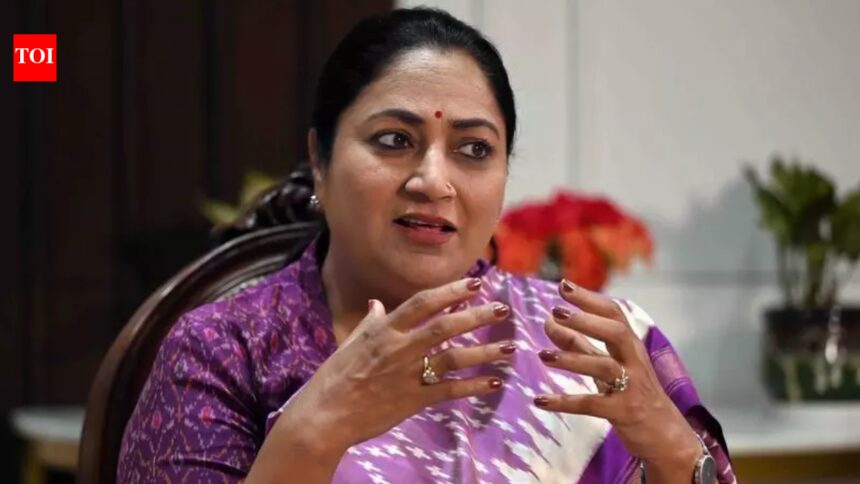
NEW DELHI: CM Rekha Gupta outlined Wednesday a series of measures taken by her govt over the past one year to curb dust and vehicular pollution in the capital, while rejecting allegations that air quality data was, in any way, manipulated or deliberately concealed. In a free-wheeling interview with TOI, Gupta said dust and smoke remained the two major contributors to Delhi’s air quality crisis. The CM asserted that in its first year, her govt was grappling with “legacy issues” while vowing that Delhi would breathe easier within a couple of years. She said her govt had implemented a structured dust mitigation plan with short-, mid- and long-term interventions. Among long-term solutions, she pointed to the ambitious target of “wall-to-wall carpeting” of roads. Gupta said her govt had prioritised electrification of public transport. “Today there are 4,200 EV buses in Delhi, more than any state in the country,” she said. Gupta expressed regret over the twin deaths in less than a week linked to civic neglect. “As CM and also as a woman and a mother, I understand that there can be no greater pain than this,” she said. Referring to trolling, she said, “When your statement, your words are twisted and presented by removing commas and hyphens… it hurts.” What are your govt’s biggest achievements so far?CM: One year is a very short time to achieve major milestones, but it has certainly been a year of laying strong foundations for big projects. One of our biggest achievements is the implementation of Ayushman Arogya Yojana, ending a wait of nearly 10 years. Today, around 7 lakh people have registered under the scheme. Approximately 25,000 people have already received treatment, and govt has made payments of about ₹Rs 45 crore. Many elderly citizens and families are now covered under the Rs 10 lakh health insurance cover, which is a significant relief for them. I consider this one of our most impactful initiatives.The second major initiative is Atal Canteen scheme, which is both important and humane. The guiding principle behind it is that no one should go to bed hungry. If a labourer or a poor person can get a meal for Rs 5, they do not have to beg or depend on anyone. This scheme ensures dignity, along with food security.Another milestone is the addition of 4,200 EV buses. Since there are limited manufacturers of EV buses and delivery takes time, we have already placed advance orders to meet Delhi’s future transport requirements. We are also focusing on improving last-mile connectivity. We are working on important policies in health, education and sports. For example, Delhi now offers the highest prize money for sports in the country. We are also investing in expanding Delhi’s metro infrastructure, which is already the largest in India, and ensuring it continues to grow.What has govt done to improve infrastructure?Delhi’s roads require comprehensive redevelopment. We have planned large-scale upgradation and wall-to-wall carpeting of nearly 1,400km of roads under PWD. There is focus on overhauling Delhi’s decades-old drainage system as well, much of which is nearly 50 years old. To replace this outdated infrastructure and build a modern drainage network, we are undertaking a project estimated at Rs 56,000 crore. This will be funded through a combination of bank loans, support from the Centre, and contributions from Delhi govt. The goal is to permanently address chronic issues, such as waterlogging, sewer overflow and drain mismanagement. We are investing in new water supply lines and sewer networks. On the social infrastructure front, we are constructing schools and hospitals, developing mini-secretariats to decentralise administration and building residential accommodation for govt employees. We are also working on housing projects for residents of slum clusters.BJP had promised to provide Rs 2,500 monthly assistance to women if elected. Why has it not been implemented yet?We are working to fulfil the commitments we made during the elections one by one. Recently, we decided to provide free cylinders to women in Delhi. On Holi, eligible families will receive the benefit of two cylinders. Around 17.5 lakh families will be covered under this initiative through direct benefit transfer, whether they use LPG or piped gas connections.We are steadily implementing all the promises we made. One such commitment is Mahila Samridhi Yojana, under which financial assistance of Rs 2,500 has been proposed for women. However, ensuring that the benefit reaches the right person is a complex task. Delhi already has multiple welfare systems in place, and often benefits end up reaching the same categories repeatedly. Our priority is to identify the women who genuinely need support and ensure that the assistance reaches them directly. Significant groundwork is being done to create a transparent and targeted mechanism so that the money benefits the intended recipient.We are also mindful of a social reality — in many households, even when financial assistance is transferred in a woman’s name, it may be diverted towards general household expenses, and she may not be able to use it for herself. Our objective is to design a model scheme in Delhi where the financial support genuinely empowers women — allowing them to spend it on their own well-being, health or personal needs. The intent is not merely to transfer money but also to create meaningful economic empowerment.Do you think the initial announcement that payments would begin from March 8, 2025, raised expectations that govt has not been able to meet?Yes, we missed that timeline. However, after coming to office, we were able to assess the actual financial position of the administration. As finance minister, when I reviewed the accounts, it became clear that the financial system was under severe stress. Several departments were running at a loss — DTC, Jal Board — and critical services were affected. There were delays in scholarships, infrastructure gaps in water and sewer systems, and pending liabilities across sectors. My immediate priority was to address the most urgent concerns. We released pending scholarships in phases. Ensuring that children receive their scholarships on time was non-negotiable for us. We also cleared outstanding dues related to the metro and began resolving long-pending projects that were stuck in arbitration, including infrastructure projects like Barapullah.There were multiple pressing priorities that required attention simultaneously. While we are working on implementing Mahila Samridhi Yojana, we also had to restore financial discipline and clear inherited liabilities. Both objectives are important, but governance requires setting priorities based on what is most urgent for Delhi at any given time.Several BJP-led states have implemented similar schemes. Will Delhi’s version be different?Yes, similar schemes exist in other states, but Delhi’s model must be different. As the capital, the needs of women here are distinct. Our focus is on creating a sense of financial independence and self-reliance. Since Delhi is a digital city, we want the assistance to be transferred and retained digitally in the beneficiary’s name. We are already issuing digital cards for free bus travel, and we envision a similar transparent mechanism for this scheme. Secondly, this cannot be a one-time or short-lived measure. Financial assistance must be sustainable. My priority is to ensure that the financial structure is strong so that the scheme does not stop midway.Any tentative timeline?The portal for the scheme is being developed and beneficiary identification is under way. We are scrutinising ration card data and pension lists to ensure accuracy. During verification, we found duplicate ration cards, cards issued in the names of deceased persons, and some cases that did not meet eligibility criteria. This exercise is to ensure that govt benefits reach only those who are genuinely entitled to them. The same careful verification will apply to Mahila Samridhi Yojana. This is taxpayers’ hard-earned money, and it must go to those who truly need and deserve it.A year has passed since BJP assumed office, but we still don’t have a new liquor policy. What will be the form of the policy now? Secondly, what is govt planning to do with the bungalow where Arvind Kejriwal stayed as CM?The previous liquor policy was not accepted by the people of Delhi, which is why it was withdrawn and the city reverted to the earlier system. This is a sensitive issue, as it affects youth, women and society at large. We are holding consultations with experts to frame a new policy that takes into account Delhi’s unique geographical and administrative realities as the national capital. Regarding ‘Sheesh Mahal’, it was built using public funds, and questions have been raised about the scale of expenditure. Since it involves taxpayers’ money, we are examining how it can be put to optimal public use or whether there are ways to recover costs. Both options are under consideration.Will recovery happen from Aam Aadmi Party?No, the law will deal with Aam Aadmi Party, the courts will deal with them. But today, what govt has is that building. So, we have to see how to use it.Will you allow the entry of private vendors in the liquor trade?Right now, I can’t say what’s going to happen. But yes, discussions are going on. We have formed a committee that will give us a full report on this.How do you compare your governance style with that of Aam Aadmi Party’s?The biggest difference is transparency. We have worked to digitise every process in govt. All departmental files now move as e-files and are digitally signed, so there is a proper record. Earlier, there was no complete record of govt assets; we are now undertaking full asset management. For grievance redressal, there was only a basic online complaints system. We are creating a comprehensive digital grievance management system. A CM dashboard is being developed to monitor projects in a time-bound manner.The second difference is being on the ground 24×7. Our MLAs, ministers and I are constantly among the public, addressing issues directly. The CM today is handling 10 departments and taking responsibility. The previous CM didn’t have even one.You have faced a lot of attacks on social media. Were you prepared for this when you became CM?Social media functions in two ways — it can be constructive or politically motivated. When criticism is constructive, I take it positively. However, there is also politically-motivated misinformation. At times, statements are taken out of context or selectively edited… These tactics are unfortunate, but they do not distract us. My accountability is to the people of Delhi. I remain focused on delivering work on the ground and responding transparently to the public.Do you feel that you are unfairly targeted? Does this affect governance?If political rivals say it, it doesn’t matter. But it hurts when young influencers create content without full information just for views. Facts should be checked. When a team works with honesty and dedication, especially in the capital, young creators should verify reality instead of repeating political narratives.Several meetings have been held on cleaning Yamuna. Can you tell Delhi’s residents when they can expect visible improvement?In simple terms, the Yamuna became polluted because untreated sewage and dirty water from Delhi and neighbouring states flowed into it for years without a clear roadmap to stop it. Many sewage treatment plants (STPs) were either inadequate or not functioning properly. We have prepared a scientific action plan. Delhi has 35 STPs; 22 have already been upgraded, and work is under way to install 37 new decentralised STPs. We have conducted drone surveys of all major drains and are tapping them to ensure that no untreated water enters the Yamuna. We have also intensified desilting. Nearly 25 lakh metric tonnes of silt have been removed from drains so far, preventing it from flowing into the river. Another major issue was cattle waste — about 1,500 tonnes generated daily — with no biogas plants earlier to process it. We have initiated biogas projects and are identifying land and awarding tenders to manage this waste scientifically. Additionally, we are strengthening overall waste management through biomining of legacy landfill sites, waste-to-energy projects and new plants for e-waste and construction and demolition waste.Our goal is clear: 100% treatment of sewage and waste so that no untreated discharge reaches the Yamuna.Any expected timeline?You will see the Yamuna improving every year. Pollution flows into it not only from Delhi but also from neighbouring states, so we are coordinating with Haryana and Uttar Pradesh to ensure treatment of their drains as well. Within Delhi, we are tapping drains, removing solid and floating waste, and working to improve water quality and ecological flow.We are also pursuing long-pending water projects such as Renuka Dam in Himachal and other agreements with Uttarakhand to ensure better water availability for Delhi in the coming years. Yamuna cleaning is a long-term effort, but we are addressing every aspect systematically. The results will be gradual, but they will certainly be visible.Yamuna pollution and air pollution are shared challenges involving Delhi and neighbouring states. Now that the same party helms Delhi, neighbouring states and the Centre, will better coordination lead to visible improvements?Pollution is not a problem for just one state. For the first time, all Delhi-NCR states are sitting together, the Centre is coordinating and policies are being made for all states to follow. Such seriousness and coordination were not seen earlier.As far as Delhi is concerned, there are two major reasons for pollution — dust and smoke. For dust mitigation, we have made a structured plan with short-, mid- and long-term steps. Short-term measures include mist spraying, watering, sprinklers and filling potholes. But long-term, we are focusing on wall-to-wall carpeting of roads. Out of 1,400km of PWD roads, we aim to carpet 400km this year and complete 100% in three years.Plantation is equally important. We have decided to plant 35 lakh trees, focusing on indigenous species like neem, peepal and banyan. For the first time, 4,200 hectares in the Ridge area have been notified as forest. Plantation contracts will include maintenance responsibility. On smoke, transport is key. Today, Delhi has 4,200 EV buses — the highest in the country. We are promoting e-autos, e-bikes and improving last-mile connectivity. Automated vehicle testing stations are also being introduced. Revival of waterbodies and clearing garbage mountains are also part of reducing pollution. While govt has taken several steps to curb pollution, critics allege that during peak pollution periods, many monitoring stations were not reporting data, and that sprinkling near stations may have distorted readings. Do you think such concerns about transparency undermine your govt’s efforts?Our intent is clear and our policies are clear. Some political people purposely try to see it differently. It has been 356 days of our govt. In this short time, we dealt with waterlogging during the monsoon, then the heat wave plan in summer, and immediately after that, pollution. This first year was also a learning phase for us.There is absolutely no manipulation of monitoring station data from our side. If water sprinkling happens near certain stations, it is because they are identified hotspots — areas where dust and pollution levels are highest. Naturally, mitigation measures like sprinkling are more focused there. This is a normal procedure, not data manipulation. The objective is to settle dust and improve conditions in the worst-affected areas.We have now moved to long-term steps. For the first time, Rs₹5,000 crore has been allocated to the metro in this financial year. We cleared previous dues and started payments for Phase-IV and Phase-V to strengthen public transport infrastructure. We are expanding the EV ecosystem and working to reduce garbage mountains, which are also major pollution factors.These are legacy problems. E-waste burning, open garbage burning and unregulated practices were not addressed earlier. For the first time, we are planning dedicated e-waste plants and structured solutions.Results will take time. It may not change in one or two years, but the work being done today will show visible improvement. Govts before us had many years. We ask for some time — results will come, and the environment will improve.Many BJP functionaries were in the race to become CM, but you were picked. Do you get the cooperation of BJP functionaries and ministers?I receive full cooperation from the party brass, my colleagues, officers and the people of Delhi. When the direction of work is positive and focused on development, everyone’s goal becomes the same — to serve Delhi and its citizens. In our party, as Team Modi, we believe in the principle of nation first, party second and self last. Once a decision is taken in the interest of the country and the people, personal opinions do not come in the way.The recent deaths in Janakpuri and Rohini due to open pit and manhole have shocked Delhi. Given that civic infrastructure improvement was a key promise, how is your govt responding?I completely agree that such incidents are very unfortunate. As CM, and as a woman and a mother, I understand there can be no greater pain. This is a legacy issue— areas that should have been addressed earlier but were not.The issue of stray dogs is no longer limited to RWA squabbles. It has now entered the courtroom. What is govt’s plan to resolve this issue? Dogs are part of our society. Many people care for them deeply, but there are also concerns about attacks and bites. This primarily falls under MCD’s domain — sterilisation, vaccination, shelters and treatment. The work done earlier was insufficient, so their population kept increasing. When I visited veterinary hospitals, I found that although 70 exist on record, many were non-functional, with no staff or doctors. We have ordered their revival, allocation of funds and proper appointments so sterilisation and vaccination can happen effectively. We are also identifying land for new shelters for dogs and cows, so they can be properly cared for.If sterilisation, vaccination and shelter management are implemented properly, the population will be controlled and conflicts will reduce.What is govt’s long-term plan to ease traffic congestion in Delhi?Two things are needed to decongest Delhi. First, we must bring people onto public transport. Like abroad, people should feel happy using it instead of private vehicles. The key issues are availability and last-mile connectivity. If commuting becomes smooth — from home to metro and from metro to office — people will prefer public transport. We need to steadily increase its capacity.Second is road infrastructure. Expressways like UER-II have benefited Delhi, which lies between states and faces heavy through-traffic. Elevated roads, flyovers, foot overbridges and better traffic management at congestion points are essential. We have started new elevated road projects and targeted flyover completions, and are coordinating with the metro for integrated infrastructure. We will work on both fronts — strengthening road infrastructure and encouraging greater use of public transport.Before the elections, BJP had said it would continue all free schemes. But now some conditions are being imposed like it was in the free bus ride scheme…My responsibility is towards Delhi. Every single rupee of my state, which is taxpayers’ money, will first be spent on the people of Delhi. Women of Delhi should ride buses for free — this is my responsibility. It was not the previous govt’s intention to give it to women of other states, it was their mismanagement.But Delhi is a city of migrants… Many don’t have Delhi Aadhaar cards… The previous govt had tried to limit treatment in Delhi govt hospitals to Delhi residents alone and you had protested the move…In Delhi today, there are electricity and water subsidies. These free benefits are provided to the citizens of Delhi, and that is where govt funds are meant to be used. If someone says they are migrants and do not have identity cards, then I’m sorry, but it becomes difficult to provide these services. This is not my personal money, it is govt money — people’s money — and it must be fully utilised for this state and the people of this state. As far as medical facilities are concerned, they are structured in a way that people from every state come here for treatment. It is not a freebie. We are all migrants, including me. In Delhi, how many people are originally from here? Delhi is mini-India. But once we become part of it, we also obtain identity cards, Aadhaar cards, ration cards — everything. My own father came to Delhi 50 years ago. In all our schemes, we say the same thing: you should be a resident of Delhi, whether you came five years ago or three years ago. We must look at the financial management of the state. It should not be like it was under the previous govt when people yearned for water.