

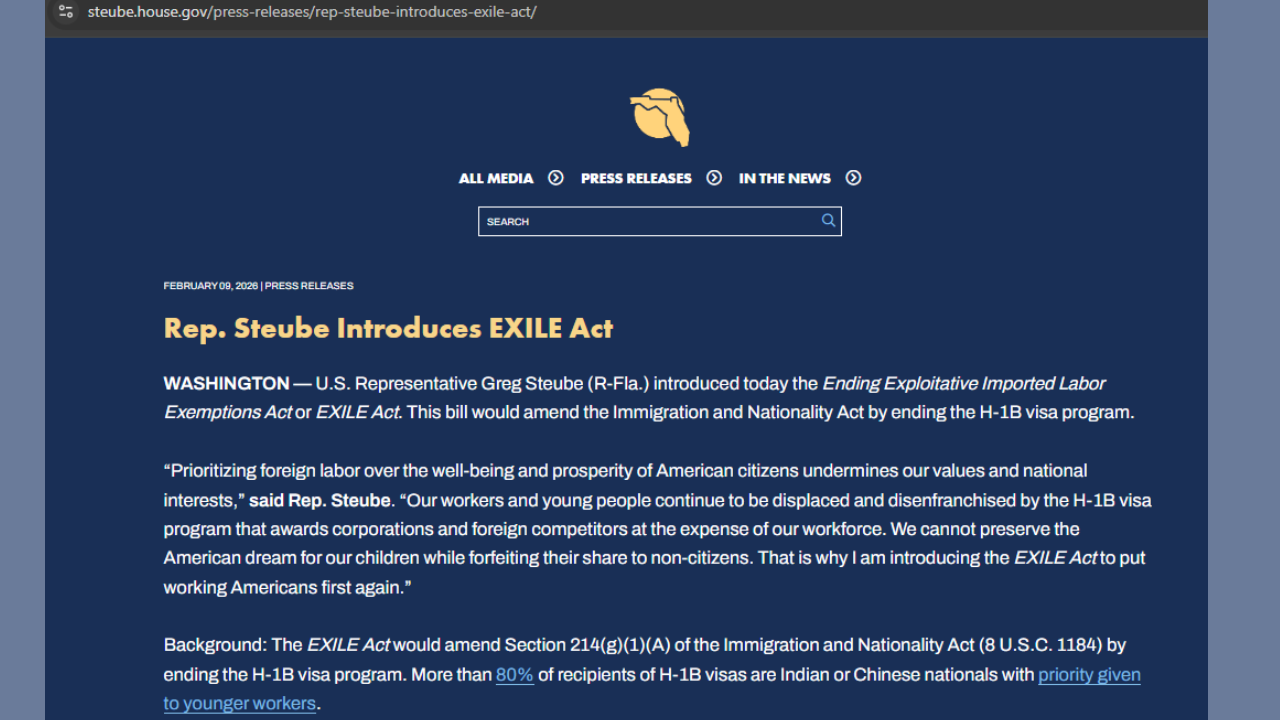
Greg Steube, a Republican congressman representing Florida’s 17th Congressional District, has introduced legislation seeking to eliminate the H-1B visa programme altogether. As per the press release, dated February 9, Steube proposed the Ending Exploitative Imported Labor Exemptions (EXILE) Act, a bill that would amend the Immigration and Nationality Act to terminate the H-1B category.
The H-1B visa currently allows US employers to hire foreign workers in specialty occupations, particularly in fields, such as technology, engineering, healthcare and finance.
What the EXILE Act proposes
According to Steube’s office, the EXILE Act would amend Section 214(g)(1)(A) of the Immigration and Nationality Act to reduce the number of H-1B visas to zero beginning in fiscal year 2027 and for every year thereafter. If enacted, US employers would no longer be able to submit new H-1B petitions once the cap is eliminated. The proposal calls for a complete termination of the programme rather than a phased reduction. In a statement, Steube argued that prioritising foreign labour over American workers undermines national interests and economic opportunity for US citizens. He said, “Our workers and young people continue to be displaced and disenfranchised by the H-1B visa program that awards corporations and foreign competitors at the expense of our workforce. We cannot preserve the American dream for our children while forfeiting their share to non-citizens. That is why I am introducing the EXILE Act to put working Americans first again.”Read more: The island that is so full of venomous snakes that humans can barely visit
Concerns cited by supporters of the bill
Steube’s office stated that more than 80% of H-1B visa recipients are Indian or Chinese nationals and that employers often favour younger workers. The bill also references several examples that, according to the congressman, demonstrate how the H-1B programme has disadvantaged American workers. These include claims that: More than 10,000 US physicians were unable to access residency programmes while over 5,000 foreign-born doctors entered under visa provisions. Over 16,000 employees at Microsoft were displaced following the approval of more than 9,000 H-1B visas in 2025. FedEx’s use of H-1B visas resulted in the closure of more than 100 US facilities. Disney laid off 250 employees in 2015 and replaced them with foreign workers through the programme. Southern California Edison terminated 540 workers in 2014 and replaced them with workers employed by outsourcing firms using H-1B visas.Read more: Heartwarming! Foreiger tourist caught on camera silently copying Indian performing rituals at the bank of Ganga in Rishikesh These examples have been cited by supporters of stricter immigration controls as evidence of domestic job displacement. Critics of such claims, however, have historically argued that the H-1B programme is designed to fill specialised skill shortages and that companies must meet regulatory wage and qualification requirements.
What it could mean for Indian nationals

For Indian professionals, the H-1B visa has long been one of the primary pathways to working and living in the United States. Indian nationals consistently form the largest share of H-1B recipients, particularly in the technology sector. If the EXILE Act passes into law, then this option would be effectively closed off from FY2027 onwards. While the US companies would have to explore other visa options, prospective applicants from countries such as India would have significantly fewer chances to work in the USA.At present, the bill has been introduced but would need to pass both chambers of Congress and be signed into law to take effect. The H-1B programme remains active under current law.The proposal adds to the ongoing debate in the United States over skilled immigration, labour markets and the balance between domestic workforce protection and global talent recruitment.