

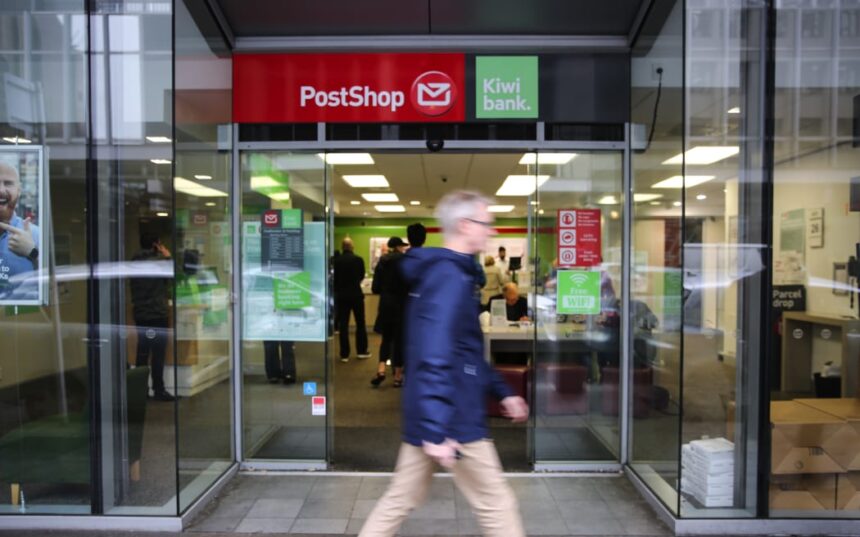

NZ Post is undergoing a change to its services as mail volumes drop.
Photo: RNZ / Richard Tindiller
Explainer – NZ Post is closing service counters and cutting delivery days. What is the future of mail going to look like?
So, is mail delivery as we know it just going to vanish?
Not so fast, says NZ Post CEO David Walsh, who says the agency is in the midst of a massive transformation in the face of rapidly dropping mail numbers.
“New Zealanders are communicating differently,” he said.
“I think we’ve all experienced that in our personal lives as well, and that change has been going on for quite some years.”
Here’s what you need to know about how NZ post is changing.
What’s happening to NZ Post?
The agency is in the middle of what it’s called “a period of transformation,” shifting its emphasis towards parcel delivery and consolidating many of its services.
In October, the Ministry of Business, Innovation and Employment approved changes to the Postal Deed of Understanding between the Crown and NZ Post, allowing them to change some of their procedures.
The changes approved include:
- Permitting a minimum frequency of 2 days delivery to urban, PO Box and private bag addresses, or 3 days for rural. The days must be spread throughout the week. Formerly, 3 days per week urban and 5 days rural were required.
- Allowing a minimum 500 total postal service points, then down to a minimum of over 400 after four years. Previously a minimum 880 points were required.
- The ability to convert up to 5 percent of delivery points to communal points annually.
For consumers, this boils down to likely fewer delivery days and postal counters.
Deed change doesn’t automatically result in operational change to NZ Post’s services, Walsh has said, but it gives the network more flexibility to make changes.
It announced back in 2024 that it would be gradually combining its two separate mail and parcel networks into one operation.
“For customers – this means your mail and parcels will eventually be delivered by one person, rather than two separate deliveries made by a Postie and a Courier,” Walsh has said.
That’s all basically because mail volumes have dropped dramatically.

Ponsonby Post Office shut down recently, part of a series of closures.
Photo: Screenshot / Google Maps
How bad has it gotten?
“It wasn’t that long ago we were delivering 700, 800 million mail items a year,” Walsh said. “We think in the next 12 months that could be well under 150 million mail items.”
According to NZ Post’s latest annual report, 158 million mail items were delivered in fiscal year 2025, down from 187m in 2024, while 88 million parcels were delivered, up from 84m in 2024.
“Parcels have grown significantly over the last three or four years, and mail has declined significantly in the same time,” Walsh said.
New Zealand addresses currently receive less than two letters each per week, compared to 7.5 in 2013, a spokesperson told RNZ.
The service has started to move back upwards after heavy losses – after a $56m loss in 2023, there was a $14m loss in 2024, and a $2m loss in 2025, according to their annual report.
The transformation toward parcel delivery is still in progress, Walsh said.
“When and how that happens we’re still progressively working our way through change, but that will depend on where volumes get to over the next few years. It’s too early to say exactly when.
“We believe it’s a good solution to maintain a great mail service.”
Consolidating parcel and mail delivery into one would be more economical, he said.
“Having one person deliver down the street is clearly more efficient than having two, so that is the goal.”

NZ Post will streamline mail and parcel delivery together.
Photo: NZ Post
So, we’ll get mail less often?
Although the changes to the Deed of Understanding now lets urban delivery be as few as two days a week, that hasn’t happened so far.
“We haven’t moved to twice a week yet, that is still something that will respond to as we see changing demand for mail services,” Walsh said. “If there is a permanent change in frequency we will certainly communicate that in advance.”
It’s hardly a transformation unique to New Zealand. Mail services around the world have been dealing with lower volume and higher costs. Last year, Denmark became reportedly the first country in the world to end its national letter delivery service entirely.
John Maynard of the Postal Workers Union of Aotearoa recently criticised some of the cuts and changes on RNZ’s Midday Report.
“It’s one thing that people will want to use emails over the old traditional mail system, but it’s quite another thing for a state-owned enterprise to act in a manner which consistently undermines people’s confidence in an institution.”

There have been concerns that plans could end letterbox deliveries for some people.
Photo: Mathyas Kurmann / Unsplash
Could you no longer get mail delivered to your house?
That’s one of the concerns raised by the union to RNZ late last year.
The Deed of Understanding now allows for up to 5 percent of delivery points annually to be changed to communal points – such as a cluster of boxes which service multiple addresses on a street.
Maynard told RNZ the suggestion to stop delivering to individual home letterboxes was “sort of hidden away in the document”.
“Putting the letterboxes in clusters makes it easier for the company to sack all the posties and have them delivered by vans which wouldn’t have to stop at your house, they’d put your mail at the end of the street,” he said.
However, Walsh said, the changes were more geared towards new developments, such as entrances to apartment buildings.
“There is both what the deed permits and what I expect us to continue to do”.
NZ Post also said in a statement, “we do not have widespread plans to move to communal delivery, and customers who currently have an individual letterbox can expect their delivery to continue as normal.”
While the deed does allow for consolidation of some delivery points, Walsh said, “From the perspective of NZ Post, if you’re in urban New Zealand and you have a letterbox outside your house, it’s almost certain we will continue to deliver to your house.”
However, he said NZ Post needs flexibility for new subdivisions or developments in rural areas.
“That will mean that we can continue to offer good service to those areas.
“As more households come on, that’s more points for us to deliver, but every site is having less mail be delivered too, so that makes it incredibly expensive for us to maintain to those new sites being developed.”
The Deed of Understanding says that “Any proposed change requires reasonable notice and community engagement before any conversions.”

The Auckland NZ Post processing centre.
Photo: Nick Monro
What about my local post shop? Is it closing?
NZ post also announced recently that it would close 142 service counters in convenience stores, pharmacies and libraries around the country, leaving 567 still operating.
Walsh said NZ Post had a “robust process” looking at what services were being used the most and where, when it came time to decide on closures.
“The data I have at the moment is that about around 90 percent of urban New Zealanders will be within 4km of a retail site” once the changes are in effect, he said.
To find out what’s happening in your area see the NZ Post Website list.
NZ Post says it has invested $290 million into infrastructure and automation.
NZ Post has also opened up new retail hubs for sending, collecting and returning parcels in Auckland, with more planned around the country, and five large processing centres.
How will these changes affect people who rely on the post?
The decision to close outlets has upset some smaller communities, who worry about the impact on older customers or those without easy access to alternatives.
“It’s easy for millennials and younger generations, but older people will really struggle,” Springfield Superette owner Raj Kumar of Rotorua told RNZ recently.
Stuart Dick is the chair of the board at the Magazine Publishers Association and general manager at Are Media which publishes weekly magazines including the New Zealand Women’s Weekly and the Listener.
“It is concerning that NZ Post are neglecting their core service and customers by reducing delivery days,” he said.
“Thankfully there are alternative delivery networks growing to provide some coverage, and the majority of magazines are sold via retail outlets.
“However this does not absolve NZ Post of their core purpose to ‘Deliver what people care about’ which includes the magazine subscriptions that our readers love, along with many other things Kiwis rely on their national postal network to deliver.”
Walsh said NZ Post was aware of those concerns.
“We will continue to work with those senders that have specific time requirements around them. We may not have perfect answers for everyone but we are absolutely committed to working with those senders to see what we can do to support their requirements.”
He said NZ Post’s goal was to make the changes with as little disruption as possible.
“It’s not easy, it’s clearly going to have impacts on some people, but we’re trying to get that balance right.”
Will mail ever go away entirely?
Asked if NZ Post as we know it is just going to vanish entirely at some point, Walsh said it was simply responding to changes in the culture.
“The way New Zealanders communicate, what they choose to receive, is choices that we don’t make, so we are responding to those changes and that’s really what we’re reflecting.”
NZ Post’s pivot to parcels also means it is more directly competing with services such as Aramex and DHL.
“It is a very competitive delivery market out there,” Walsh said.
“I’m proud of how well NZ post both competes and operates. We have made some pretty significant investments over the last few years to make sure we can continue to scale up our parcel and parcel delivery services.”
However, the Postal Union’s Maynard told Midday Report he was still concerned about what the future might hold.
“I think we’re going to see some more reductions in NZ Post services allowed for under the deed. I think this sort of thing will continue, pressure from the government, for NZ Post to cut costs and give the cash back to the government.”
Sign up for Ngā Pitopito Kōrero, a daily newsletter curated by our editors and delivered straight to your inbox every weekday.