
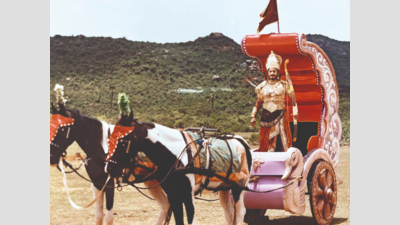
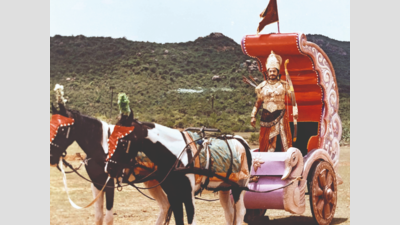
It was sometime in late 1985, when R S Manohar, playing the titular role of Indrajith (son of Ravana), fell 12ft during a stage performance. The actor struggled to his feet, finished the play, only to collapse after the curtains fell. Manohar was then rushed into surgery.Industrialist and patron of the arts, Nalli Kuppuswami Chetti, recalls that moment. “Manohar, an actor and director, was known for his special effects on stage. In this case, to create an illusion of a severed head, Manohar sat on a high trolley, hidden from the waist down between black sheets, to appear as though hovering on stage.” The actor, says Kuppuswami Chetti, instructed his stagehand to ‘wait’, by saying ‘iru daa’, which the man accidentally heard as ‘izhu daa’ meaning ‘pull’. “The audience saw Manohar fall 12ft,” says Kuppuswami Chetti.Through the 1960s and 1970s with more than 7,900 performances, Manohar was known for his dramas, his ‘dramascope’ technique (where his plays felt like movies with stereophonic sound), elaborate set design, and use of pyrotechnics.Born on June 29, 1925, in Namakkal, Manohar graduated from Madras University and was part of the University Officers’ Training Corps and Indian Air Training Corps.Despite excelling academically, acting was always his first love. During his school and college years, he acted in Shakespearean, Tamil and Sanskrit dramas. Even in his birth centenary year, he remains relevant, says nephew S Shivpprasadh, who stages some of Manohar’s major works in Chennai sabhas. “His devotion and dedication, to giving his best and bringing out the best in fellow artistes, raised the standards of Tamil theatre to this day.” Through his plays, Manohar projected the region’s rich cultural heritage, spanning social dramas, historical themes and mythological stories.“He was a one-man army when it came to his shows. His eyes and voice would draw audiences,” says director P Vasu.For several years Manohar worked in the administrative wing of the postal department before he was discovered by director R M Krishnaswamy to play the lead in crime thriller ‘Rajambal’ (1951). The prudent Manohar, knowing he had to compete with established villains such as M R Radha, P S Veerappa and M N Nambiar, quit his job only after establishing himself in the field.But Manohar’s grasp of roles made him a director’s favourite, and he became known for his cold, villainous stare and thunderous voice that could send chills down the spine of his audience. It took only a handful of films such as ‘Kaithi Kannayiram’, ‘Vallavanukku Vallavan’ and ‘Iru Vallavargal’ in the 1960s for him to make an impact on audiences and within a few years of entering the film industry, he quit his job.“Manohar’s screen presence was a challenge to co-stars,” says Vasu. “One had to match his calibre. Cinema comes naturally to actors with stage experience, be it MGR or Sivaji Ganesan, all had long innings because of their drama background.”Director K S Ravikumar says when he was younger, he and his friends would volunteer at Manohar’s plays across various sabhas. “Manohar’s backdrops were distinctive; he aimed for sensory immersion. If a play featured a jasmine garden, he would make us spray jasmine perfume everywhere, so the fragrance filled the auditorium,” says Ravikumar. “Just as director Shankar brought grandeur to cinema, Manohar pioneered realism and unconventional sets on stage. I would call him the Shankar of theatre. If a python was required on stage, he would bring a real one. He was fearless.”Actor and director R Pandiarajan, whose films often featured veteran artists, says Manohar gave a stellar performance in ‘Manaivi Ready’ (1987). “I was a fanboy on the sets. Manohar would remind me that I was the director and needed to guide him, not watch in awe.”After the accident during the Indrajith performance, Manohar slowed down, until 1991, when chief minister J Jayalalithaa, one of his admirers, asked him to stage ‘Thirunavukkarasu’. Though frail, he delivered a powerful performance. “Jayalalithaa’s mother Sandhya acted in Manohar’s plays. Jayalalithaa always watched his plays at the Music Academy, seated in the same row and seat. Before a Kalaimamani awards function, Manohar had a knee replacement surgery. She postponed the ceremony until he recovered,” says Shivpprasadh. At her request, Manohar later staged ‘Velicham’, a Tamil Nadu govt programme on the evils of alcoholism.Manohar died on Jan 20, 2006, leaving behind a legacy in stagecraft.A LOVE FOR DRAMA
- Manohar was honoured as Nadaka Kavalar (Guardian of Theatre) in 1970
- A voracious reader, he was known for his precise diction
- Despite close associations with three chief ministers,
M Karunanidhi , M G Ramachandran and Jayalalithaa, he was never keen on politics. - His troupe, National Theatres, staged about 7,950 shows. He acted in more than 200 movies.
- Manohar’s first mythological play ‘Lankeswaran’ faced criticism as writer Thuraiyur Murthy had portrayed Sita as Ravanan’s daughter. When Manohar consulted Kanchi Paramacharyar, the seer told him there was nothing wrong with his representation. The play was then staged repeatedly in Ceylon and honoured there as ‘Lankeswaran Manohar’.