

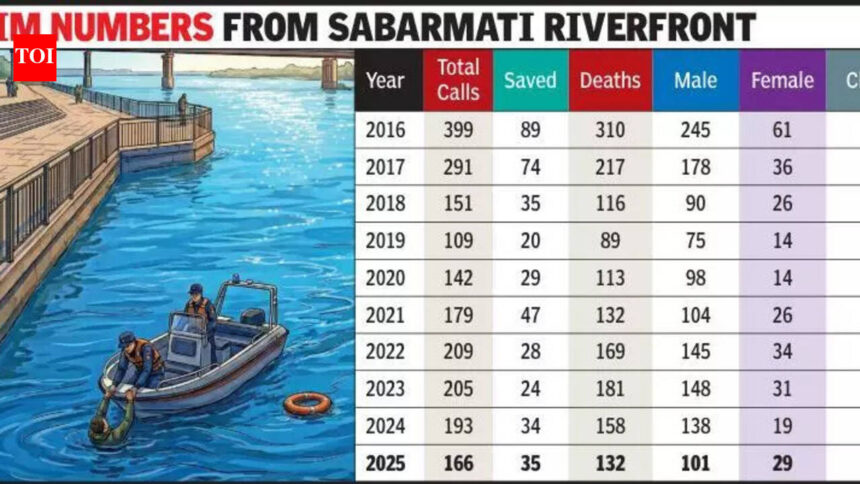
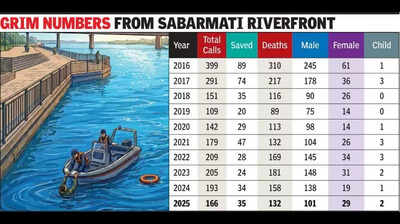
Ahmedabad: The Sabarmati riverfront, one of Ahmedabad’s most celebrated public spaces, has emerged as the site of a disquieting trend: since 2016, at least 1,617 people have died by suicide by jumping into the Sabarmati. That means, on average, one life has been lost every 48 hours during the 2016-2025 period.Authorities receive one distress call a day from the riverfront stretch. Another statistic shows that men account for an overwhelming majority of riverfront deaths year after year, particularly those in the 20-50 age group.“Most of the cases are linked to prolonged illness, financial crises, and relationship problems,” a senior police officer said.Police said that suicides involving women are often linked to harassment by husbands or in-laws, while in some cases young women take the extreme step due to relationship issues.“In cases involving children, we found instances of mothers throwing their children into the river and later dying by suicide themselves,” an officer said.The lack of personnel and citizens’ apathy are two reasons for lives easily going over the edge.Along the nearly 12km stretch of the riverfront, the fire brigade has deployed only three rescuers. “In an emergency, bystanders shoot videos instead of calling rescuers,” said an official familiar with rescue operations.The official added, “Many avoid calling the helpline 112, fearing legal trouble. By the time the fire brigade is alerted and rescuers are mobilized, crucial minutes are lost.”Rescuers also struggle to pinpoint the exact locations from which people have jumped into the river. “Time is the most critical factor in such cases, and delays mean that the chances of survival drop sharply,” the official said.In 2016, the Ahmedabad Municipal Corporation installed high grills and railings on all bridges over the Sabarmati to curb suicides. While that reduced deaths from bridges, people began jumping from the open promenades and walkways. “The riverfront was designed to create a sense of proximity to water. That very design has now become a vulnerability,” an urban planner said.Experts warn that without round-the-clock patrols, better lighting, CCTV monitoring, location markers, and a dedicated rescue force, the riverfront will continue to claim lives.



