


With every major tech company now boasting its own generative AI model, from Meta AI, X’s Grok, Google’s Gemini and Microsoft’s Copilot, the race to have the best is heavily reliant on how they’re trained and the data that trains them. This is the price we pay for the service.
Meta, which owns Facebook, Instagram and WhatsApp, started using the public posts of European users late last year to train its AI model, following the examples of its key competitors, Google and ChatGPT-owner, OpenAI.
This data, spanning information on millions of individual users, is stored in the companies’ own cloud, almost always transported out of Europe and into the US, and under their control to either keep for themselves or to farm out to other private third parties with their own agenda.
“I think if the last few months have taught us anything, it’s that the US and Europe have different standards when it comes to AI,” says Jerry Sweeney, founder and managing director of Cork cloud computing and data centre company, CloudCIX.
“When our local councils, government organisations and semi-state bodies eventually start to widely adopt AI, which we are already seeing now, that data should and needs to stay within the State.”
What Mr Sweeney is referring to is the concept of sovereign AI, a movement that prioritises control and data localisation, keeping it out of the hands of large corporations spread across other jurisdictions. His company, CloudCIX, is hoping to contribute to the movement.
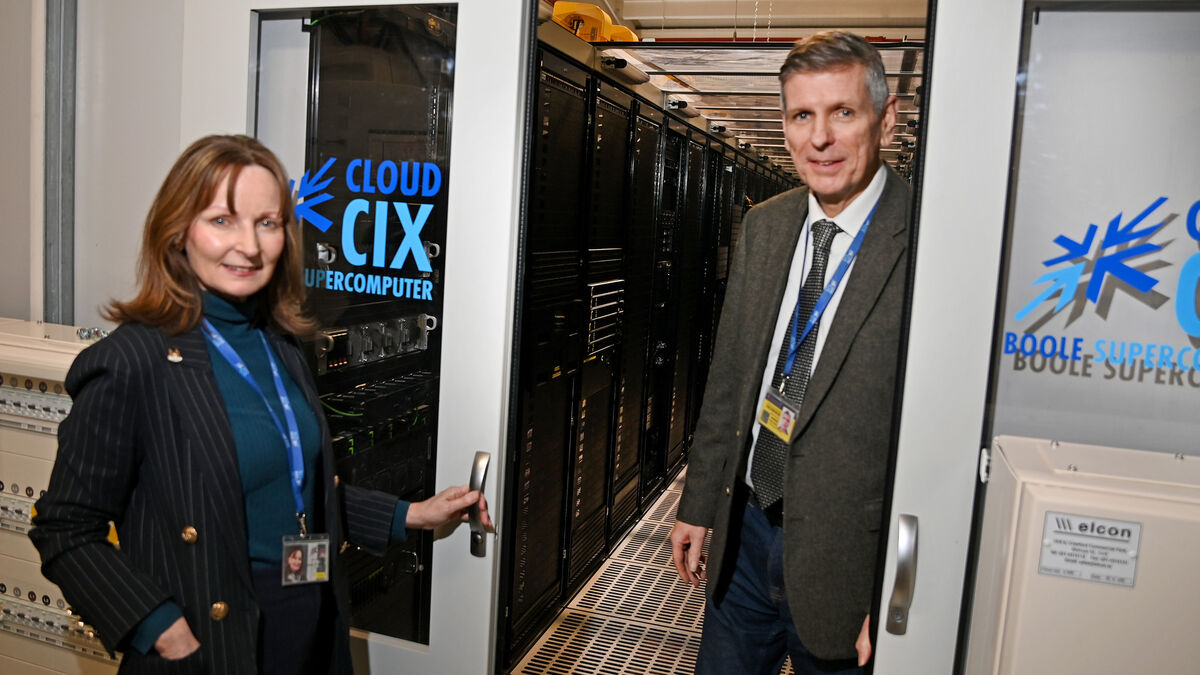
Located in Hollyhill, the facility provides a sovereign data-centre environment from where the system is hosted and made available to customers. Its systems are owned wholly by an Irish entity, hosted in Ireland and governed by Irish and EU law.
“This is extremely important for customers, who now know where their data resides and how it is accessed,” Mr Sweeney explains.
In January, the firm, which operates the industry-leading Boole Supercomputer, deployed Ireland’s first liquid-cooled Nvidia B200 system, introducing a new level of AI infrastructure capability into the country.
The system, one of the earliest of its kind in Europe, enables organisations to run advanced AI workloads locally rather than relying solely on global cloud platforms.
As Mr Sweeney explains: “the Boole Supercomputer operates entirely within Irish and EU jurisdiction, supporting GDPR compliance and alignment with the EU AI Act.”
The system is also liquid-cooled, which does not use any water. “This means it can run 15% faster and saves 15% more electricity,” Mr Sweeney tells the Irish Examiner.
Supported by Enterprise Ireland and in collaboration with academic partners including University College Cork (UCC), Munster Technological University (MTU), Technological University of Shannon (TUS) and the National University of Galway (NUIG), the system is designed for industry, start-ups, scale-ups, and applied research teams, with sectors known for data-intensive and compute-heavy workloads said to benefit the most from this type of infrastructure.
In tandem with this, CloudCIX also celebrated the launch of Guiden, a sovereign AI chatbot built on the French-developed Mistral Large 3, a large language model native to the EU and a direct competitor to the chatbots of the US’s magnificent seven, which include Meta, Alphabet, Apple, and Microsoft, among others.
In the wake of the most recent scandal involving Elon Musk’s X, formerly Twitter, whose AI chatbot Grok is now being investigated by EU authorities for its nudification feature enabling the digital undressing of people, including children, without consent, Mr Sweeney emphasises the need to move away from dangerous and less regulated models in favour of further control and sovereignty.
Looking forward, Mr Sweeney says from a research perspective, the work is done.
“We’ve identified the markets and what we want to achieve, which is sovereign EU infrastructure.” With EU directives coming down the line to improve clear red tape and enable further AI innovation, Mr Sweeney sees this as a key and trusted opportunity.
“The EU takes this stuff seriously, and there is a clear difference in standards between Europe and Grok,” the Cork-native argues.
“We should not have to deal with US companies. If we want to ensure sensitive data does not leave the country, we cannot rely solely on the magnificent seven.”
“The current shift in the US’s governance has accelerated the need for Europe to be independent,” Mr Sweeney also noted.
“The EU has had a wake-up call: The need for sovereign AI is critical.”