

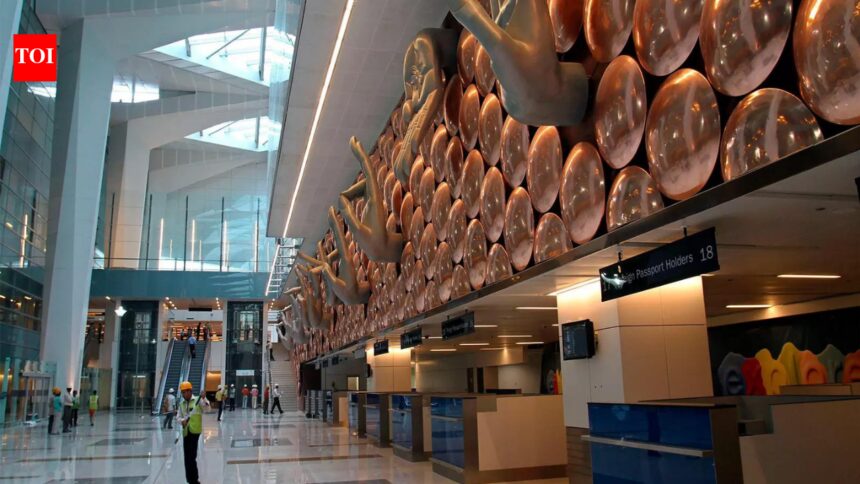
NEW DELHI: Passengers flying in and out of Delhi will see some major changes at Indira Gandhi International Airport in the next two-three months. The blueprint for ensuring a slightly smoother approach to India’s busiest flying hub could also be laid during this period by planning a flyover between terminals 1 and 3 for signal-free access on wider roads.The long-awaited air train for inter-terminal transfers is, however, stuck with little chance of it becoming a reality in the remaining one decade of GMR-backed Delhi International Airport Ltd’s (DIAL) first 30-year concession period that ends in 2036. The upcoming Golden Line of Delhi Metro, which will link T1 to Aerocity, is now being seen as the possible mode of transfer.TOI takes a look at what will change by March-April at IGIA and what will remain unchanged, at least for now.
BCAS, DGCA Nod Sought; Govt Looks To Boost Traffic Flow On Runway Tunnel Road
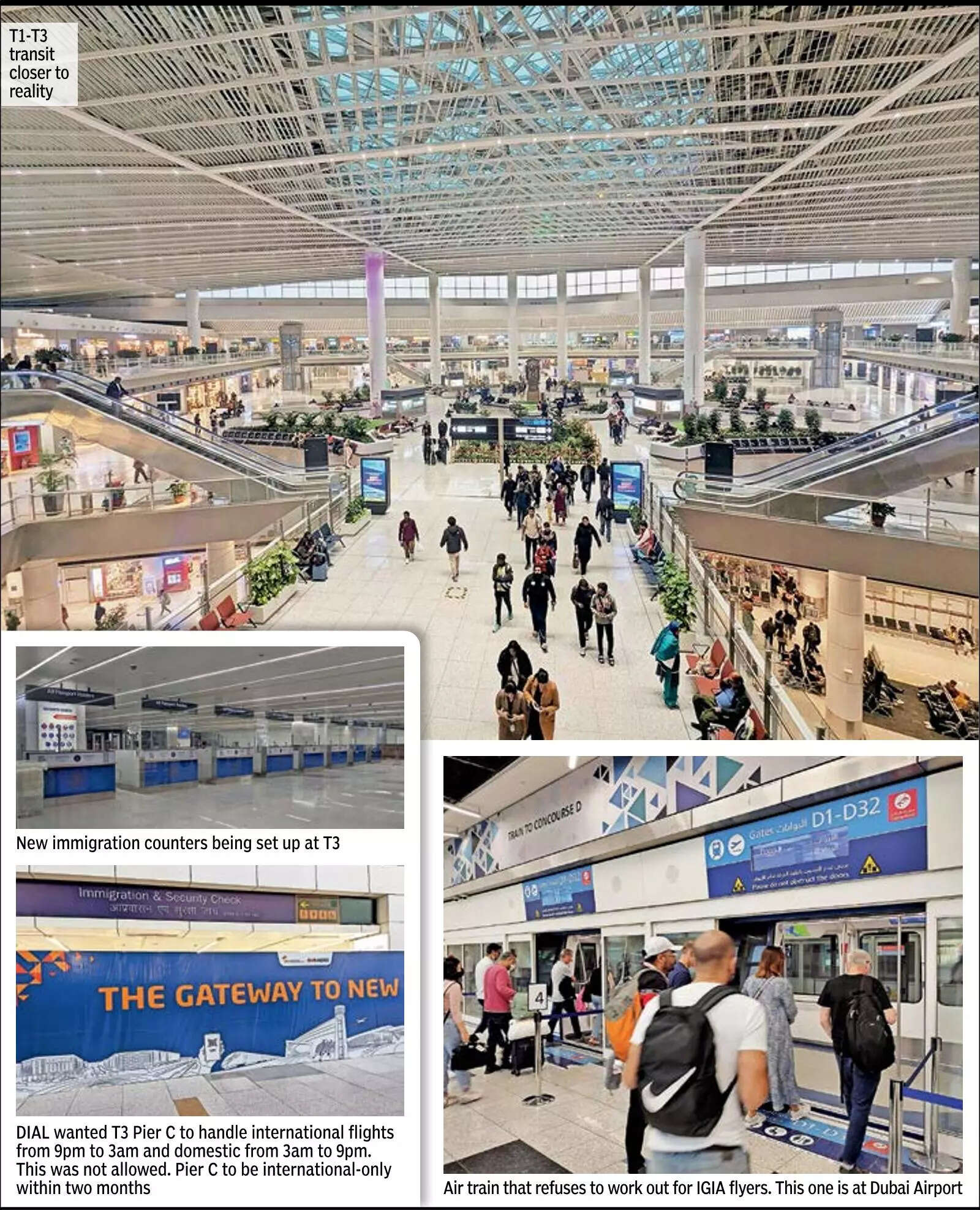
Airside transfersDIAL has sought Bureau of Civil Aviation Security’s (BCAS) nod to start airside transfer of domestic-to-international and vice-versa passengers between T1 and T3, about eight km apart. It has also sought clearance from Directorate General of Civil Aviation (DGCA) as these buses will cross some taxiways. While BCAS will examine the move from security angle, DGCA will look at it from an aviation safety perspective. Domestic-to-domestic transfer passengers will continue to be ferried by buses from the city side between T1 and T3. DIAL is also getting the T2-T3 airside linkage examined by multiple technical experts from various angles, including the structural integrity impact of any intervention in T2. This transfer may happen by the middle of this year.“DIAL has applied for BCAS clearance for airside transfers between T1 and T3. Hopefully that should be in place by March and airside transfers of domestic to international and vice-versa may start by April,” said people in the know.Among IGIA’s three terminals, T3 is the only one that handles international flights while T1 and T2 are all domestic. Going ahead while T1 will remain all domestic and for low-cost carriers, the proposed T4 that will eventually be built in place of the 1986-era T2 may handle both domestic and international flights. However, when the process of razing down T2 and starting work on T4 starts remains to be seen. DIAL will wait to see the impact of the long-delayed Noida Airport on the IGIA footfall. Another reason for T2 getting another extension is DIAL’s 2036 timeline. DIAL can get a 30-year extension till 2066 if the then govt agrees. But big ticket decisions may have to wait till then.Pier C international by MarFour govt agencies – BCAS, Central Industrial Security Force, immigration and Customs – are giving final touches to the process of converting T3’s Pier C from all domestic to all international. DIAL expects all the clearances in Feb and then Pier C can start handling international flights by March.The airport operator had toyed with the idea of having ‘swing gates’ for Pier C. That would have meant this pier handling international flights at night peak hours and domestic flights during the day. However, this was not approved due to fears of domestic and international passengers getting mixed up.This summer, T3 should have three piers – A, B, C – for international flights and only D for domestic.Consultant for widening roadPWD has appointed RITES as the consultant to study the old proposal for having a Y-shaped flyover between T1 and T3 along with widening the runway tunnel road. The report is expected by March-April. It will be sent to central govt for implementation under its urban development fund where Centre will fund 80% of the expense and the state 20%,” said sources. The wider road is needed as Aerocity will soon host one of India’s biggest malls and a larger commercial complex.Air train stuckDIAL’s about-a-decade-old proposal for having an air train for seamless transfers among T1, T2/3, Aerocity and the cargo terminal is firmly stuck. With just a decade left for DIAL’s first 30-year concession period, anyone bidding for the project will look at a six-seven-year window of recovering the investment as three-four years will be required to build the partially under, on and over-ground automated people mover. DIAL can’t make any financial commitment beyond 2036 till it gets another 30-year concession period.The upcoming Golden Line of Delhi Metro, which will link T1 and Aerocity via an 2.3km underground section, is the option now. With Aerocity already having a metro link to T3, the operator sees passengers transiting between T1 and T3 via Aerocity on two lines through a platform-to-platform transfer. It will, however, not be the same as a dedicated airport air train like that at New York JFK or Zurich or Dubai.