
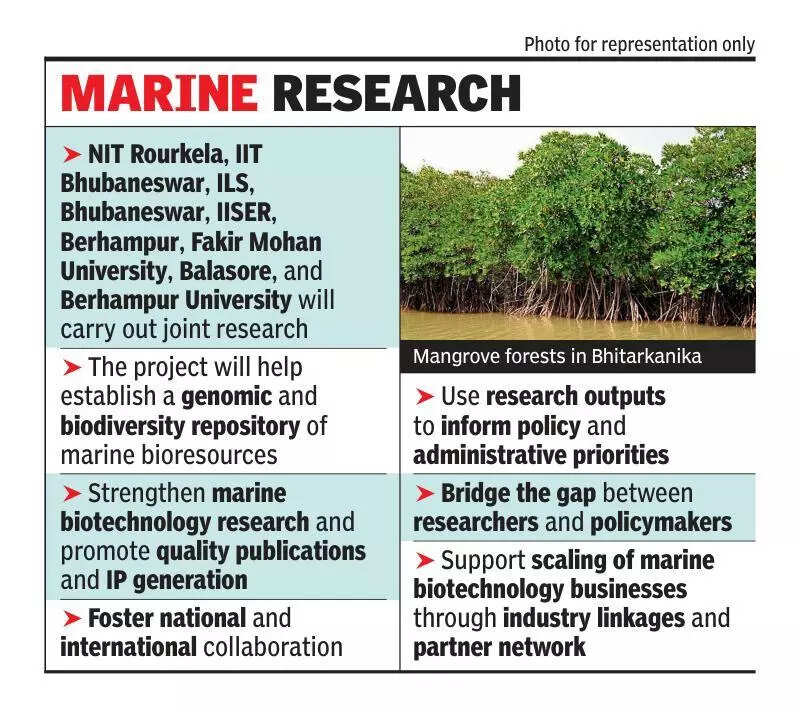
Chithra Arumugam, additional chief secretary (science and technology), said six institutes — NIT Rourkela, IIT Bhubaneswar, Institute of Life Sciences (ILS), Bhubaneswar, Fakir Mohan University, Balasore, IISER Berhampur and Berhampur University — will work towards a common goal of placing Odisha on the marine map for economic and knowledge advancement. “We conducted a number of consultations before signing agreements with these institutes to proceed with the project,” she added.Arumugam said IIT Bhubaneswar was tasked to map the entire 574-km-long Odisha coastline for bioresources availability and pollution monitoring. “It will use modern technology such as satellite images, GIS, remote sensing and drone technology with sensors to identify where bioresources are available and document technical details,” she added.She said the Balasore and Bhadrak coasts are well known for the availability of rare horseshoe crabs, and FMU will take a lead by developing a research centre on the blue-blood animal. “From the horseshoe crab, they can try to find some new molecule or some new protein which will help industry and humanity in some medicinal way or in some other way,” she added. She said Berhampur University will work on marine algae, seaweed, seagrass and marine fish. “The research will bring new things to the fore,” she added. Further, it will also focus on developing a scientific scuba diving training centre to explore the underwater marvels.NIT-R will look for high-potential marine microorganisms with tremendous potential for new enzymes, antibiotics, antioxidants, among others. They will also try to create designer synthetic media to culture the extremophilic marine microorganisms in the laboratory.“For any new potential novel bioactive compounds generated from the different marine bioresources, IISER Berhampur will conduct chemical and structural profiling of each of these organisms,” she added.ILS Bhubaneswar will study the genome sequence of all marine bioresources and create a state-of-the-art marine microbial biorepository, which will be the first of its kind in the state. Sashi Kanta Dash, deputy director, biotechnology, said the project will operate on a hub-and-spoke model with multiple partners and mentors. “The project will be closely monitored and guided by a team of renowned marine biotechnologists of the country. The project will lead to the establishment of at least six centres of excellence on different aspects of marine biotechnology and will help translating all the research activities into products for societal well-being,” he added. “The platform will also involve many PhD students, providing them space to work and develop their research skills. A number of high-quality research articles, products and patents are expected from the research. To add more value to the project, National Institute of Ocean Technology, Chennai will be our knowledge partner,” he added.