

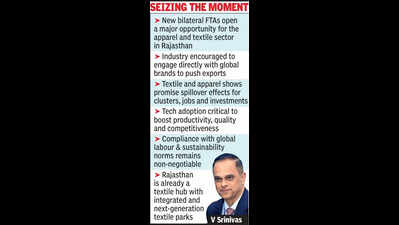
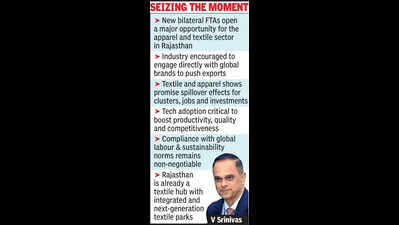
Jaipur: Following the Union Budget announcement to set up seven mega textile parks nationwide, officials of the Apparel Export Promotion Council (AEPC), led by its chairman A Shaktivel, visited Kota Saturday to assess prospects. While the council’s representatives declined to comment, govt sources confirmed Rajasthan’s keen interest to host one such mega textile park, citing the state’s strong industrial ecosystem and export potential.At a meeting with AEPC senior representatives and members of Garment Exporters of Rajasthan (GEAR) Friday evening, chief secretary V Srinivas urged the industry to seize the moment and convert momentum from India’s trade talks with the UK, EU and the US into export growth.Addressing exporters, Srinivas stressed the need for international outreach through flagship apparel and textile shows. “Along with Asia, we must be present in the US and Europe. A show in Los Angeles is essential, and we should also look at other major industrial capitals,” he said, adding that structured, brand-focused engagements must be the priority.Suggesting that Rajasthan could explore hosting a large-scale, apparel-focused show, given its growing industrial ecosystem, Srinivas said, “A large textile show has powerful spillover effects. Jaipur would be more than happy to host such an event”.On the employment potential of the sector, the chief secretary said, “Every additional $1 billion in textile exports creates nearly 10 lakh jobs,” while describing textiles as the country’s biggest employment generator after agriculture.He showcased the state’s strength by highlighting textile parks in Jaipur, Pali, the Kishangarh high-tech weaving park and the Rupaheli Textile Park at Bhilwara. He assured exporters that operational issues would be promptly addressed by state authorities.Despite global trade disruptions, Srinivas noted that job losses in the textile sector were contained as global brands continued sourcing from India. He also pointed to the Rajasthan Foundation and Pravasi Rajasthani networks across Europe and the US as vital bridges for international investors.Srinivas identified three pillars for growth: technology adoption, compliance and global outreach. Drawing from his experience with the Tirupur Apparel Park in Tamil Nadu, he said adherence to norms there was “remarkable”. On compliance, he recalled past challenges of child labour allegations, underlining that initiatives like DISHA were game changers. “Thousands of apparel factories across the country were brought under strict compliance frameworks, ensuring global standards were fully met,” he said.Amendments to the Shops and Establishments Act, labour codes and deregulation of working hours now allow factories to operate round the clock and even employ women during night shifts with necessary security provisions. “These reforms allow us to build large, globally competitive factories,” said Srinivas.