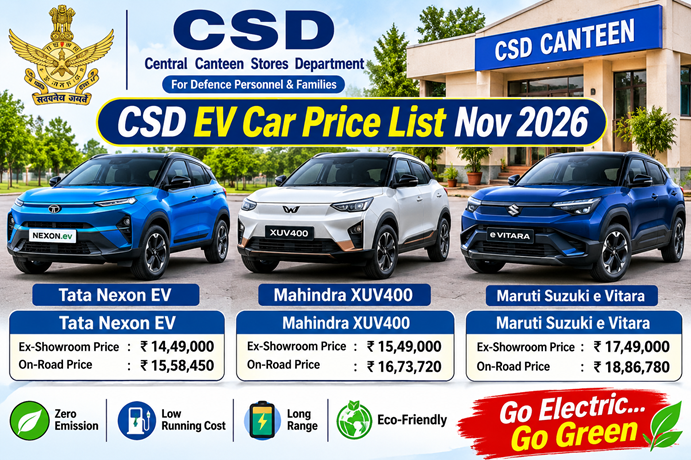
The Big Shift: Why CSD EVs Are Finally Making Sense in 2026
There was a time when buying an EV felt like a gamble. Range anxiety, lack of charging infrastructure, and high upfront costs deterred many buyers. However, as we look at the CSD EV Car Price List updated Nov 2026, the narrative has flipped. The Indian government’s aggressive push under the PM E-DRIVE scheme has stabilized the ecosystem, and manufacturers have localized production, bringing prices down significantly .
For the defence fraternity, the CSD route offers a dual advantage. First, you bypass the rising RTO charges and insurance premiums associated with conventional vehicles in many states (though EV road tax exemptions are becoming the norm). Second, the AFD portal has streamlined the process, allowing you to book specific variants of popular EVs directly. The November 2026 update is particularly crucial because it reflects the stabilization of supply chains post the festive season rush and incorporates the latest revisions from manufacturers like Maruti Suzuki, which has just entered the mainstream EV segment with the e Vitara.
If you have been holding off on switching to electric, this is the time to pay attention. The savings on the top-end variants of these cars can effectively cover the cost of a home charging setup and years of electricity bills. Let’s break down the exact numbers you need to know.
The Complete CSD EV Car Price List (November 2026 Update)
Note to Reader: The prices listed below are based on the CSD AFD (Against Firm Demand) portal data for November 2026. These prices are subject to change based on manufacturer revisions and GST updates. Always verify the final on-road price (including RTO and insurance) with your nearest CSD depot or the official AFD portal before booking.
1. Tata Nexon EV: The People’s Champion
The Tata Nexon EV remains the most accessible and popular choice among defence personnel. It strikes the perfect balance between a compact footprint for city cantonments and a robust build for highway drives. The November update shows two distinct trims available through CSD, catering to different budget ranges.
| Model / Variant | SKU | CSD Price Range (₹) | Approx. Ex-Showroom (for comparison) |
|---|---|---|---|
| TATA NEXON FEARLESS 45 | 64460 | ₹ 14,84,700 – ₹ 14,89,655 | ~₹ 15.34 Lakh |
| TATA NEXON EMPOWERED 45 | 64205 | ₹ 15,83,761 – ₹ 15,88,715 | ~₹ 16.34 Lakh |
Analysis: The “Fearless” variant is the sweet spot for most buyers. It offers the larger 45 kWh battery pack (which provides a real-world range of over 350 km) without the premium price tag of the top-spec Empowered trim. At a CSD price of under ₹14.9 Lakh for the Fearless, you are saving a significant amount compared to the standard ex-showroom price, effectively getting the benefits of a higher trim for the price of a lower one.
2. Mahindra XUV400 EV: The Torque Monster
For those who prioritize performance and a slightly more rugged SUV feel, the Mahindra XUV400 is a compelling option. It is larger than the Nexon and offers a more powerful motor. The CSD list features the “EL Pro” variants with the 39.4 kWh battery, which is the more practical choice for daily driving and occasional inter-city trips.
| Model / Variant | SKU | CSD Price Range (₹) | Approx. Ex-Showroom (for comparison) |
|---|---|---|---|
| MAHINDRA XUV400 EL PRO FC (39.4 kWh, 7.2 kW Charger) | 67356 | ₹ 15,18,958 – ₹ 16,05,003 | ~₹ 16.74 Lakh |
| MAHINDRA XUV400 EL PRO FC DT (Dual Tone) | 67357 | ₹ 15,38,609 – ₹ 16,24,664 | ~₹ 16.94 Lakh |
Analysis: The XUV400 is a driver’s car. The 39.4 kWh battery in the EL Pro variant offers a good mix of range and affordability. The dual-tone (DT) option adds a bit of flair for a marginal premium. If you are posted in an area with hilly terrain or often travel with a full load of family and luggage, the XUV400’s extra torque and slightly larger cabin might justify the slightly higher price tag compared to the Nexon.
3. Maruti eVitara: The Newcomer with a Premium Touch
The biggest news in the CSD EV Car Price List updated Nov 2026 is the inclusion of the Maruti Suzuki eVitara. This is Maruti’s first serious foray into the mainstream EV space, and it comes with the brand’s legendary reliability and an upmarket interior. The CSD list includes four variants, ranging from the practical Delta to the fully loaded Alpha.
| Model / Variant | SKU | CSD Price Range (₹) | Approx. Ex-Showroom (for comparison) |
|---|---|---|---|
| MARUTI EVITARA EV DELTA 49 KWH | 65379 | ₹ 15,58,836 – ₹ 15,61,640 | ~₹ 16.19 Lakh |
| MARUTI EVITARA EV DELTA ZETA 61 KWH | 65380 | ₹ 17,40,715 – ₹ 17,43,519 | ~₹ 17.94 Lakh |
| MARUTI EVITARA EV ALPHA 61 KWH | 65382 | ₹ 19,39,759 – ₹ 19,42,564 | ~₹ 20.21 Lakh |
| MARUTI EVITARA EV ALPHA 61 KWH DUAL TONE | 65381 | ₹ 19,40,072 – ₹ 19,63,924 | ~₹ 20.21 Lakh |
Analysis: The eVitara is positioned above the Nexon and XUV400 in terms of cabin quality and refinement. The 61 kWh battery pack on the Zeta and Alpha variants offers a significantly longer range (over 400 km real-world), making it the best choice for personnel who frequently undertake long journeys between stations. The Delta variant with the 49 kWh battery is an excellent value proposition for city-centric users, offering Maruti’s fuss-free ownership experience at a competitive CSD rate.
Decoding the “Additional Incentives”: The 5 Lakh Loophole
While the price list is straightforward, the fine print on the CSD EV policy is where the real advantage lies. The official guidelines state a crucial point: “Beneficiaries will be entitled to purchase EVs costing up to 5 Lakhs more than the limits stipulated in the table above.”
What does this mean in practical terms? The CSD has set certain car price slabs based on your rank and entitlement. Typically, officers and JCOs have different ceilings. This clause means that if your entitlement allows you to buy a car worth, say, ₹15 Lakh, you can actually purchase an EV worth ₹20 Lakh through the CSD. The government is actively incentivizing the shift to electric by relaxing the price caps.
The “First EV” Rule and the 8-Year Wait:
The policy also introduces a specific timeline for EV adopters. It states that beneficiaries purchasing an EV for the first time can do so after six years of their previous four-wheeler purchase. However, the subsequent purchase (whether EV, Petrol, Diesel, or Hybrid) is permitted only after a gap of eight years.
This is a critical planning point. If you bought your last car in 2021, you become eligible for a new EV under this scheme in 2027 (six years later). But if you buy that EV in 2027, your next car purchase (even if it is a petrol car for your spouse or child) will only be allowed in 2035 (eight years later). This policy is designed to lock in the EV transition for the long haul.
For a deeper dive into the official government stance on EV adoption and infrastructure, you can refer to the Press Information Bureau (PIB) updates on the PM E-DRIVE scheme .
The Real-World Savings: CSD vs. Civilian Market
To truly appreciate the CSD EV Car Price List updated Nov 2026, we need to move beyond the sticker price and look at the total cost of ownership.
1. The Upfront Savings:
As seen in the tables, the CSD price is generally ₹40,000 to ₹80,000 lower than the standard ex-showroom price for the same variant. For the Maruti eVitara Alpha, the saving is nearly ₹80,000. This is a direct, immediate benefit that you can put towards the down payment.
2. The Tax and Registration Savings:
Depending on your state of posting, EVs often enjoy waivers on road tax (RTO) and registration fees. In states like Delhi, Maharashtra, and Uttar Pradesh, this can mean an additional saving of ₹1.5 Lakh to ₹2 Lakh on a car priced around ₹20 Lakh. The CSD price does not include these RTO charges, so you must calculate your on-road price separately. However, the combination of CSD discount + EV tax waiver creates a massive gap between what you pay and what your civilian colleague pays for the same car.
3. The Running Cost:
This is the silent killer of petrol budgets. A typical petrol SUV like the Hyundai Creta or Kia Seltos costs roughly ₹7-8 per kilometer to run in city traffic. An EV like the Nexon or eVitara, when charged at home (using the subsidized electricity rates often available in cantonments), costs roughly ₹1 to ₹1.5 per kilometer. If you drive 1,500 km a month, you are saving upwards of ₹9,000 every single month. Over a 5-year loan tenure, that is nearly ₹5.4 Lakh saved on fuel alone.
Choosing the Right CSD EV for Your Posting
The “best” EV depends entirely on where you are stationed.
Scenario A: The Metro/Cantonment Dweller
If you are posted in a major city like Delhi, Pune, or Bangalore, your daily commute is likely stop-and-go traffic. Here, the Tata Nexon EV Fearless is the undisputed king. Its compact size makes parking easy, and the regenerative braking (which recovers energy in traffic) is highly effective. You can easily manage with a 15A plug point at home, and the extensive Tata charging network covers most metros.
Scenario B: The Highway Warrior
If your role requires frequent travel between units or you are posted in a semi-urban area with good highway connectivity, range becomes paramount. The Maruti eVitara Zeta (61 kWh) or the Mahindra XUV400 EL Pro are better suited. The eVitara’s longer range and comfortable ride quality make it a fantastic highway cruiser. The XUV400 offers a slightly more engaging drive for those who enjoy driving themselves.
Scenario C: The High-Altitude Posting
For those stationed in regions like Leh, Srinagar, or the Northeast, the cold weather can impact battery performance. While all modern EVs have thermal management systems, the Mahindra XUV400’s robust build and slightly higher ground clearance (compared to the Nexon) might offer more peace of mind on rough terrain. However, it is crucial to verify the availability of fast chargers on your specific route before committing.
Frequently Asked Questions (FAQs) on CSD EV Purchase
Q1: Can I book the Maruti eVitara through the CSD AFD portal right now?
A: Yes, the November 2026 update includes four variants of the eVitara. However, since it is a newly launched model, there might be a waiting period. It is advisable to check with your nearest CSD depot for the current delivery timeline.
Q2: Does the CSD price include the cost of the home charger?
A: Generally, the CSD price covers the vehicle (with the standard charging cable). The installation of a dedicated 7.2 kW AC fast charger at your home is usually an additional cost, which varies based on your location and the vendor. Some manufacturers offer it as a bundle, but it is best to confirm this with the dealer handling your CSD file.
Q3: What happens to the warranty if I buy through CSD?
A: The warranty is exactly the same as if you bought the car from a civilian showroom. The CSD is simply a procurement channel. Your vehicle will be registered in your name, and all service records will be maintained by the authorized dealership.
Q4: Can I get a loan for the CSD price amount?
A: Yes. Most major banks (SBI, HDFC, ICICI) and the CSD’s own tie-ups offer attractive car loans for defence personnel. The loan is typically sanctioned on the final on-road price (CSD price + RTO + Insurance). Since the CSD price is lower than the market price, the loan-to-value (LTV) ratio is often more favorable for you.
Q5: Is the 5 Lakh relaxation applicable to all ranks?
A: The relaxation applies to the entitlement limits. If your rank entitles you to a car costing up to ₹10 Lakh, you can technically buy an EV costing up to ₹15 Lakh under this clause. However, the specific implementation might vary slightly based on the latest CSD circular. Always cross-check with the official CSD price list PDF or your unit’s CSD representative.
The Verdict: Is the CSD EV Route Worth It in 2026?
Absolutely. The CSD EV Car Price List updated Nov 2026 represents a convergence of favorable factors: aggressive government incentives, a maturing product lineup from trusted brands, and the inherent financial benefits of the CSD system.
If you are due for a car purchase in the next 6–12 months, the electric route is no longer a compromise. You are not sacrificing space, features, or safety. In fact, the Nexon, XUV400, and eVitara are among the safest and most feature-rich vehicles in their respective segments.
The key takeaway is to plan your purchase around the 6-year/8-year rules. If you are eligible, the financial argument is overwhelming. You are saving on the purchase price, saving on fuel, and saving on maintenance (EVs have far fewer moving parts). The only real “cost” is the slight adjustment to your lifestyle—plugging in at night instead of visiting a petrol pump. For the defence community, which is accustomed to discipline and routine, this is a minor adjustment for a major financial win.