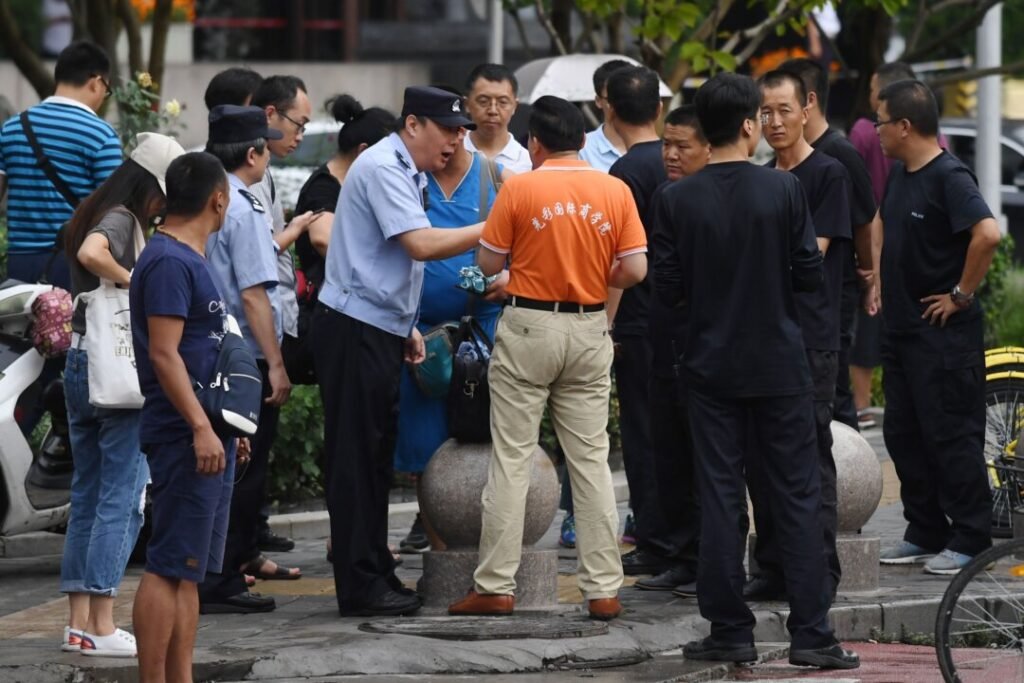
A former judge’s attempted suicide underscores the growing desperation among Chinese petitioners after new rules further limited their ability to seek redress in the capital.
Guo Youxian, a former judge at the Heshan District Court in Yiyang, Hunan Province, along with two other petitioners, had planned to end their lives by jumping into a lake at Beihai Park—a historic imperial garden in central Beijing—on Oct. 11, according to China-based rights activist Wang Xiuying.
Their plans were thwarted when two disabled petitioners intervened and persuaded them not to carry out the act, Wang told The Epoch Times.
The introduction of new petitioning rules this summer, which require written documentation from provincial authorities before petitioning in Beijing, has made it more difficult for individuals to pursue their complaints.
Petitioning is an administrative procedure under the communist regime to seek redress of grievances. However, in practice, petitioners are oftentimes persecuted and suppressed for expressing dissent.
Guo has engaged in repeated administrative petitions, formal court appeals, and legal procedures for more than a decade to challenge decisions made by local authorities. But the legal framework has failed to yield a final resolution or remedy for his grievance, he previously told the Chinese-language edition of The Epoch Times.
Related Stories


The former judge said he was persecuted because he refused to handle unjust cases according to the wishes of the authorities. He was later arrested and tortured to extract a false bribery confession.
He described wrongful convictions and judicial miscarriages as deliberate rather than accidental, the work of corrupt legal officials acting in concert under the protection of powerful backers.
In an article by Wang, she drew parallels between Guo’s experience and her own, showing the difficulties ordinary citizens face when seeking justice through the Chinese communist regime’s legal system.
Wang said the deeper problem was the failure of formal channels for seeking redress.
“When ordinary people are driven to a dead end, the root cause is that legitimate channels for defending their rights have long been spinning their wheels. With nowhere to turn for help, they can only resort to extreme measures to attract attention,” she wrote.
She added that Guo’s case stands out in particular.
“Sadly, Guo Youxian, a judge who once wielded the gavel, is also trapped in a wrongful case. After 10 years of appeals, he still has no result,” Wang wrote. “This is a warning that injustice does not target only ordinary people.”
Wang argued that public trust in the rule of law hinges on whether wrongful convictions and unjust rulings can be rectified. When citizens who suffer injustice are left without legal recourse, the damage extends far beyond their individual lives, ultimately undermining the credibility of the entire judicial system.
New Rules
The National Public Complaints and Proposals Administration issued “Measures on Further Standardizing the Registration of Public Visits,” which took effect on July 1. The rules generally direct petitioners to submit complaints in writing or visit designated reception offices at the appropriate lower administrative level before heading to Beijing.
The regime says the measures are intended to resolve legitimate complaints locally, improve the handling of petitions, and maintain orderly procedures.
However, some petitioners and rights advocates say the rules could further restrict access to central authorities when local officials fail to address alleged abuses.
For people who have spent years pursuing complaints without a satisfactory response, the prospect of losing another avenue of appeal can deepen their sense of hopelessness, Wang said.
On Sept. 18, nine petitioners jumped into a waterway near the National Public Complaints and Proposals Administration in Beijing. Four died, and five were injured, according to accounts circulated on Chinese social media.
A Chinese-language account on X, @Cyberxinfang, which documents petitioning cases in China, publicly solicited evidence to corroborate reports of the Sept. 18 incident.
The incident cannot be independently verified by The Epoch Times.
Jiang Jiawen, a petitioner from Liaoning Province, told The Epoch Times that petitioners resort to suicide in a desperate effort to draw the attention of senior officials after exhausting other options.
He described people traveling long distances to Beijing, spending their savings and enduring years of hardship to seek an explanation or resolution for what they consider legitimate grievances.
“But from the local level to the central level, no one gives you an explanation, let alone solves the problem,” he said.
Li Xi contributed to this report.