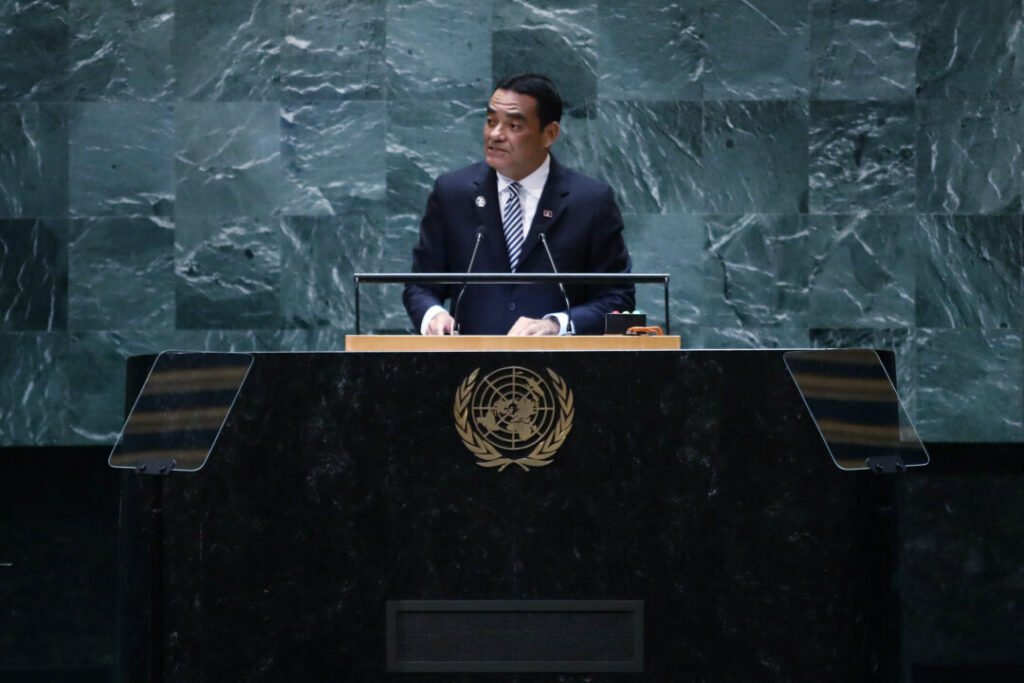
The U.S. State Department condemned Beijing’s “coercion and aggression” toward Taiwan’s diplomatic allies on Oct. 12 in response to Chinese sanctions against ministers from Paraguay and Belize.
“The Trump Administration opposes coercion and aggression by China against countries in our hemisphere for exercising their sovereign rights,” U.S. State Department spokesperson Tommy Pigott said in a statement.
“We stand with our friends and partners, including Taiwan, to advance our shared prosperity, security, and values,” Pigott added.
The United States and Taiwan enjoy a robust relationship despite a lack of formal diplomatic relations. Under the Taiwan Relations Act, Washington remains Taipei’s primary arms supplier for its self-defense.
Related Stories


Belize’s foreign ministry condemned China’s sanctions, urging all states to “refrain from unilateral coercive measures against officials of other states,” according to a statement on Oct. 12.
“Belize is a sovereign and independent state,” the ministry said. “Under the Charter of the United Nations, every state has the right to conduct its foreign policy free from external pressure.”
Belize’s foreign ministry also highlighted its longstanding diplomatic ties with Taiwan, established in 1989, saying bilateral cooperation in health, education, infrastructure, environment, and agriculture had benefited the Belizean people.
“These measures will not alter Belize’s foreign policy, nor will they deter the Government from carrying out its responsibilities. The Government of Belize continues to stand fully behind Minister Fonseca,” Belize’s foreign ministry added.
Paraguay’s ministry of external relations said in an X post on Oct. 12 that China’s decision had created “unnecessary friction” with the country, according to a translation. It reaffirmed the country’s “steadfast support” for Taiwan and its commitment to democratic values and principles.
“No external sanctions dictate our decisions,” Villate said in an X post on Oct. 12, according to a translation.
Paraguay and Taiwan have maintained diplomatic relations since 1957. In May, Paraguayan President Santiago Peña Palacios visited Taiwan for the fourth time.
Under the sanctions, Villate and Fonseca are prohibited from entering China, including Hong Kong and Macao. The measures are largely symbolic, however, as officials from Taiwan’s diplomatic allies generally do not travel there.
On Tuesday, Mao Ning, a spokesperson for China’s foreign ministry, criticized Pigott’s remarks during a daily briefing, saying that the United States should “handle the Taiwan question prudently.”
Taiwanese Deputy Foreign Minister Chen Ming-chi told reporters at parliament in Taipei on Tuesday that China was extending its practice of “transnational repression” to Taiwan’s allies.
The Republic of China, Taiwan’s official name, and the People’s Republic of China “are not subordinate to one another,” a fact that is “internationally recognized,” Chen said.
Chen added that it was only natural for Taiwan to “engage with the international community on the basis of its sovereignty as a state,” but said Beijing had “continued to suppress such efforts.”
Given Taiwan’s growing international visibility, Beijing will be “increasingly busy,” Chen said, before asking, “Are they going to sanction the whole world?”
Also speaking at Taiwan’s parliament on Tuesday, Taiwanese Premier Cho Jung-tai condemned China’s decisions, saying Beijing has “no right to interfere in the domestic affairs of or influence the foreign relations of any sovereign, independent country in the world,” including Taiwan.
“Taiwan will continue to strengthen cooperation with its diplomatic allies and democratic partners to safeguard freedom, democracy, and human rights, as well as regional peace and security, while resisting the expansion of hegemonic and authoritarian powers,” Cho added.
Reuters contributed to this report.