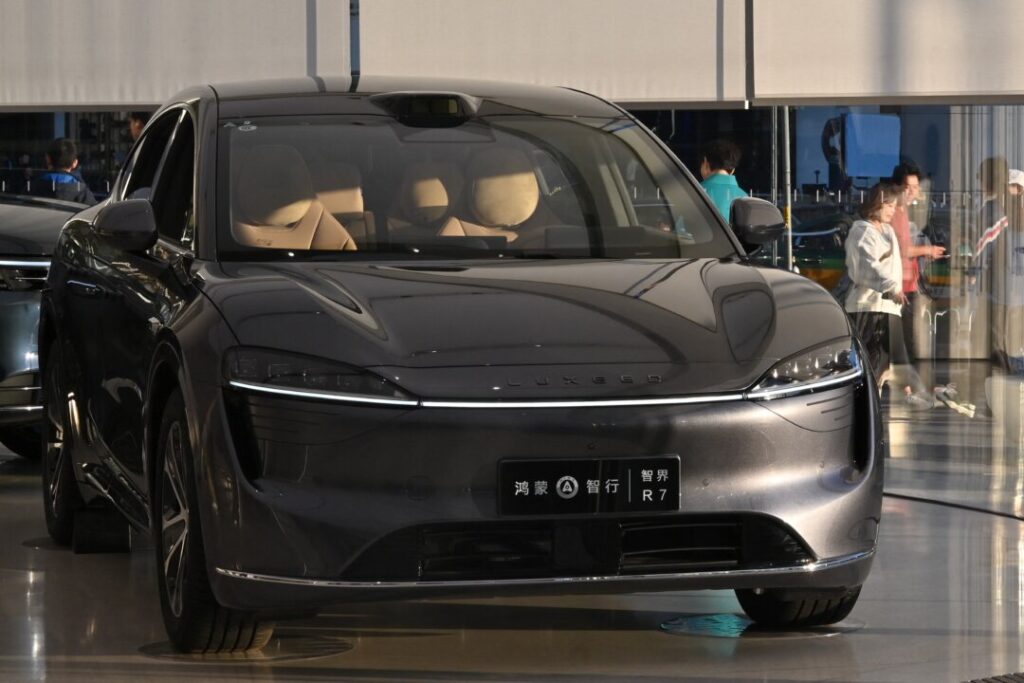
China’s automakers are increasingly turning to overseas markets as domestic sales slump and factories operate below capacity, intensifying competition with foreign manufacturers already facing an influx of Chinese-made vehicles.
Domestic vehicle sales in China fell 26 percent in September from a year earlier, while exports surged 61.4 percent, according to figures released by the China Association of Automobile Manufacturers (CAAM) on Oct. 12.
China exported 1.05 million vehicles during the month, accounting for nearly 36 percent of total sales, up from roughly 20 percent a year earlier.
Despite the export surge, overall vehicle sales declined 8.4 percent.
The increase in exports offset only about 60 percent of the decline in domestic sales, according to CAAM’s data.
The industry’s growing dependence on foreign buyers comes amid substantial unused manufacturing capacity and falling profits.
Related Stories


European Union (EU) investigators have previously found that China’s electric-vehicle industry benefited from government subsidies and had far more production capacity than its domestic market could absorb.
Weak Domestic Demand, Excess Capacity
China’s automobile manufacturing industry operated at 70.8 percent of its production capacity in the second quarter of 2026, below the manufacturing sector’s overall rate of 73.5 percent, according to the China National Bureau of Statistics.
That means approximately 29 percent of the industry’s measured production capacity went unused.
The figures cover automobile manufacturing as a whole, including parts production, rather than vehicle assembly plants alone.
Financial pressure has also intensified.
Automobile manufacturing profits fell 16 percent during the first eight months of 2026 from a year earlier, even as revenue increased 2.9 percent, according to the National Bureau of Statistics.
The China Automobile Dealers Association’s passenger-car branch said in an Oct. 12 market report that exports have become an important source of sales and profit growth for manufacturers.
Some automakers now export more than half their vehicles, while the number with export shares approaching 70 percent is increasing, the association said.
The association also reported that domestic passenger-car retail sales fell 28 percent in September, with dealers facing weak consumer demand and continued pressure on their businesses.
Chery Group, one of China’s largest automakers, reported 207,814 overseas vehicle deliveries in September, representing approximately 71 percent of its total monthly sales of 292,308 vehicles.
Its overseas deliveries jumped by 51 percent from a year earlier.
Overseas Expansion Meets Trade Barriers
China’s excess vehicle production capacity has already prompted trade action in Europe.
In its 2024 investigation into Chinese battery electric vehicles, the European Commission (EC) estimated that Chinese manufacturers had annual production capacity of 9.18 million vehicles, including approximately 3.34 million vehicles’ worth of unused capacity.
The EC concluded that subsidized Chinese electric-vehicle imports threatened economic injury to European manufacturers.
The EU imposed additional countervailing duties on Chinese-made battery electric vehicles in October 2024.
Following talks with Chinese Commerce Minister Wang Wentao, European Trade Commissioner Maros Sefcovic said on Oct. 9 that the two sides had reached an understanding over the issue.
The deal was intended to reduce projected Chinese hybrid and plug-in hybrid vehicle exports to the EU by more than half over four years compared with a scenario without the arrangement.
Sefcovic said the arrangement could prevent several million Chinese vehicles from entering the European market over that period.
The EC has not publicly detailed the final implementation mechanism.
The commissioner said the understanding was an initial step toward rebalancing EU–China trade, with further negotiations planned and the EU prepared to use trade-defense measures if those talks fail to produce additional results.
The United States is also examining industrial overcapacity.
The investigations are examining whether government policies and industrial practices burden or restrict U.S. commerce.
Chinese electric vehicles already face steep U.S. tariffs and restrictions on connected-vehicle technology, limiting their direct access to the American market.
Chinese manufacturers nevertheless compete with American and other international automakers in overseas markets.