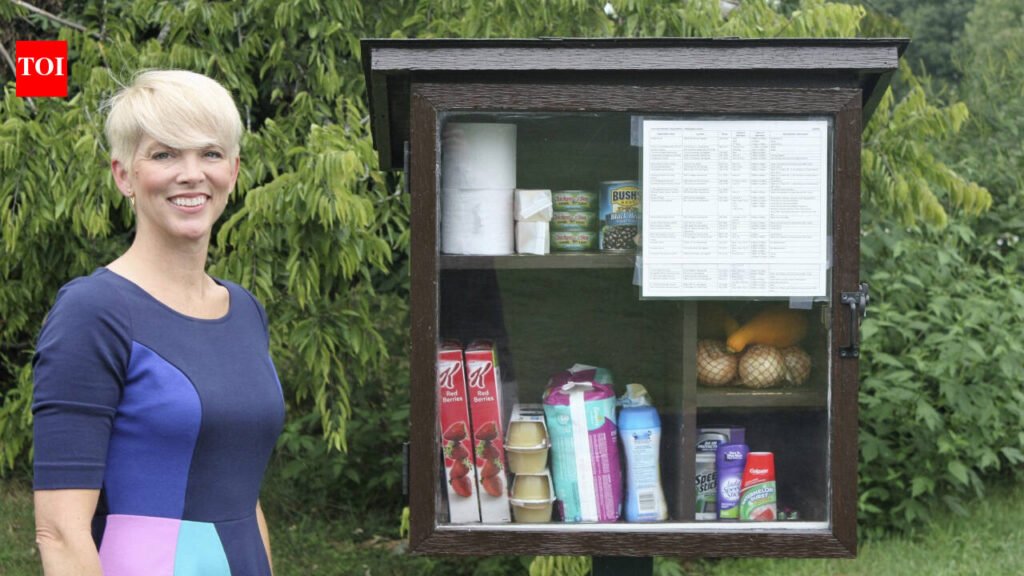
Sometimes an idea for helping people does not begin with a foundation, a fundraiser or a grand plan. Sometimes it starts with a small wooden box, a few cans of food and the simple realisation that a neighbourhood can look after its own. In Fayetteville, Arkansas, Jessica McClard was fascinated by the Little Free Library movement, which was bringing tiny book-sharing structures into neighbourhoods. She began wondering whether the same principle could be applied to something more immediate than books. What if people could share food, toiletries and everyday essentials in exactly the same way?In May 2016, that question became the Little Free Pantry and that slowly became a huge success. Scroll down to read this success story.
From books to basic needs
According to ABC News, McClard installed what she believed to be the first Little Free Pantry outside Good Shepherd Lutheran Church in Fayetteville. The small wooden structure was stocked with canned food, personal-care products, paper goods and other necessities. The model was deliberately uncomplicated. People who had something to spare could leave it. Anyone who needed something could take it. There were no forms, membership cards or complicated systems to navigate.The pantry quickly demonstrated how much demand existed for such a simple resource. Items that disappeared particularly quickly included deodorant, toothpaste, toothbrushes, diapers, feminine hygiene products, toilet paper and paper towels. Food remained important, but the experiment also highlighted how expensive everyday necessities can become when household budgets are stretched.
A community takes ownership
What made the pantry distinctive was not simply what was placed inside it, but what happened around it. As per the same report, people began adding school supplies for children and other useful items. The structure itself became something of a community canvas, with neighbours decorating it for occasions such as Memorial Day. The pantry was no longer just McClard’s project. It had begun to belong to the neighbourhood. Handwritten thank-you notes left inside the pantry became another small but meaningful sign of its impact. The reach also extended beyond the immediate area, with people travelling from other places to visit the original pantry.
A small idea spreads
The idea soon travelled beyond Fayetteville and Arkansas, developing into networks of mini pantries in communities across the United States and elsewhere. Some local networks began maintaining their own maps, including the Lowcountry Blessing Box Project and Pātaka Kai Open Street Pantries, adds the official website of Little Free Pantry. The wider movement now maps 2,301 mini pantries, illustrating how a hyper-local experiment can develop into a much broader community-driven network, the website adds.The project has also found connections with wider cultural and charitable initiatives. In 2021, the Little Free Pantry partnered with Celadon Books and the Jane Goodall Institute around the launch of Jane Goodall’s The Book of Hope, bringing the idea of everyday community action into a broader conversation about hope and collective responsibility.
The power of something small
The lasting appeal of the Little Free Pantry lies partly in its simplicity. It does not attempt to solve food insecurity through a sweeping programme. Instead, it creates a visible point where one person can help another without ceremony. Its success also reveals something easily overlooked about community support: people do not always need to be told how to help. Sometimes they simply need a place to put their generosity.Image Courtesy: The Chronicle of Philanthropy