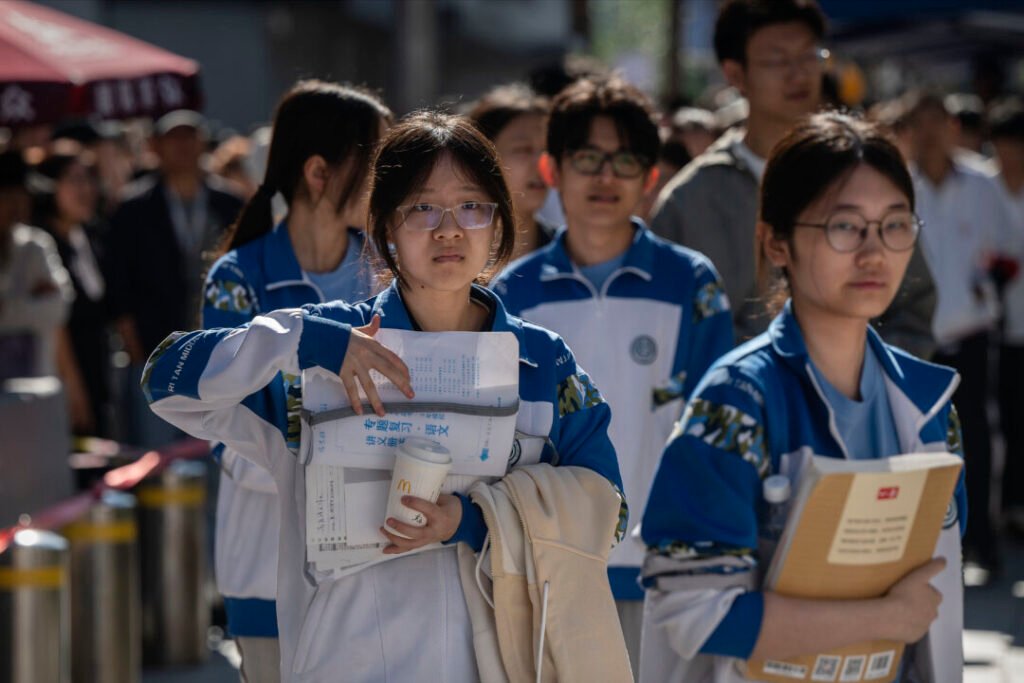
Several high schools in China’s Jiangsu Province extended this year’s National Day holiday to seven days amid reports of student suicides, prompting speculation that the longer break was a response to a series of deaths.
The reports have renewed concerns about intense academic competition, family pressure, and inadequate mental-health support among Chinese youths.
The post fueled speculation that the unusually long break was connected to recent student deaths. Some online claims alleged that as many as 30 students had died, while others referred to multiple deaths at individual schools in Nanjing and elsewhere. Those figures and specific accounts have not been confirmed by authorities.
Academic and Family Pressure
Related Stories


A 17-year-old high school senior in Zhenjiang, Jiangsu, told The Epoch Times that a friend at his school recently died after falling from a building. He said the school did not allow students to discuss the death and that posts about it were quickly removed from the internet.
“Don’t look for them; you simply can’t find them online,” he said.
The senior said his friend had previously told him several times that she could no longer endure the pressure. He said she died before the National Day holiday on Oct. 1.
The senior attributed the pressure to both school and family expectations. He said students in his school typically arrived around 7 a.m. and studied until 9 or 10 p.m., with examinations held frequently.
“I’m under pressure because of my parents, my relationship with my parents, and the pressure of studying. We’re all seniors, and the pressure is great,” he said.
The senior said his school notified students of the seven-day holiday only the night before Oct. 1. He associated the decision with several deaths that occurred at the time.
He said he had rarely seen a school counselor and that students generally had little access to mental health support.
Another Jiangsu high school student told The Epoch Times that his school had also experienced a student suicide. He said students faced long school days, beginning around 5:30 a.m. and continuing until about 10 p.m.
“The pressure is great for us. The main thing is worrying that we won’t be able to get into college,” he said.
A third Jiangsu high school student told The Epoch Times on Oct. 5 that three students at a middle school in Lianyungang, Jiangsu, had died after falling from a building before the National Day holiday. She said the school subsequently closed for seven days.
The pressure extends beyond individual schools. A college student in Nantong, Jiangsu, told The Epoch Times that students routinely face weekly, monthly, midterm, and final examinations, as well as frequent smaller tests.
She said some schools nominally observe holidays but encourage students to return voluntarily for additional study, sometimes requiring parents to sign forms.
“If you don’t sign and don’t go, the school will call you and make you feel that everyone else has gone, so your child cannot fall behind,” she said.
The college student said reports of student suicides were not isolated incidents.
“Actually, there are incidents every year; it seems every semester,” she said.
She said information about such incidents was often quickly suppressed, making the overall number difficult to determine.
Pressure Beyond Jiangsu
Similar reports have emerged outside Jiangsu. A junior high school student in Zhoukou, Henan Province, told The Epoch Times that student suicides became more frequent around major entrance examinations.
“One month before this year’s college entrance exam, someone at our school jumped again. This was the fourth one that month,” the junior high student said.
He said the student was academically outstanding and expected to score highly on the national college entrance examination, which made the death particularly shocking to students.
He said his school had installed protective barriers to prevent students from jumping from buildings.
A 2023 study published in the Chinese Journal of Public Health examined more than 20,000 middle and high school students ages 11 to 20 in five provinces. It found that 23.54 percent had engaged in some form of suicidal behavior, including suicidal thoughts, plans, or attempts. The study reported depression and anxiety detection rates of 19.70 percent and 13.97 percent, respectively.
The Chinese Ministry of Education introduced measures last year intended to strengthen student mental-health services, including reducing the frequency of routine testing.
Feng Chongyi, an associate professor in China studies at the University of Technology Sydney in Australia, told The Epoch Times that student suicides cannot be attributed to a single cause.
He cited China’s exam-oriented education system, excessive parental control, intense competition, economic pressures, declining expectations for the future, and a lack of spiritual support as factors that can accumulate over time.
Feng also linked the problem to a broader crisis of confidence among young Chinese.
He said that the regime’s communist propaganda had lost much of its credibility, leaving a widening gap between promises of an ideal society and young people’s experiences in reality.
Combined with intense competition for education and jobs, he said, those pressures have left many young people uncertain about their future.
Li Jing and Gu Xiaohua contributed to this report.