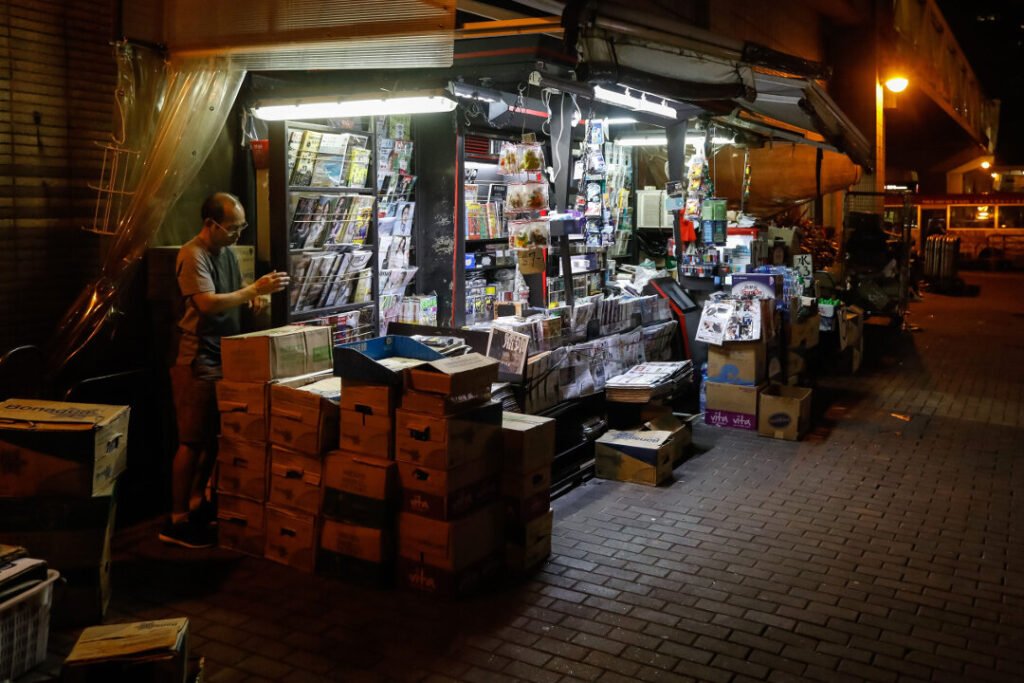
China’s prolonged economic slowdown is increasingly being felt at the household and small-business level, with people across several provinces describing weaker incomes, declining sales, and more cautious spending.
Interviews with The Epoch Times offer a glimpse into how the broader economic pressures are affecting everyday life, from small retailers and restaurants to tourism and self-employed workers. The interviewees spoke on condition of anonymity out of fear of reprisal.
A businessman in northern China’s Shanxi Province, surnamed Wang, told The Epoch Times that he accumulated about 1 million yuan ($150,000) in debt after his sizable electrical-equipment business declined following the COVID-19 pandemic.
He now works in a smaller solar-panel installation business and employs more than 20 workers. However, he said the work is irregular, and payments can be delayed for months.
“If there is work, I earn some money; if there is no work, not a penny comes in,” Wang said. “Sometimes I have to pay out of my own pocket to pay the workers.”
Weaker Demand and Price Competition
Related Stories

The pressure is also visible among small businesses, where owners say weaker demand and aggressive competition are making it increasingly difficult to stay profitable.
A convenience-store owner in Hubei Province told The Epoch Times his sales began deteriorating around the beginning of last year.
He said weaker consumer spending, online shopping, and intense competition have all hurt small retailers.
“Everyone is downgrading their consumption,” Yang said. “If they can avoid buying something, they don’t buy it.”
Yang operates the store from a rented property and said the business is no longer profitable. He is considering shutting it down and finding work elsewhere, although he is uncertain what kind of work he could find.
“I haven’t had a single day off in 365 days,” he said. “I’m tired.”
In Beijing, a restaurant owner surnamed Xiao recently closed her noodle shop and returned to her hometown in Henan Province. She said declining foot traffic and aggressive price competition had made the business increasingly difficult.
Her restaurant sold bowls of noodles for about 14 to 15 yuan ($2.20), but nearby competitors began offering much cheaper meals.
“Customers are saving money and choosing cheaper restaurants,” Xiao said.
A woman in Shandong Province who has operated a mobile-phone accessories and repair business for more than 20 years similarly described a sharp deterioration in sales.
“There are fewer people shopping, and fewer people are buying phones,” she said. “The economy has declined, and consumption has weakened.”
The slowdown is also affecting workers whose incomes remain well below previous expectations.
A young woman surnamed Ai, who works in the tourism industry in Fujian Province, told The Epoch Times that she recently took a second job at a supermarket to supplement her income.
“Everyone is earning less, so fewer people are going out to travel,” Ai said.
She said she has started budgeting her expenses carefully, which is becoming a common trend nowadays.
“People [only] buy what they need,” she said. “They are not as willing to spend freely as before.”
Regime Officials Urge Confidence
In late August, the Central Financial and Economic Affairs Commission issued a series of statements over four consecutive days emphasizing the need to restore confidence in the economy and markets.
Even an article in Hong Kong’s pro-Beijing newspaper Ming Pao questioned whether official statements alone could restore confidence, arguing that ordinary people continue to face difficult economic conditions, including weaker incomes and employment pressures.
Cai Qi, a member of the Chinese Communist Party’s top Politburo Standing Committee, also called for greater confidence during a late-August opening ceremony for the Party’s Central Party School’s fall semester.
Cai urged officials to “correctly view” China’s current economic situation, “strengthen confidence and stabilize expectations,” and “correctly understand and grasp the current situation and tasks.”
U.S.-based China current affairs commentator Li Linyi told The Epoch Times the language reflected growing concern among officials about the economy.
Li said that Cai had previously emphasized presenting a positive view of the economy and argued that his latest calls to “correctly view” and “correctly understand” the situation suggested that confidence among lower-level regime officials had weakened.
Tang Bing and Gu Xiaohua contributed to this report.