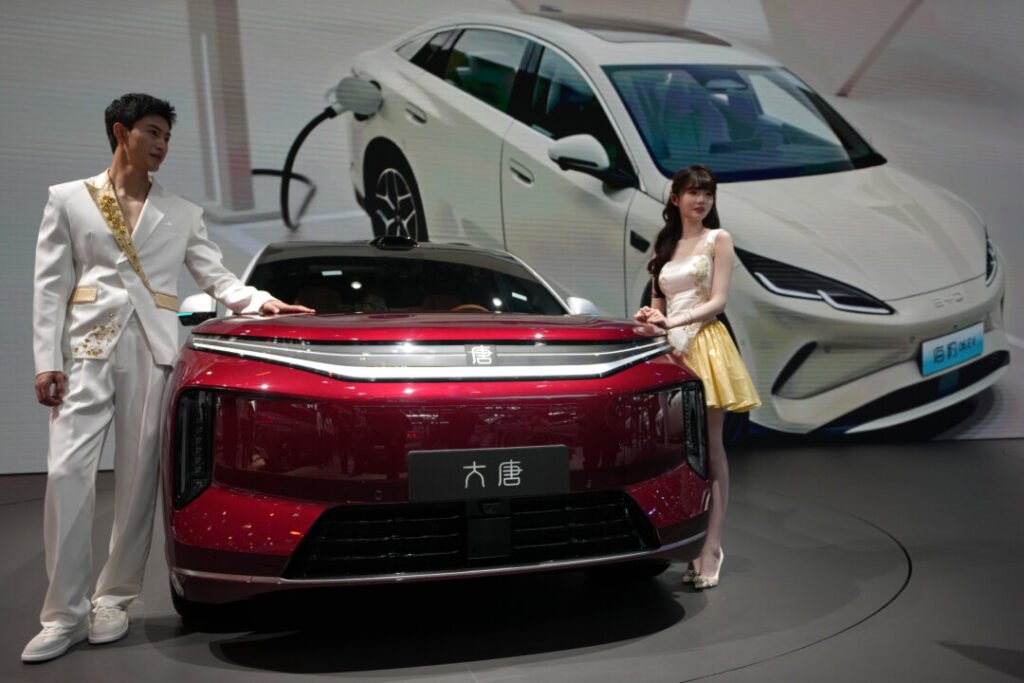
China’s rapid expansion of high-tech and green industries has yet to make up for the economic demand, jobs, and fiscal revenue lost as the country’s real estate market contracts, according to a recent International Monetary Fund (IMF) analysis.
The shift from property and traditional investments toward industries such as electric vehicles (EVs), AI, semiconductors, and other advanced manufacturing sectors is reshaping China’s economy. However, the emerging sectors remain too small and too capital-intensive to fully replace the broad economic role once played by real estate and traditional manufacturing.
At the same time, China’s property sales fell from about 18 trillion yuan ($2.68 trillion) in 2021 to roughly 8 trillion yuan ($1.19 trillion) in 2025.
The decline in property therefore has consequences well beyond developers and home sales.
“Demand gaps caused by the continued adjustment of real estate cannot be completely filled by rapidly growing new industries in the short term,” Li Tingqian, a China current affairs analyst, told The Epoch Times.
Related Stories
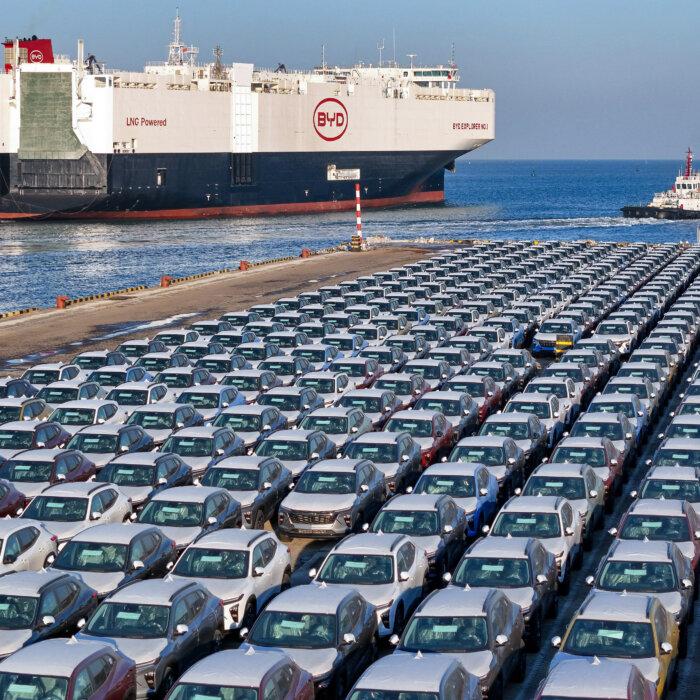

New Industries Grow as Traditional Sectors Contract
China’s property downturn has also affected industries that depended heavily on construction and property investment.
Chinese state media China News Service reported via news portal Sina on Sept. 20 that apparent steel consumption fell for five consecutive years from 2020 through 2025, declining 20.9 percent from its peak, citing data from China Iron and Steel Association.
Steel production fell 9.8 percent over the same period, from 1.065 billion tons to 961 million tons.
The pressure has continued into 2026. Major steelmakers reported about 16.7 billion yuan (about $3.9 billion) in profits from their core steel operations in the first half of the year, down 40 percent from the same period last year, according to the association. Fourteen of 22 publicly listed Chinese ordinary steelmakers reported losses during the period.
“Traditional industries are struggling,” Li said. “Take the steel industry as an example. This huge gap mainly comes from real estate.”
Meanwhile, Beijing has continued to promote sectors including AI, the low-altitude economy, aerospace, EVs, and other advanced tech industries.
However, these sectors do not necessarily generate employment at the same scale as the industries they replace.
“High-tech industries are mostly technology- and capital-intensive, such as AI, the low-altitude economy, and aerospace,” Li said. “They provide almost no help with general employment for the ordinary population.”
China’s National Bureau of Statistics (NBS) said in July that the country’s so-called “three new” economy—covering new industries, business models, and forms of economic activity—accounted for 18.39 percent of GDP in 2025.
That figure, however, does not mean that the sector employed a similar share of the workforce, Li said. Advanced manufacturing, renewable energy, semiconductors, robotics, and AI can generate substantial economic output with relatively few workers because of their high capital intensity and productivity.

A technician watches over humanoid robots from Chinese company UBTECH as they demonstrate their working skills in a mock factory-warehouse environment at the World Robot Conference in Beijing, China, on Aug. 20, 2026. Photo by Kevin Frayer/Getty Images
The Employment and Fiscal Challenge
The adjustment is particularly significant because traditional industries remain major sources of employment and tax revenue.
According to China’s fifth national economic census released by the NBS in 2025, manufacturing employed about 104.8 million people as of the end of 2023, accounting for 24.4 percent of such employment.
Construction employed another 51.2 million, while wholesale and retail employed about 53.3 million. Together, the three sectors accounted for nearly half of employment in China.
Manufacturing is also an important source of government revenue. The NBS reported that manufacturing accounted for about 31 percent of total tax revenue in 2025 and contributed 48 percent of that year’s increase in tax revenue.
However, China’s Finance Ministry acknowledged in its 2026 budget report that tax growth from traditional industries had slowed while the overall tax contribution from emerging industries remained relatively small.
Li said this creates a gap that rapid growth in new manufacturing has not yet closed.
“Traditional manufacturing’s tax base is weakening, while new manufacturing is growing rapidly, but its current size is still insufficient to completely replace the fiscal contribution of traditional industries,” he said.
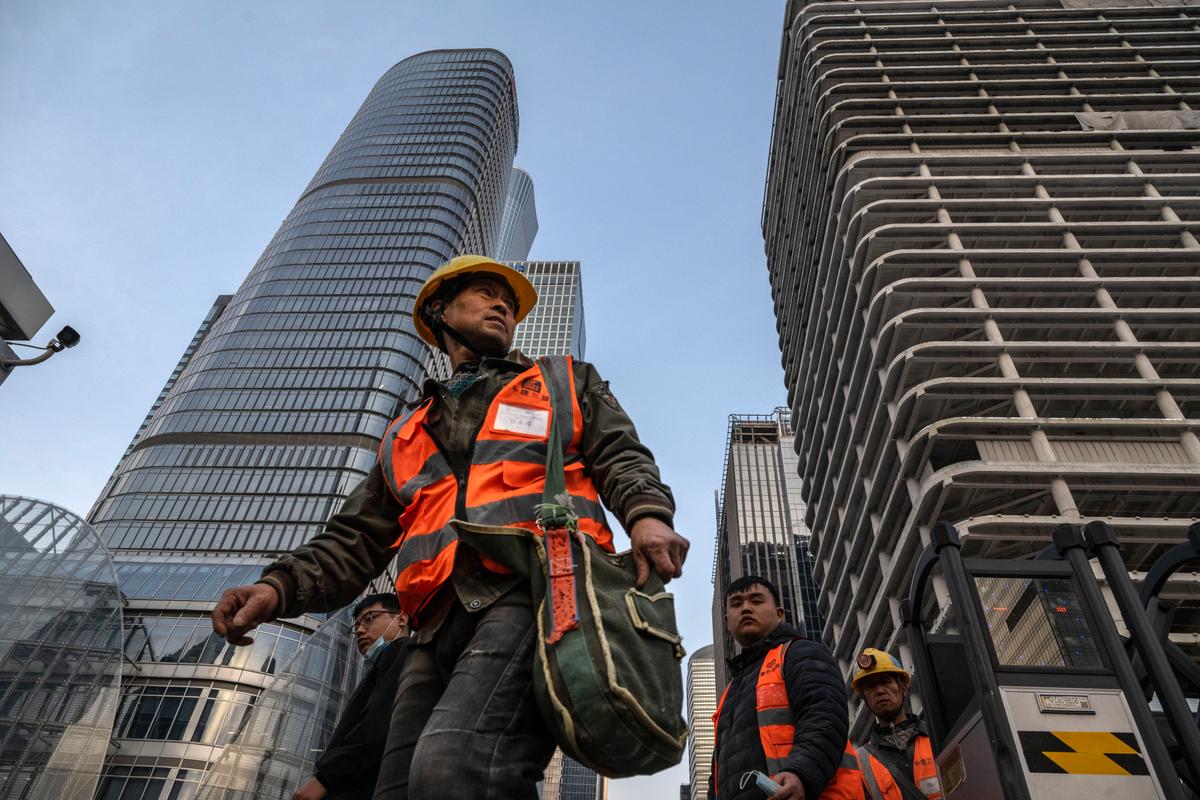
Construction workers leave a building site for a new office tower in the Central Business District in Beijing, China on April 3, 2025. Kevin Frayer/Getty Images
Why Transition Could Take Years
The IMF report argued that China’s economic transition requires more than expanding high-tech production. It called for measures to increase household incomes, strengthen social security, and encourage greater consumption of services.
The IMF also said China needs to address local government and property-related debt and repair balance sheets to improve credit conditions and domestic demand.
Household consumption accounts for about 40 percent of China’s GDP, according to the report, compared with an average of about 53 percent in middle-income economies.
Weak domestic consumption leaves Chinese companies more dependent on investment and overseas markets to absorb production.
“If domestic consumption growth continues to lag behind production capacity expansion for a long time, companies can only continue to rely on overseas markets, inevitably increasing external risks such as international trade friction and tariff barriers,” Li said.
That gap between the speed of industrial transformation and the slower recovery of household demand could remain a central challenge for China as its economy moves beyond its property-driven growth model, according to Li.
Li Jing contributed to this report.