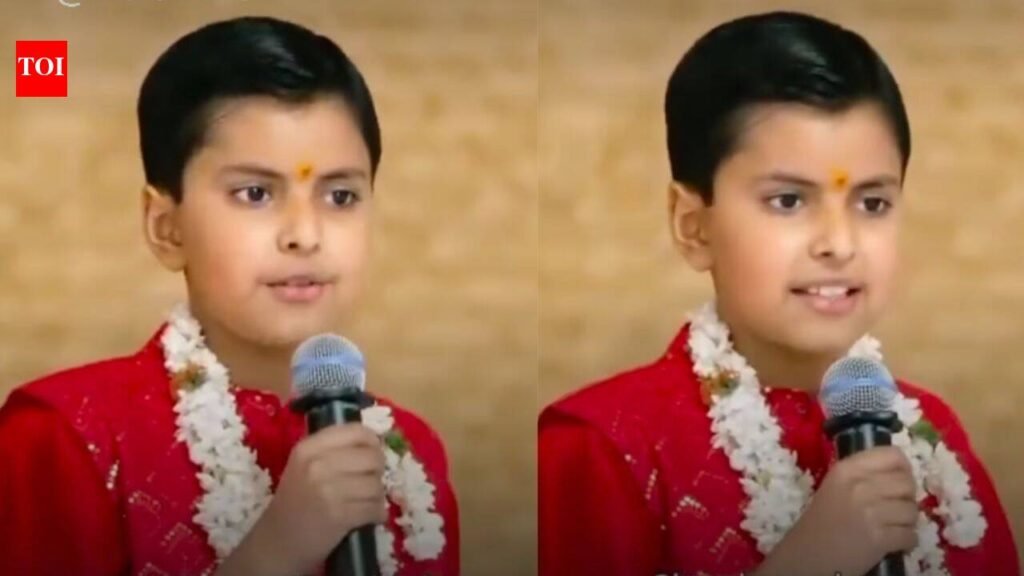
Vrishvardhan Sharma is a nine-year-old currently based in Bengaluru, with family roots tracing back to Patna on his mother’s side and Jaipur on his father’s side. What sets him apart is the sheer scale of what he has committed to memory at such a young age, not simply as recitation, but paired with grammatical understanding and meaning. At the age of five, Vrishvardhan memorised the entire Bhagavad Gita and was given the opportunity to recite it in full at Shringeri before Shankaracharya Vidhushekhar Bharati. A year later, at six, he won the National Gita Medal. Since then, he has reportedly completed more than 526 full Gita parayanas, chanting six chapters every morning while analysing each shloka grammatically.His most demanding achievement came at age eight, when he memorised the Ashtadhyayi, Panini’s foundational and famously complex work on Sanskrit grammar, comprising roughly 4,000 sutras, along with the Amarkosha, a classical Sanskrit thesaurus. For this, he reportedly won a national gold medal, competing against university-level postgraduate scholars. He has also attained the status of Ghanapathi for Shri Rudram, a highly advanced and rigorous mode of Vedic chanting.
22 Sept 2026 | 14:56
Does your child tell you everything about school? What helps them open up?
From ancient grammar to self-taught computer code
What makes Vrishvardhan’s story particularly striking is the second half of it. Alongside his classical training, he taught himself modern programming languages, including Python and C, entirely on his own. He has used these self-taught skills to build several real, functioning tools. His most notable creation is GitaVardhan, an app offering the complete Bhagavad Gita in thirteen Indian languages, featuring the commentaries of Adi Shankaracharya and Ramanujacharya. Every shloka in the app includes audio recitation in Vrishvardhan’s own voice, and the app works entirely offline, is free to use, and carries no advertising or user tracking. He has also built KannadaVardhan, a tool designed to help newcomers to Bengaluru pick up spoken Kannada naturally, and has engineered a pocket-sized, voice-activated offline Gita reader device, built in two separate versions, one with an e-ink screen and one with a touchscreen, with a third version reportedly in progress. Beyond apps and devices, he has also handwritten the complete Gita in eleven different Indian scripts as a personal project dedicated to the idea of Ek Bharat Shreshtha Bharat, or One India, Great India.
Recognition beyond social media
While much of Vrishvardhan’s recognition has spread through viral social media posts, he has also received notable, verifiable acknowledgement. He was featured on Vaartaavali, Doordarshan’s national weekly Sanskrit programme, where he was interviewed in Sanskrit, Hindi, and English. He has also appeared as a guest on The Pamphlet podcast, was welcomed by spiritual leader Gurudev Sri Sri Ravi Shankar at a felicitation event where he demonstrated his GitaVardhan app and device, and was separately felicitated on stage by the Bharatiya Janata Party’s Karnataka unit for his combined work in science and scripture. His competitive track record includes a silver medal at age six at a Central Sanskrit University event held in Ayodhya, competing against university-level students, followed by another silver at Haridwar, and reportedly a first-place finish in India’s Ashtadhyayi Kanthapatha recitation category at a national final held in Kanchipuram in March 2026, where he competed against participants aged eighteen to twenty-five.
A rare blend of tradition and technology
Vrishvardhan Sharma’s story stands out not simply because of his memory or his age, but because of how deliberately he has connected two very different worlds, ancient Sanskrit scholarship and modern software engineering, using one to make the other more accessible to others. At nine years old, he is not just preserving centuries-old texts in his own memory; he is actively building tools to help other people access that same knowledge, entirely free and without needing an internet connection.