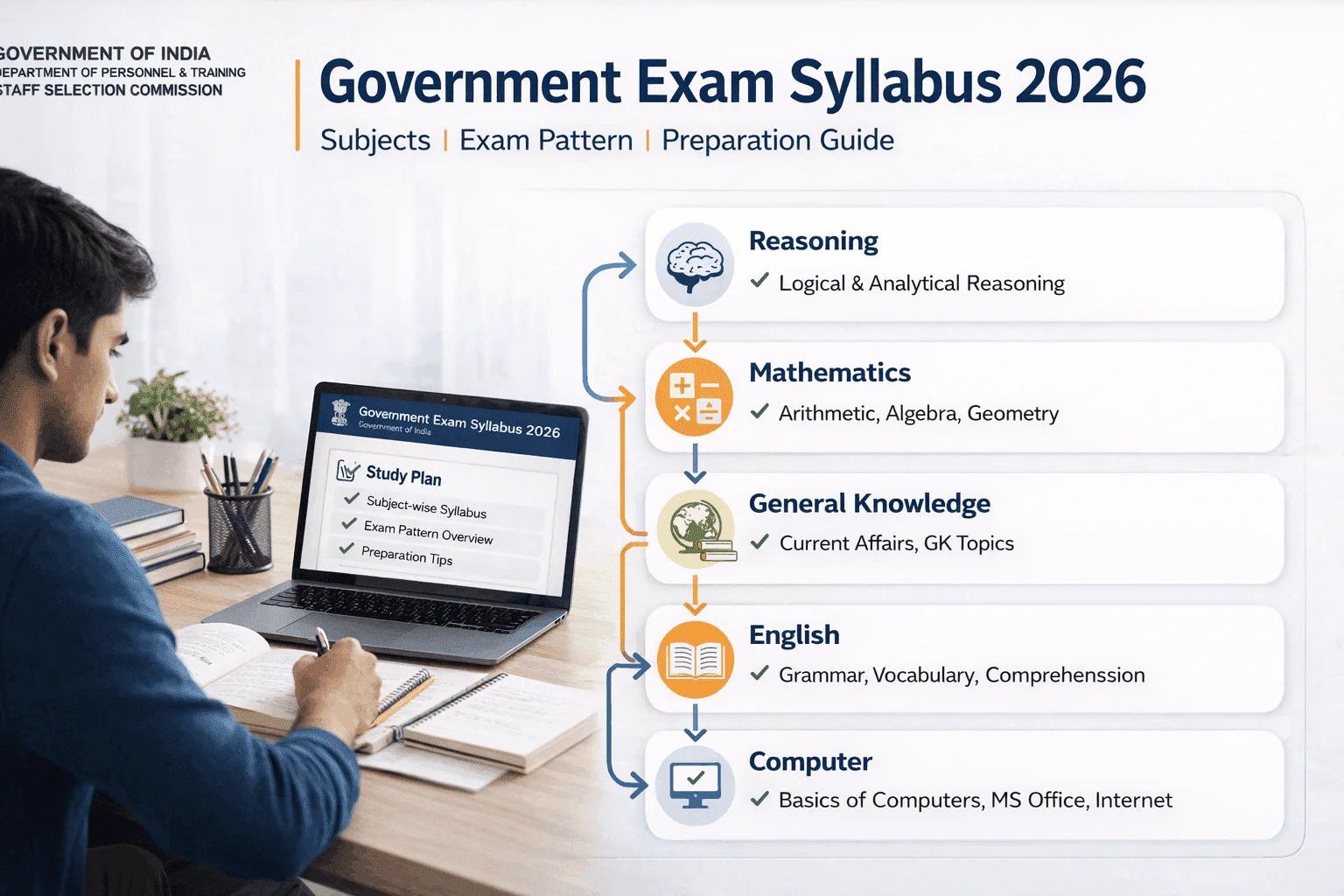
A syllabus is one of the most important resources for students and candidates preparing for an examination. It provides a clear overview of the subjects, topics, chapters and sections that candidates need to study. Whether you are preparing for a school examination, competitive exam, government job exam, entrance test or professional course, checking the latest syllabus should be one of the first steps in your preparation.
The syllabus helps students understand what to study, how much to study and which topics are important. It can also help candidates organize their preparation, select study materials and create an effective study timetable.
In this guide, we explain the meaning of syllabus, how to download the latest syllabus, how to understand the exam pattern, how to prepare according to the syllabus and what candidates should check before starting their preparation.
What Is a Syllabus?
A syllabus is an official or structured list of subjects, topics, chapters and units that are included in a course or examination.
For competitive examinations, the syllabus generally explains the subjects and topics from which questions may be asked. For school and university courses, it may include chapters, units, learning objectives, practical work and assessment details.
A syllabus can help students avoid studying unnecessary topics and focus their preparation on the prescribed curriculum.
Why Is the Syllabus Important?
Checking the syllabus before starting preparation is important for several reasons.
1. Helps You Know What to Study
The syllabus provides a clear list of subjects and topics. This helps candidates understand the complete scope of the examination.
2. Helps Create a Study Plan
Once you know the syllabus, you can divide topics according to available preparation time.
3. Helps Select Study Material
Books, notes, online classes and practice papers can be selected according to the topics mentioned in the syllabus.
4. Helps Identify Important Topics
Comparing the syllabus with previous-year question papers can help candidates identify topics that have frequently appeared in previous examinations.
5. Prevents Unnecessary Preparation
Without a syllabus, students may spend valuable time studying topics that are not part of the examination.
Latest Syllabus
Candidates should always check the latest syllabus before beginning exam preparation. Examination authorities can change subjects, topics, exam patterns or marking schemes.
The latest syllabus should preferably be downloaded from the official website of the examination authority, education board, university or recruiting organization.
Before downloading a syllabus, check:
- Examination name
- Examination year
- Official notification
- Subject-wise topics
- Exam pattern
- Number of questions
- Total marks
- Examination duration
- Negative marking
- Selection process
How to Download Syllabus Online?
Downloading a syllabus online is usually simple.
Step 1: Visit the Official Website
Open the official website of the relevant examination authority, board, university or organization.
Step 2: Find the Syllabus Section
Look for sections such as:
- Syllabus
- Examination
- Academic
- Recruitment
- Downloads
- Notifications
- Candidate Information
Step 3: Select Your Examination
Choose the relevant examination, course, class or recruitment post.
Step 4: Open the Syllabus PDF
Click the syllabus link or PDF provided by the official authority.
Step 5: Download and Save the PDF
Download the syllabus and keep a copy on your phone or computer for future reference.
Exam Syllabus and Exam Pattern
The syllabus and exam pattern are related but they are not the same thing.
The syllabus explains what you need to study, while the exam pattern explains how the examination will be conducted.
For example, an exam pattern may include:
| Exam Information | Details |
|---|---|
| Subjects | As mentioned in the official notification |
| Questions | Depends on the examination |
| Total Marks | Depends on the examination |
| Duration | Depends on the examination |
| Question Type | Objective/Descriptive/Practical |
| Negative Marking | As specified by the authority |
| Selection Process | Exam/Interview/Skill Test etc. |
Always verify these details from the latest official notification because they can vary between examinations.
Subject-Wise Syllabus
A subject-wise syllabus makes preparation easier because students can divide the complete syllabus into smaller sections.
Common subjects in competitive examinations may include:
Mathematics
Topics can include:
- Number System
- Percentage
- Profit and Loss
- Ratio and Proportion
- Average
- Time and Work
- Time, Speed and Distance
- Simple and Compound Interest
- Algebra
- Geometry
- Mensuration
- Data Interpretation
Reasoning
Common reasoning topics may include:
- Analogy
- Classification
- Coding-Decoding
- Series
- Blood Relations
- Direction Test
- Syllogism
- Seating Arrangement
- Puzzles
- Statement and Conclusion
- Venn Diagram
General Knowledge
This section may include:
- Indian History
- Geography
- Indian Polity
- Economy
- General Science
- Important Events
- Awards
- Books and Authors
- Sports
- Important Days
Current Affairs
Depending on the examination, current affairs may cover:
- National News
- International News
- Government Schemes
- Appointments
- Awards
- Sports
- Economy
- Science and Technology
- Important Government Decisions
English
Common English topics may include:
- Grammar
- Vocabulary
- Reading Comprehension
- Synonyms
- Antonyms
- Sentence Improvement
- Error Detection
- Fill in the Blanks
- Active and Passive Voice
- Direct and Indirect Speech
- Cloze Test
How to Prepare According to the Syllabus?
A syllabus becomes much more useful when it is converted into a practical study plan.
Step 1: Read the Complete Syllabus
Read every subject and topic before starting preparation.
Step 2: Divide Topics Into Sections
Separate topics into easy, moderate and difficult areas according to your preparation level.
Step 3: Check Previous-Year Papers
Previous-year question papers can help you understand the types of questions asked from different syllabus topics.
Step 4: Create a Timetable
Allocate specific time for each subject and topic.
Step 5: Complete One Topic at a Time
Avoid studying too many topics simultaneously. Finish a topic, revise it and practice questions before moving to the next one.
Step 6: Practice Mock Tests
Mock tests can help you understand your preparation level and improve time management.
Step 7: Revise Regularly
Revision is essential because completing the syllabus once does not guarantee that you will remember everything during the examination.
Syllabus vs Curriculum
The terms syllabus and curriculum are sometimes used interchangeably, but they can have different meanings.
A syllabus generally provides a detailed outline of subjects and topics for a particular course or examination.
A curriculum is broader and can include the overall educational framework, learning objectives, teaching methods, activities and assessment system.
In simple words:
Syllabus = What topics are covered
Curriculum = Overall learning framework
How to Finish the Syllabus Quickly?
Candidates who have limited preparation time should focus on systematic preparation rather than trying to study everything randomly.
Some useful strategies include:
- Identify the complete syllabus.
- Divide it into smaller topics.
- Prioritize frequently tested areas using previous papers.
- Set daily study targets.
- Practice questions after completing each topic.
- Keep separate revision notes.
- Take regular mock tests.
- Analyze mistakes.
- Revise weak topics.
- Complete multiple rounds of revision before the examination.
What If the Syllabus Is Changed?
Sometimes an examination authority may introduce changes to the syllabus.
If the syllabus is revised:
- Download the latest version.
- Check the official notification.
- Compare the old and new syllabus.
- Identify newly added topics.
- Identify removed topics.
- Update your study plan.
- Use study materials that match the revised syllabus.
Candidates should avoid relying only on old syllabus PDFs when preparing for a new examination.
Importance of Previous-Year Question Papers
Previous-year question papers are useful because they provide practical information about the examination.
They can help you understand:
- Question difficulty
- Frequently tested topics
- Question format
- Time requirements
- Repeated concepts
- Subject distribution
However, previous-year questions should be used alongside the latest syllabus and official exam notification.
Syllabus for Competitive Exams
Competitive examinations generally have a detailed subject-wise syllabus. The exact syllabus depends on the examination.
Popular categories include:
- SSC Exams
- Banking Exams
- Railway Exams
- UPSC Exams
- State PSC Exams
- Police Recruitment Exams
- Teaching Exams
- Defence Exams
- Entrance Exams
- State Government Exams
Candidates should always check the specific syllabus for their examination because two examinations may have similar subjects but different topics and difficulty levels.
Government Exam Syllabus
For government examinations, candidates should check the official recruitment notification carefully.
The notification may contain information about:
- Eligibility
- Syllabus
- Exam pattern
- Number of vacancies
- Application process
- Important dates
- Selection process
- Examination stages
- Negative marking
- Document requirements
The official notification should be treated as the primary source for current examination information.
How to Make a Syllabus Checklist?
Creating a checklist is a simple way to track preparation.
For every topic, maintain three columns:
| Topic | Preparation | Revision |
|---|---|---|
| Topic 1 | ✓ | ✓ |
| Topic 2 | ✓ | Pending |
| Topic 3 | Pending | — |
This allows you to see which topics have been completed and which still require attention.
Common Mistakes While Preparing From a Syllabus
Students often make the following mistakes:
Studying Without Checking the Latest Syllabus
Using an outdated syllabus can lead to inefficient preparation.
Ignoring Difficult Topics
Candidates sometimes study only easy topics. Difficult areas should also be included in the preparation plan.
Not Practicing Questions
Reading theory alone is usually not enough for competitive examinations. Practice is important.
Skipping Revision
Revision should be included throughout the preparation period.
Ignoring the Exam Pattern
Knowing the syllabus but ignoring the question format can make time management difficult.
Frequently Asked Questions About Syllabus
What is a syllabus?
A syllabus is a structured outline of subjects, chapters, units and topics that are included in a course or examination.
Where can I find the latest syllabus?
The latest syllabus is generally available on the official website of the examination authority, education board, university or recruiting organization.
Is syllabus the same as exam pattern?
No. The syllabus explains the topics to study, while the exam pattern explains how the examination will be conducted.
Why should I check the syllabus before studying?
It helps you understand the scope of the examination and organize your preparation effectively.
Can the syllabus change?
Yes. Examination authorities can revise the syllabus. Candidates should always verify the latest official notification.
How can I complete the syllabus quickly?
Divide the syllabus into smaller topics, set daily targets, practice previous-year questions, take mock tests and revise regularly.
Should I study outside the syllabus?
For most exam preparation, your primary focus should be the topics mentioned in the official syllabus. Additional study may be useful for understanding concepts, but preparation should remain aligned with the examination requirements.
Is the syllabus available in PDF format?
Many examination authorities publish their syllabus as a PDF on their official websites.
Final Words
The syllabus is the foundation of effective examination preparation. It tells candidates what topics they need to study and helps them create a structured preparation strategy.
Before starting your preparation, download the latest syllabus from the official source, understand the exam pattern, divide the topics into manageable sections and prepare a realistic study timetable.
For better preparation, combine the syllabus with previous-year question papers, mock tests, revision and regular practice. Most importantly, always verify the latest syllabus and examination details from the official authority because requirements can change from one examination cycle to another.