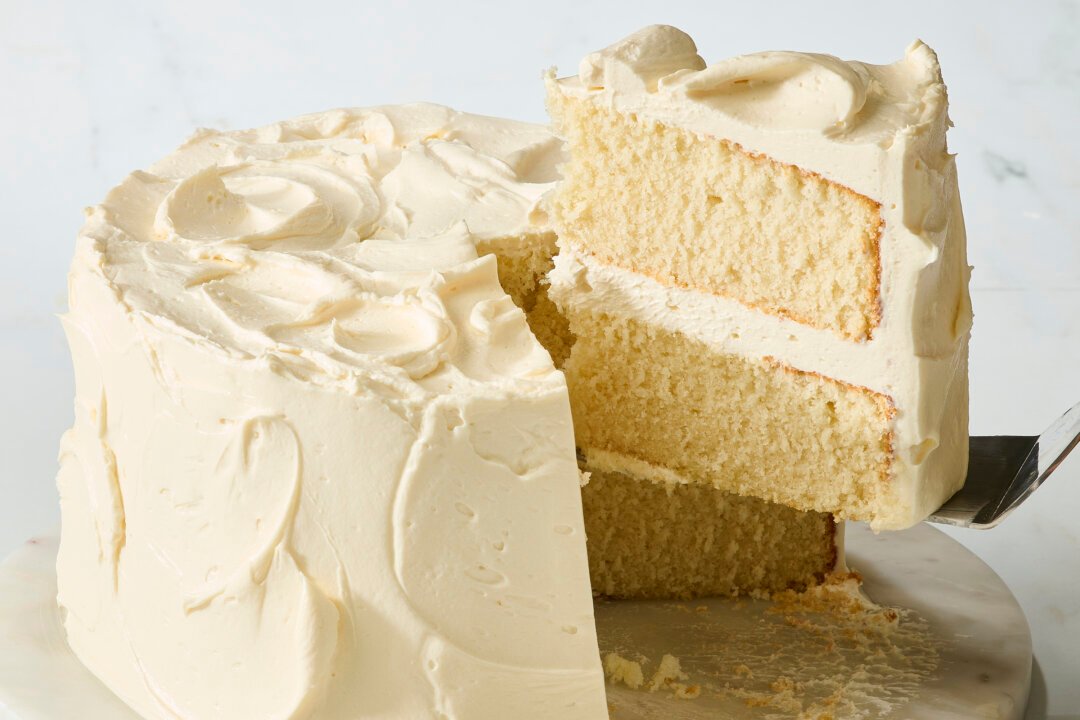
Why You’ll Love Our White Cake
Really big on flavor. You might think that a white cake would be one-note, but with nearly 1/4 cup of vanilla between the batter and the buttercream, along with enough salt to balance the sweetness and make everything sing, this cake is anything but plain.
Nearly foolproof. Using the reverse creaming method means it’s virtually impossible to overwork the cake batter, so you’re guaranteed a tender, fluffy result.
Related Stories


Key Ingredients
Egg whites: Yield a pure white cake with a velvety interior.
Cake flour: Lower in protein than all-purpose flour and so less prone to gluten development, cake flour gives the cake a fine, soft, even crumb.
Butter: In the cake, it coats the dry ingredients in fat, which further limits gluten development and ensures a tender cake. It’s also the foundation of the creamy, fluffy buttercream. Try using a high-quality butter—you’ll taste the difference!
Vegetable oil: Alongside butter, it replaces fat lost to the exclusion of egg yolks and helps create a beautiful crumb that stays moist for days.
Vanilla: Used here in generous amounts, it gives depth and subtle complexity to both the cake and buttercream.
Heavy cream: Helps aerate the buttercream and lends body and richness.
Storage and Make-ahead Tips
The cake layers can be baked, cooled, tightly wrapped in plastic wrap, and stored at room temperature one day ahead, or frozen for up to one month (thaw overnight in the refrigerator or on the counter at room temperature for one hour).
The buttercream is perfect and ready to use right out of the mixing bowl, but can be covered tightly and left out at cool room temperature for up to 48 hours (press a piece of plastic wrap directly on the surface to prevent crusting). It will keep, refrigerated, for up to 1 week. Let come to room temperature and re-whip it in a stand mixer with the paddle attachment, adding a splash of cream if necessary, to bring it back to a light, silky consistency before using.
The cake can be fully baked and assembled up to one day before serving. Store at room temperature, covered, or refrigerate uncovered and let come to room temperature before slicing.
Leftover cake can be stored covered, with plastic wrap pressed against the cut sides, for up to three days at room temperature or five days in the refrigerator. Let the cake come to room temperature before serving.