Christmas Day arrived, and the war had ended. Thomas W. Nason, a sergeant major with the U.S. Army’s 26th Division, sat with his comrades enjoying a Christmas dinner of chicken, turkey, dressing, mashed potatoes, and pumpkin pie. President Woodrow Wilson had recently visited to thank them for their sacrifices. Nason was among the first Americans deployed to France during World War I. It had been 18 months since his deployment, and he was certainly ready to return home. The question was what he would he do when he did.
Thomas W. Nason (1889–1971) was born in the quaint Massachusetts town of Dracut, a short distance northwest of Boston. He grew up with three sisters and one brother on a 50-acre farm in the religious home of a Congregationalist clergyman. Although the acreage was large, the family was not wealthy. As Nason recalled, whenever the family needed something, they typically crafted it by hand. The large plot of land, however, gave young Nason plenty of space to hunt, fish, and hike, allowing him to take in the beauty of Massachusetts.

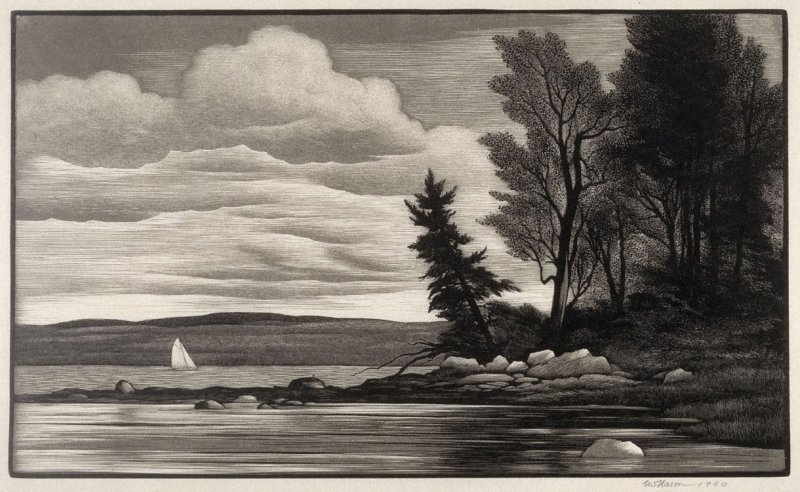
“Near Lyme, Sunset,” 1944, by Thomas Willoughby Nason. Public Domain
“My pursuits,” he recalled, “though not frowned on by my parents, were hardly constructive except insofar as they contributed a bit to the table, game being plentiful in those days. I was really left to my own devices and subsequent career.”
After grammar and parochial school, he attended Howe High School in nearby Billerica, about a mile from the family farm. After graduating in 1906, he worked for several businesses and attended business school at night.
Work, Love, and War
He worked for Standard Oil Tank Wagon Station in Cambridge, then the Portsmouth Navy Yard beginning in 1908, where he worked as a clerk. A couple of years later, an opportunity arose to become secretary for Newton Gilbert, the Vice Governor-General of the Philippine Islands. Nason remained in the Philippines until the summer of 1913.
Upon his return, he became secretary to wealthy industrialist Albert C. Burrage, whose travels to Redlands, California, led Nason to meet his future wife, Margaret Warren.
In 1916, he began taking art classes. He and his siblings had grown up drawing. In a sense, their childhood home was artistic, as their father and grandfather were fine writers in their own right. His time working for Burrage and taking classes, however, looked to be coming to an end, if just temporarily. America was inching closer to war, and on April 6, 1917, Congress declared war on Germany and entered the European conflict.
Related Stories


With America’s intervention, Nason enlisted in the Eighth Massachusetts Regiment and soon deployed with the 26th, which saw some of the heaviest fighting in 1918. After the armistice was signed on Nov. 11, 1918, the war came to an end. Nason and his compatriots were finally able to relax, enjoy their Christmas dinner, and look forward to returning home. Nason returned home in April 1919 and married Margaret Warren the following month. He also returned to the employment of Burrage.
Coming Into His Own
The couple moved to Boston near Beacon Hill, a fine location for an aspiring artist. He spent much of his time studying art at the Boston Public Library and the Museum of Fine Arts. He also frequented bookstores like Smith and McCance, which always stocked the latest editions of art magazines, and Goodspeed’s, which not only had a great selection of art books but also had a print department.
He took a keen interest in the artistic medium of wood engraving and began creating his works of art in 1921. For its November 1923 edition, The Century Magazine printed six of Nason’s pieces. This all took place while he was still working full-time. Through the decade, he continued producing engravings and growing his network of printers and publishers.
In 1928, he and Margaret moved to Reading, Massachusetts, to assist his family. His father had died several years prior. His mother had become an invalid, cared for by his younger sister. Nason remained in the employ of Burrage. The Great Depression began in 1929, making the job with Burrage even more precious. Nason, however, would soon make a momentous decision.
When Burrage died during the summer of 1931, Nason dedicated himself fully to his art. He saw his family’s future in wood engraving.
That same year, he and Margaret purchased land in Lyme, Connecticut, where stood the ruins of an old 18th-century home. They planned to build a new home there. The following year, the local bank failed, taking their money with it. The family relied on their garden and Nason’s sales for provisions. Luckily, the demand for Nason’s pastoral art was steady.
“It might not be much, but it was something,” he recalled. “And there were quite a few dealers.”
Making a Name

The artist’s self-portrait, 1955, by Thomas Willoughby Nason. Copper engraving; 9 3/4 inches by 7 3/4 inches. Courtesy of The Cooley Gallery
The self-taught engraver began making a name for himself nationally and internationally. The year he moved to Reading, he completed a work entitled “Willow Tree and Cottage.” In 1929, it won the Print Club of Philadelphia’s Mildred Boericke Prize, beating out more than 200 other artists. At the Art Institute of Chicago in 1930, the same print took home second place during the first International Lithograph and Wood Engraving Exhibition. In 1930, he won the Mildred Boericke Prize again for “Farm Buildings.” He won prizes in 1932 and 1933 from the Northwest Printmakers and the First International Exhibition of Wood Engravings at Warsaw, Poland.
In 1933, Goodspeed’s Book Shop in Boston hosted an exhibition of his artwork. During the fall and winter months of 1935, he conducted other one-man art exhibits at the Dallas Art Museum, the Carnegie Public Library in Fort Worth, Texas, and again at Goodspeed’s. Nason soon had his work in the permanent collections of the Boston Museum of Fine Arts, the Art Institute of Chicago, the New York Public Library, the Library of Congress, the Victoria and Albert Museum in London, and the Bibliotheque Nationale in Paris.
‘The Poet Engraver’
As Nason’s star soared, so did another New England artist. Robert Frost had moved from California to Massachusetts at age 11 and had risen to prominence as a poet. Nason and Frost became friends, and in 1934, Nason’s artwork graced the cover of a reprint of Frost’s first book of poetry, “A Boy’s Will.”
The two collaborated often. Frost’s poetry seemed to capture the pastoral nature of the northeast, with its snow, barren trees, old houses, and rarely traveled roads. Nason’s art was a perfect fit to illustrate the words. Carl Zigrosser, a renowned art dealer, fittingly identified Nason as “a pastoral poet on wood.”
Frost also personally selected Nason as illustrator for his 1950 work entitled “The Complete Poems of Robert Frost.” Their last collaboration came in 1961 for Frost’s “The Wood-Pile.”
As prominent 20th-century lithographer Francis Adams Comstock wrote, “The meeting of Frost and Nason produced a perfect match, for never did a poet have an illustrator so exactly fitted to interpret him and to complement him in another medium.”
Nason illustrated for other poets, including the late William Cullen Bryant, for whom he created 26 pieces of art for the 1947 book “The Poems of William Cullen Bryant.” Critics rightfully dubbed him the “poet engraver of New England.”
In addition to individual art works, he worked for The Atlantic Monthly, Houghton Mifflin Company, Phillips Andover Academy, Columbia University, and Harvard University.
In 1938, Nason and Margaret finished building their home in Lyme. He lived and worked there until 1971, when he suffered a heart attack while working in his studio.