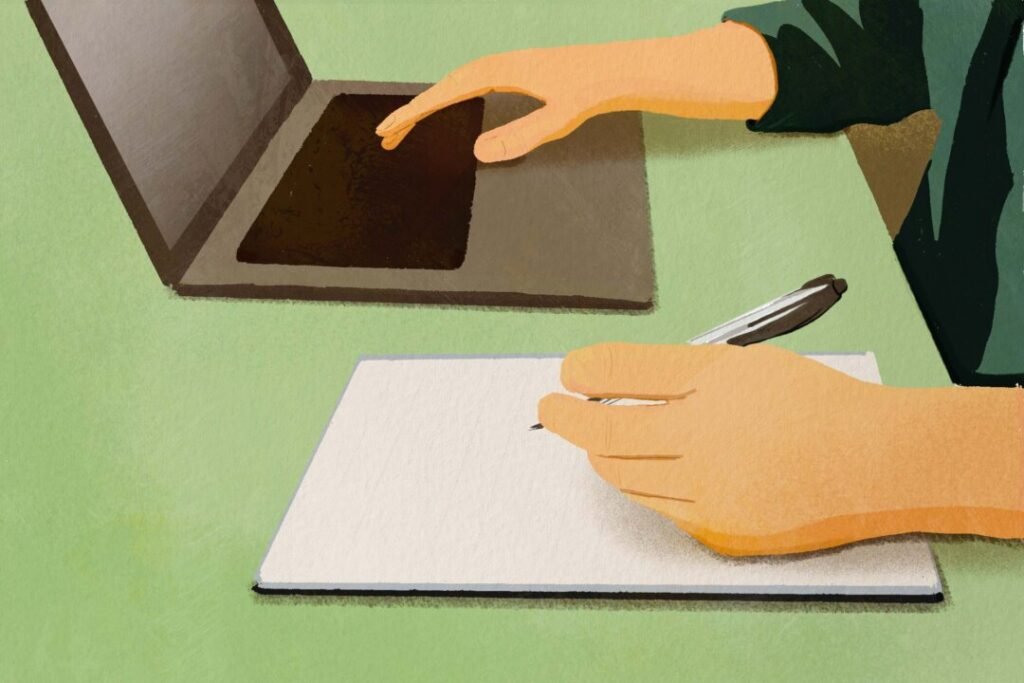
Spoiler alert: The viral health tip claiming that brushing your teeth with your non-dominant hand to reverse dementia is oversimplified, mostly because it’s untested and therefore unproven.
But that doesn’t mean switching everyday tasks to your other hand does not benefit your brain at all. What scientists do know is that it strengthens specific regions of the brain for the same reason puzzles, new hobbies, or earning a degree do: It’s challenging.
That’s exactly why right-handed Victoria Brownlee uses her left hand for daily tasks. While it might seem odd that she’s choosing to fumble her toothbrush, write illegibly, make a bigger mess while mopping, and smear mascara on her eyelids, her goal as a woman who struggles with ADHD is sharper focus.
“It’s not about making ADHD go away,” she told The Epoch Times. “It’s about making me more present in the moment, being more focused, being more intentional in what I’m doing, being more aware of what I’m doing.”
The benefits of using your non-dominant hand aren’t limited to people with ADHD. Anyone who has let ordinary tasks become mindless, automatic habits—which is to say, nearly everyone—stands to gain something.
Why a Clumsy Task Wakes Up Your Brain
Related Stories

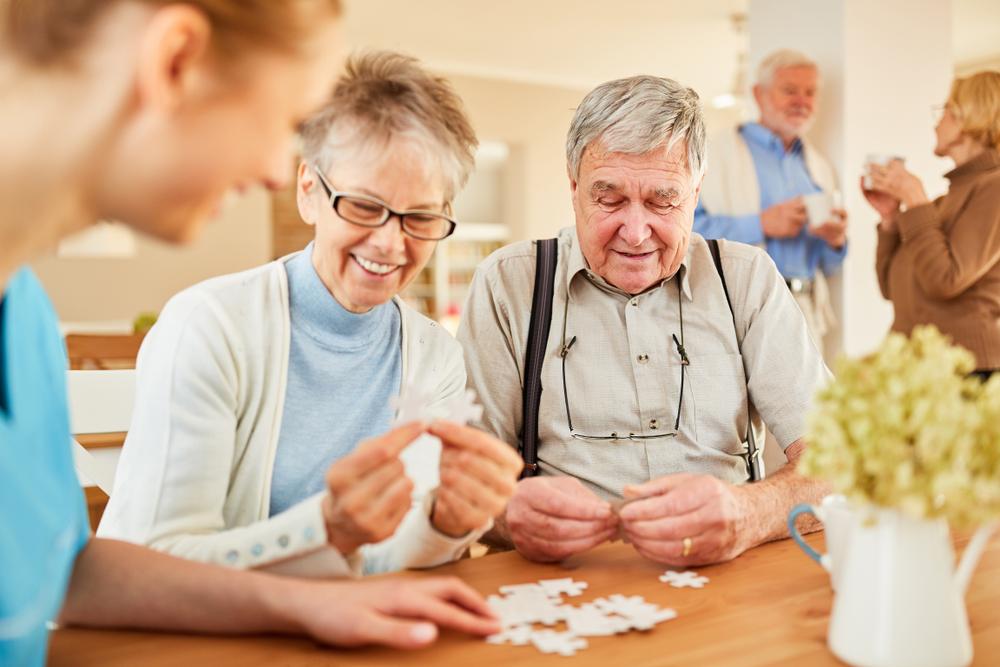
Performing activities with your non-dominant hand helps because novel activities challenge the brain, according to Dr. Ahmet Arac, a neurologist at UCLA.
“The brain likes to be challenged, and when you practice to overcome that challenge, that is an internal stimulation for the brain in terms of improving its functions,” he told The Epoch Times. “Practicing a complex task with that [non-dominant] hand would certainly be a more unusual thing to do, and that would certainly induce some plasticity events.”
In other words, doing something out of the ordinary strengthens neurons and improves the connections between them, a process called neuroplasticity. It acts as a protective strategy against cell decline that’s associated with neurodegenerative diseases such as Alzheimer’s.
Areas beyond motor control remained unaffected in the study, meaning the exercises didn’t induce broader brain benefits.
Still, don’t discount the benefits anytime the brain shifts into a mode that requires more attention and potentially more planning, said Benjamin Philip, assistant professor and director of the neuroscience and rehabilitation laboratory at Washington University. Examples include not only non-dominant hand activities but also anything that challenges cognition, such as learning an instrument or a foreign language.
How Using Your ‘Wrong’ Hand Recruits Your Whole Brain
Another reason the trick works is that our brain has two hemispheres, and switching to your non-dominant hand engages both sides.
Normally, each hand is controlled by the opposite side of the brain—your right hand by your left hemisphere, and vice versa. Over years of practice, the hemisphere that controls your dominant hand builds up a deep library of fine-tuned motor skills for everyday tasks, almost like software it has installed over time.
When you switch to your non-dominant hand, the hemisphere that’s now in control doesn’t have that built-up skill library, and it has to “borrow” it from the other side. That means the two hemispheres have to send signals back and forth and work together to get the task done.
“It has to try to use those advantages, and you end up using both sides of the brain,” Philip told The Epoch Times. “Your brain has to do a lot more work.”
Something else to consider, he added, is that most people aren’t right-handed or left-handed for everything, he said. Rather, they have certain skills they do better with one side—like writing right-handed but throwing a ball left-handed. In other words, the “harder” hand varies not only from person to person but potentially from activity to activity.
Why Movement Matters
Want to make it more challenging?
To increase the challenge, add activities such as writing and throwing a ball that require smooth, flowing movement with accuracy and precision, Philip said.
“Movement involves pulling things together, matching up vision with touch and aligning those things based on your eye position,” he said. “The brain is going to work harder.”
Movement and thinking are closely linked; however, not all movement challenges the brain equally. Some activities recruit more areas of the brain than simple or gross motor control activities.
For instance, threading a needle takes more brain power—including a great deal of visual and sensory feedback—than lifting a heavy bucket, which is primarily an act of brawn.
Challenging Our Brains Is Easier Than We Think
Using our non-dominant hand for something we do every day checks two boxes: It’s novel, and it activates more parts of the brain. Make the task genuinely difficult, and you’ll check a third box, too.
That’s why Philip is skeptical of the specific claim that brushing your teeth with your non-dominant hand can affect dementia risk—it’s simply not very demanding.
“If you want to challenge your brain, being hard is the point,” he said. “Think of the hardest thing you can do.”
That’s exactly why Brownlee added applying mascara to her left-handed routine. Once you master a new task with your non-dominant hand, consider a new activity. Think of it like graduating to a new level in a video game.
The best part of her strategy is that she doesn’t need a gadget, game, app, or even more time in her day, Brownlee said. The payoff extends beyond her brain: When she switches hands for a task every day, it activates her full attention—a practice that has helped her, as a nutritionist, be more mindful with loved ones and clients. She doesn’t plan to stop, and she suggests it to her clients, too, to improve mindfulness around eating.
“There is a moment every day where I’m intentionally focusing on my brain,” Brownlee said. “As long as you’ve got two working hands, you’ve got an opportunity to challenge your brain each day.”