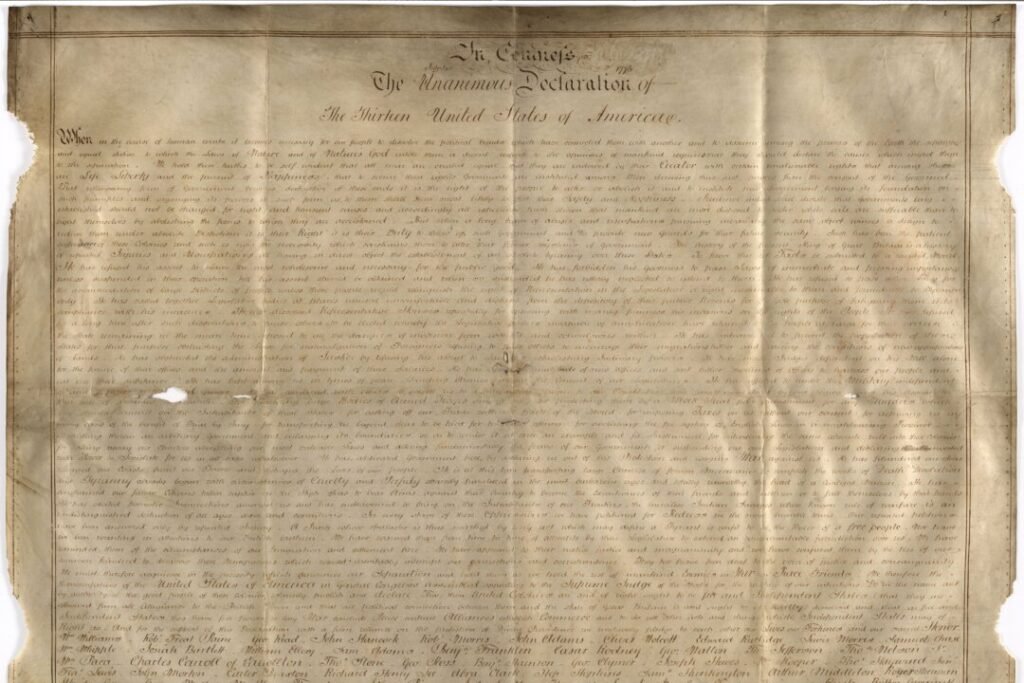

A close-up shot of the copied signatures on the Sussex Declaration. Courtesy of the West Sussex Record Office
This rarest of copies has recently joined the “Declaring Independence: USA 250” at the British Museum in London, commemorating America’s 250th anniversary. Along with the Declaration are three other historic items: a wampum belt, which was used in 1712 as a symbol of peaceful diplomacy between the Lenape (Delaware) and the Haudenosaunee Confederacy; a pipe tomahawk that was a gift from the Duke of Northumberland with the inscription “Given to my friend Joseph Brant from the Duke of Northumberland 1805”; and the Washington Peace Medal, which Paul Revere engraved in 1777.
The Washington Peace Medal has been the exhibit’s centerpiece since it opened on June 30. According to the museum, the medal was a gift from the patriots to the Wabanaki Confederacy to mark a treaty of friendship. The medal was taken from the Wabanaki as part of an enforced treaty with the British. The medal was then given to King George III and passed down to King George IV before he donated it to the museum in 1825.

The Washington Peace Medal is on display at the British Museum. Public Domain
“The Washington Peace medal is an extraordinary survivor of this turbulent time, having passed through the hands of all three main protagonists in the Revolutionary War,” noted Tom Hockenhull, the Museum’s keeper of the Department of Money and Medals.
This is the first time all of these pieces have been displayed together. For curator Rose Taylor, it allows visitors to see diplomatic artifacts from the three cultures most affected by the war: the Americans, the British, and the Native Americans.
Sussex Lore
With the arrival of the Sussex Declaration, visitors to the British Museum will be able to view a copy that most resembles America’s most prized version. There are, however, noticeable differences in this copy. Instead of the parchment being vertical, it is horizontal. All 56 names of the signers are included, but they are not written according to state, nor are they all correctly spelled, indicating that the signatures were copied by someone else.
What is most fascinating about the Sussex Declaration, along with its rarity, is who supposedly handled the copy. Sneff and Allen concluded that it was James Wilson, a lawyer and a prominent Founding Father, who had it created. From there, they believe it was given to Thomas Paine, known for his influential pamphlets during the early days of the American Revolution, and was then delivered to Charles Lennox, the 3rd Duke of Richmond, known as the “Radical Duke” for his support of the American colonists in their cause for independence.
Related Stories
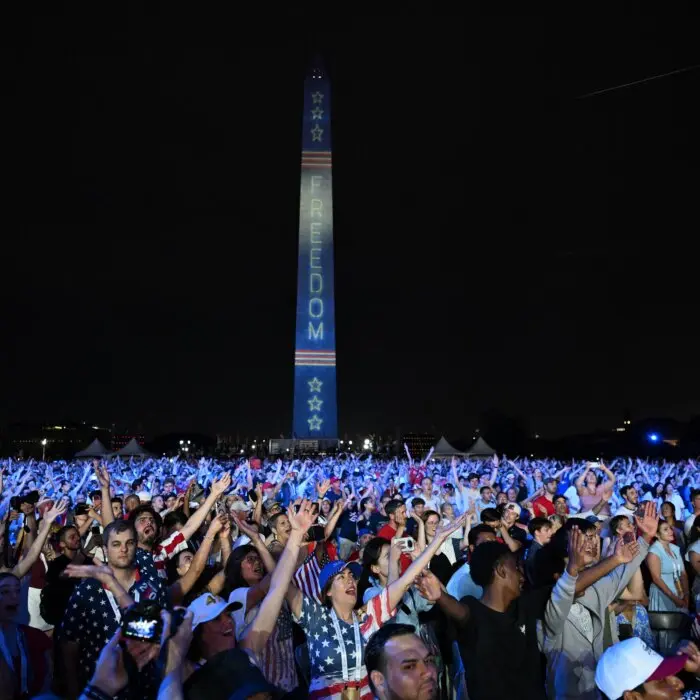
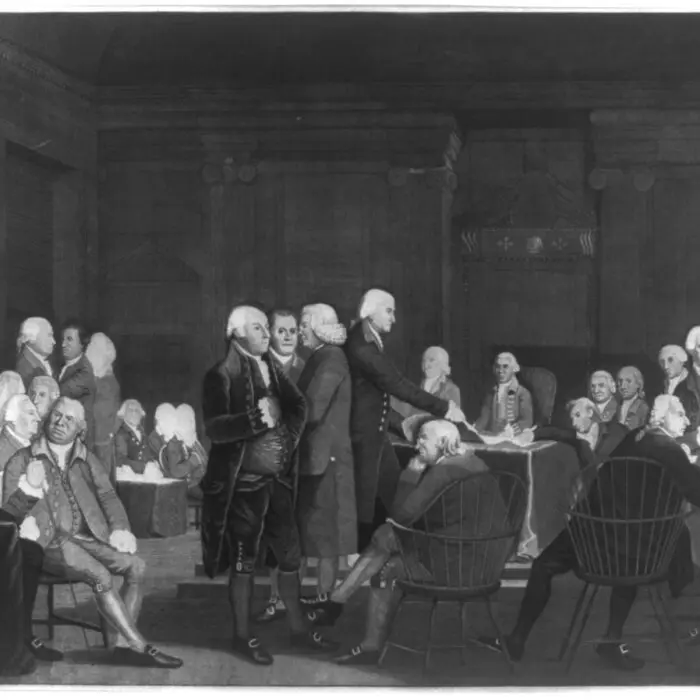

James Wilson was a Founding Father who served as a Supreme Court Justice for nearly a decade. Public Domain
An Exhibit for Both Sides
“The generous loan of the Sussex Declaration, a rare copy of one of the most famous documents in the world, will complement the narrative,” stated Nicholas Cullinan, director of the British Museum. “The United States of America and Britain have a long and interwoven history, as evidenced through this fascinating and timely display.”
Warren Stephens, U.S. ambassador to the UK, echoed Cullinan’s sentiments. “We hope this exhibit allows visitors on both sides of the Atlantic to remember not just our past, but the enduring relevance of the ideas contained in the Declaration today.”
“Declaring Independence: USA 250” is a free exhibit sponsored by Bank of America, and will continue at the British Museum until Nov. 29.
“As we celebrate 250 years of American independence, we know everyone seeing the exhibition will engage with and celebrate this history as if it were part of their own,” Warren said. “Because while the revolution was in America, it started long before, with the ideas that underpinned the United Kingdom, today our closest ally. Those values continue to connect us in the present day.”