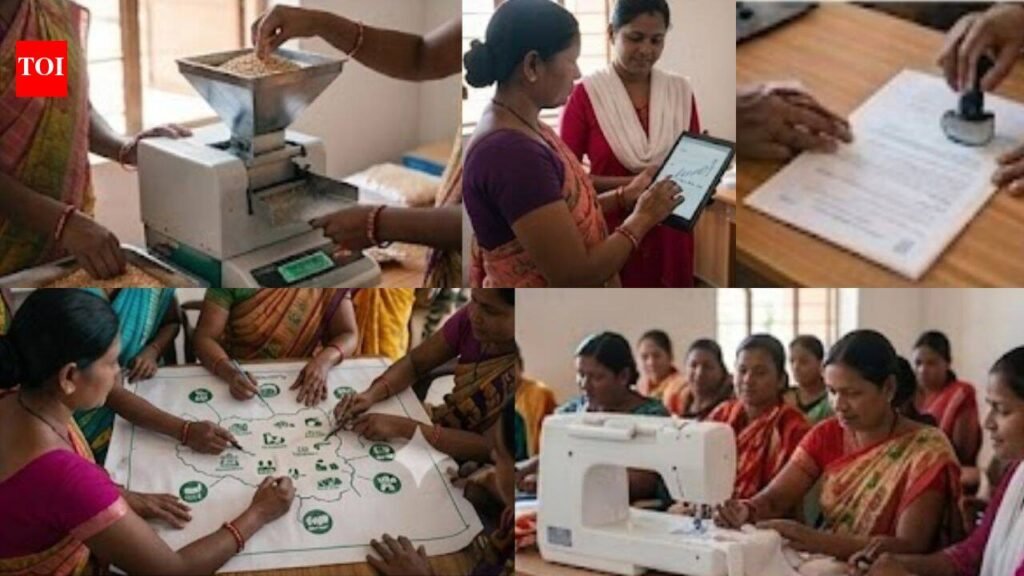
How Aajeevika Mission Transformed Nirmala’s Life in SonbhadraIn the tribal and economically backward regions of Uttar Pradesh, a quiet transformation is taking place. Women who were once dependent on agricultural work and daily-wage labour for household survival are increasingly becoming entrepreneurs, managing businesses and contributing significantly to their families’ incomes.The story of Nirmala, a Scheduled Caste woman from Bichpai village in Robertsganj block of Sonbhadra district, is a compelling example of this change. Once dependent on daily wages, Nirmala of Bichpai village in Sonbhadra now earns around Rs 2.5 lakh annually. Her journey from labourer to entrepreneur reflects how the Aajeevika Mission is creating new opportunities for women in Uttar Pradesh’s rural and backward regions.Once compelled to work as a daily-wage labourer to support her six-member family, Nirmala has today established a diversified rural enterprise. Her annual income has risen to approximately Rs 2.5 lakh, while her success has inspired nearly 12 to 15 other women in her village to explore livelihood opportunities and move towards self-reliance.At the heart of this transformation is the Aajeevika Mission, being implemented by the Uttar Pradesh government to organize rural women into Self-Help Groups (SHGs), build their skills, facilitate access to financial assistance and encourage them to establish sustainable livelihood activities.Aajeevika Mission: From women’s groups to economic empowermentThe basic idea behind the Aajeevika Mission is to ensure that rural women are not merely recipients of welfare but become active participants in the rural economy.Through Self-Help Groups, women are brought together and encouraged to develop savings habits, acquire livelihood skills, access financial support and undertake income-generating activities. The SHG platform provides women with a collective support system that can help them overcome one of the biggest barriers faced by poor rural households—the lack of capital and access to organized livelihood opportunities. Nirmala’s journey demonstrates how this approach can translate into tangible economic empowerment.A graduate, Nirmala had the educational qualifications to aspire for a better future, but her family’s weak economic condition limited her opportunities. Her family consisted of her husband, three daughters and a son. Despite managing household responsibilities, she was forced to undertake wage labour to supplement the family income.Joining a Self-Help Group under the Aajeevika Mission became the first major turning point in her life. Instead of remaining dependent on irregular wage employment, Nirmala was introduced to skill development and livelihood opportunities. She received training in candle-making, a relatively low-investment activity with strong seasonal demand, particularly during festivals.She decided to convert this newly acquired skill into an enterprise. Seed capital turned s a skill into a business. Training alone cannot create a successful enterprise unless women also have access to the resources required to put their skills into practice. This is where financial assistance under the livelihood-development ecosystem became crucial for Nirmala.Recognizing her initiative, the Udyamita Vikas Pariyojana provided her with Rs 60,000 in seed money as initial assistance. For Nirmala, this support became the starting capital for her enterprise. She used the money to purchase moulds for making candles in different designs and shapes. Rather than limiting herself to conventional candles, she began producing attractive, colourful designer candles in the form of flowers, trees and other decorative figures.Initially, she focused on the festival market, particularly Deepawali, when demand for decorative candles rises sharply. What began as a seasonal activity gradually developed into a regular business as customers responded positively to her products. The transformation is significant: the woman who once sold her labour for daily wages was now producing a marketable product of her own.Diversification creates a stronger livelihoodNirmala’s journey also demonstrates another important principle of the Aajeevika Mission—livelihood diversification. Instead of depending on a single product, she gradually expanded her enterprise into different activities. With support from the Khadi Gramodyog Department, she received a popcorn-making machine, adding another source of income.She subsequently received specialized training from the Food Safety and Food Processing Department. The two-month training programme equipped her with skills to prepare value-added food products such as rose gulkand, sharbat and gajar ka murabba (carrot preserve).Nirmala now produces these products according to seasonal demand. This diversification has helped her move beyond a single festival-dependent enterprise towards a broader rural business model. Designer candles provide opportunities during the festive season, while food-processing products create additional avenues for income during other periods.In this way, different government interventions have complemented one another—SHG mobilization, skill development, seed capital, equipment support and food-processing training—to help convert a rural woman’s potential into a sustainable livelihood.Household responsibilities no longer stand in the wayNirmala’s success also challenges the traditional perception that women in rural areas can engage in economic activity only when they are relieved of household responsibilities. She continues to manage her family while simultaneously running her enterprise.This is one of the important social outcomes of the Aajeevika Mission. When livelihood activities are designed around the circumstances of rural women and are supported with training, finance and local opportunities, women can combine entrepreneurship with their responsibilities at home.The result is not merely an increase in income. It brings greater confidence, decision-making ability and social recognition. For Nirmala, entrepreneurship has given her an identity beyond that of a wage labourer.One woman’s success inspires an entire villageThe most powerful impact of Nirmala’s story can perhaps be seen in the women around her. Her success has encouraged 12 to 15 women in the village to move towards self-reliance. Her journey has demonstrated that entrepreneurship is possible even in a rural and economically disadvantaged area, provided women receive the right combination of training, institutional support and access to capital.This is precisely the larger objective of the Aajeevika Mission: creating an ecosystem in which one empowered woman can become a catalyst for change within her community. The transformation therefore extends beyond individual income. As more women join SHGs and take up enterprises, the economic role of women within rural households and communities becomes stronger.From self-reliance to market expansionNirmala is not stopping at her current achievements. Her next objective is to take her products to the online marketplace. This aspiration reflects the changing character of rural entrepreneurship in Uttar Pradesh.The journey that began with selling candles locally is now moving towards wider markets. Digital platforms can potentially help rural entrepreneurs overcome geographical limitations and connect their products with customers beyond their villages and districts. Nirmala’s ambition to enter the online market is therefore another important step—from local production to market expansion.A model of women-led rural developmentNirmala’s story illustrates the potential of a well-connected rural livelihood ecosystem.The Aajeevika Mission provided the institutional foundation by bringing her into the Self-Help Group network. Skill training gave her the capability to produce marketable goods. Seed money enabled her to purchase the equipment and raw materials necessary to begin production. Departmental support helped diversify her enterprise, while further training opened the door to food processing.The result is a woman who has moved from wage labour to entrepreneurship, from economic dependence to self-reliance and from individual struggle to becoming an inspiration for other women. Her journey also reflects the broader vision of the Yogi government to strengthen rural economies by empowering women as economic actors. In backward and tribal regions, where conventional employment opportunities can be limited, women-led micro-enterprises can provide an important alternative source of household income.Nirmala’s colourful candles may have been the first product of her enterprise, but they have come to symbolize something much larger—a new confidence among rural women. Today, Nirmala earns around Rs 2.5 lakh a year, manages her household and runs a diversified enterprise. More importantly, her story is encouraging other women in Bichpai to believe that self-reliance is possible.From a daily-wage worker to a rural entrepreneur, Nirmala’s journey is a powerful example of how Aajeevika Mission can transform skills into livelihoods, livelihoods into enterprises and individual success into a movement for women-led rural development.(District Transformation)