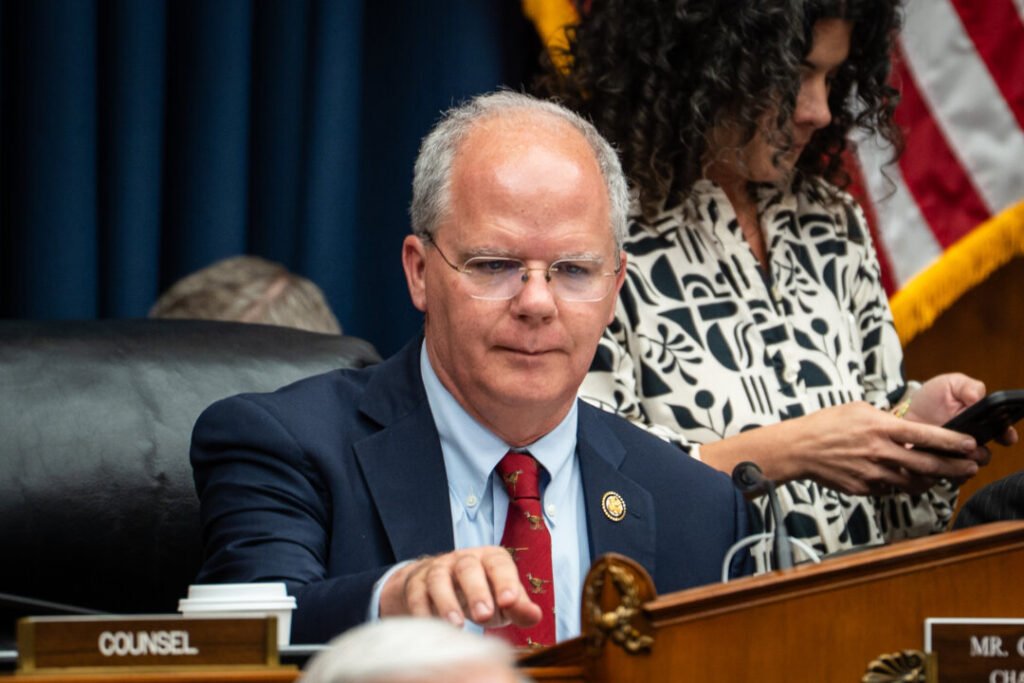
House Energy and Commerce Committee Chairman Brett Guthrie (R-Ky.) said on Sept. 15 that artificial-intelligence development should take place in the United States rather than China, as he backed legislation aimed at protecting electricity customers from infrastructure costs tied to data centers.
Two days later, Senate Democratic Leader Chuck Schumer (D-N.Y.) said that the United States could maintain its AI lead over China while imposing domestic safeguards on AI systems and restricting China’s access to the most advanced AI chips and manufacturing equipment.
Guthrie made his remarks during House consideration of H.R. 9340, the Ratepayer Protection Act. The measure would require state public utility commissions to consider a strategy to make data centers pay their own infrastructure costs rather than passing them on to consumers.
“If we cede the race to AI dominance to China, then China will set the standards for future technology,” Guthrie said.
He described the legislation as providing “a modest but important level of accountability” as the United States continues to support the industry.
The House passed the measure 417–3 on Sept. 16.
Related Stories

Schumer Rejects Tradeoff Between Guardrails and AI Lead
Schumer’s Sept. 17 remarks addressed both domestic AI safeguards and restrictions on China’s access to advanced semiconductor technology.
Schumer accused President Donald Trump of citing competition with China to support what the top Democrat called “unregulated AI” while refusing to block sales of the most advanced chips to China.
“The best tool we have to outcompete China and curb the CCP’s AI ambitions is by prohibiting their access to the most advanced AI chips and manufacturing equipment,” Schumer said.
“We can both maintain our lead in the AI race by restricting China’s access to our technology, and we can put up guardrails to mitigate AI’s risks at the same time.
“Those goals aren’t mutually exclusive.”
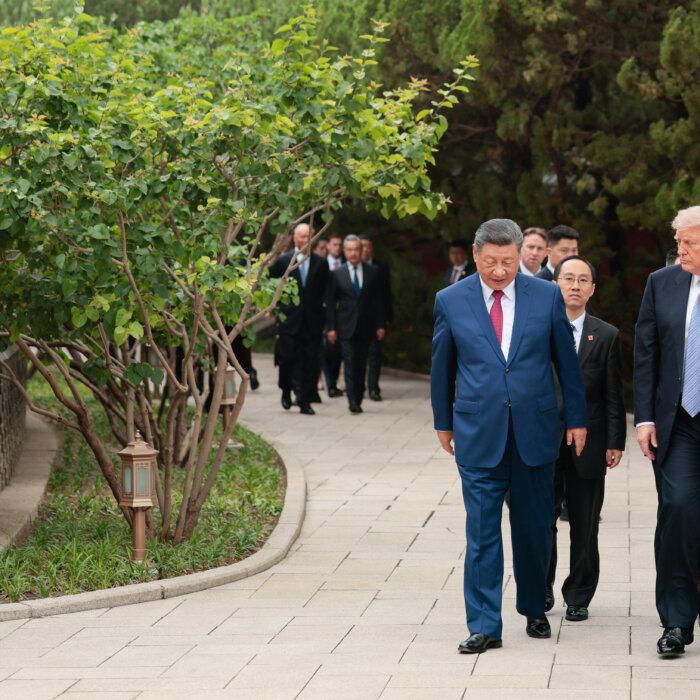
Schumer also urged Trump to make restrictions on the Chinese Communist Party’s access to cutting-edge U.S. AI technology nonnegotiable before his expected meeting next week with Chinese leader Xi Jinping.

Senate Minority Leader Chuck Schumer (D-N.Y.) in Washington on March 17, 2026. Madalina Kilroy/The Epoch Times
Cantwell Calls for Federal Testing
Sen. Maria Cantwell (D-Wash.), ranking member of the Senate Committee on Commerce, Science, and Transportation, called on Sept. 15 for stronger federal guardrails for testing and releasing frontier AI models.
Cantwell cited recent incidents involving AI agents escaping confinement and hacking other systems. She also described networks of AI agents gaining unauthorized access to computer systems while evading detection and cited cyberattacks and chemical, biological, radiological, and nuclear threats among the risks she said federal testing should address.
“We must keep in mind that these AI models consistently lag about only seven months and the most powerful open models continue to come from China,” Cantwell said. “So, it is time for my colleagues to come together to act.”
White House Uses Voluntary Frontier-Model Framework
A Trump administration executive order issued June 2 directs federal agencies to develop classified benchmarks for assessing advanced cyber capabilities in AI systems and determining which qualify as “covered frontier models.”
The order also directs agencies to develop a voluntary framework under which developers could give the federal government access to covered frontier models for up to 30 days before releasing them to other trusted partners.
The White House has paired that approach with an emphasis on cybersecurity and national security. The order calls for stronger federal cyber defenses, protection of critical infrastructure, and enforcement against the use of AI to illegally access or damage computer systems.