When Peter Lyndon-James turned to faith as he was about to face jail time for drug-related offences, he had no idea it would lead him to establish one of Australia’s largest drug rehabilitation centres.
“The whole program is set up where residents take responsibility for their choices,” he said at a briefing organised by the Drug Advisory Council of Australia (DACA) at Victoria Parliament last month.
“We are unashamedly a faith-based rehab, so we are a Christian. I make no apologies for that, but when [people] come into Shalom, [they] don’t have to become a Christian. There are many rehabilitation centres across Australia that do a great job.”

Peter Lyndon-James, founder of Shalom House rehabilitation centre in Perth, Western Australia, speaks at briefing organised by the Drug Advisory Council of Australia at Victoria Parliament on Aug. 19, 2026. Henry Jom/The Epoch Times
Hitting A Brick Wall
Before establishing Shalom House in 2012, Lyndon-James said he spent 26 years going in and out of Western Australia’s prison system for various drug-related criminal offences.
Related Stories

His life of crime—breaking into houses, stealing cars, dealing drugs, and becoming addicted—stemmed from family breakdown, which he says is a common theme among individuals with addiction issues that require rehab.
“I believe [drug abuse occurs] because of the breakdown of the family home, and structure,” he told The Epoch Times.
He described his childhood as dysfunctional, with split parents, an alcoholic father who ran off with a babysitter, a mother of five who went in and out of rehab, family violence, sexual abuse, constant school changes, only finishing grade six, and moving through different prisons.
“My whole childhood was literally stolen from me. I never remember my dad cuddling me, my mum cuddling me, I’ve never played sports. My sports was breaking in houses and stealing cars,” he said.
“Every time I wanted to change, I just hung around normal people, but I felt like I didn’t belong. I had a lot of unforgiveness and bitterness.”
The turning point occurred in 2001 when he saw a five-year-old boy kick a ball in between his father’s legs and noticed how joyful that moment was for them.
“My whole life, I wanted to make my son feel special. I never spent any time with my kids. I was always on drugs,” Lyndon-James said.
Facing his then-impending jail sentence, he became emotional, saying: “I remember chucking a prayer up, I don’t pray, but I said: ‘God, I need your help. I can’t do this anymore.’”
He recalled chance encounters following this prayer, including from an elderly woman who told him, “God loves you, and he has a plan and purpose in your life.”
After serving jail time, Lyndon-James enrolled in Bible college. During the course of his studies, he needed to hang around “geeks and normal people, and do normal stuff,” which he wasn’t accustomed too.
For instance, when he went to church, someone went to hug him but Lyndon-James’s instinct was to “give him one [punch him]” instead—but he didn’t.
“In 2005, I finished Bible college and became a volunteer prison chaplain for the next five years, three days a week,” he said. He spent those years watching former acquaintances cycle through the prison system before becoming a full-time volunteer in 2010.
From 2010 to 2012 he worked on the streets, taking people to different rehabilitation centres and studied different rehabilitation programmes.
Paying Your Own Way to Sobriety
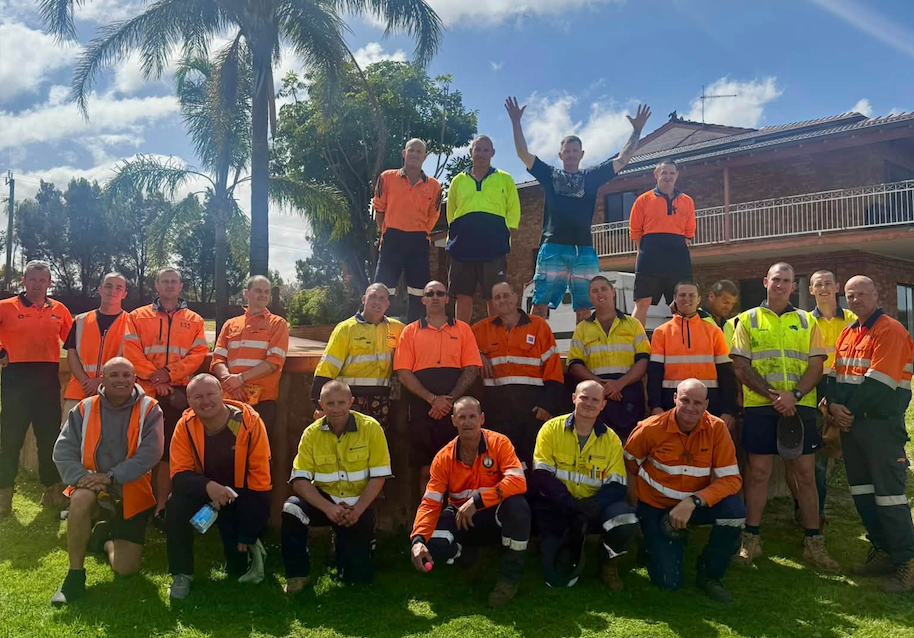
Shalom House runs a “tight ship”: residents go through a medically supervised cold-turkey drug detox programme, give the centre control of their finances including Centrelink accounts, pay $300 in weekly rent, go to church, pray, and work.
“I’m getting people who have never had a routine in their life,” he said.

Residents of Shalom House attending Church. Courtesy of Shalom House
All 160 residents have tailored five-stage programmes that are designed in consultation with psychiatrists, psychologist, child psychologists, and doctors. The residence provides “holistic rehabilitation” services to men, women, and families for a minimum of 12 months.
“It’s not just about delivering them free from addiction, it’s about reintegrating them back into society as a normal, productive person and the community free from drugs and substances. And that’s what we do,” he said.
“The whole of the program is designed for them to take ownership of their mistakes and to pay for their own rehab. We are a registered not-for-profit, tax-deductive organisation. We don’t ask for money, we don’t ask for funding, we don’t get funding, we don’t apply for grants,” he said.
“If you can’t pay your rent, you’re not staying here. It’s simple.”
Getting Patients Off Welfare Quickly
He said that government-subsidised welfare programmes, such as Centrelink, were set up for people in short-term crises, not to live off.
“Every person I’ve ever taken have abused Centrelink for the last 20 years—not in my rehab—our aim is to get them off of Centrelink as quickly as possible so they can pay their own [way].”

A male resident at Shalom House holds a signing saying he is debt free. Courtesy of Shalom House
“I personally don’t believe it’s okay for a person to use drugs and substances, have parties, knock on somebody’s door, and expect the taxpayer to pay for it.”
Additionally, Lyndon-James said he is critical of Australia’s current harm minimisation drug policy.

Courtesy of Shalom House
“What I’ve seen is a lot of people getting taken off an illegal drug, then get put on a legal drug. They get taken off the heroin and they get stuck with the methadone, then they get chained to chemists where they get the $7-a-day dose, their teeth’s bloody white and they live with it. [But] at least it stops the crime rate.”
He said that people addicted to heroin, for example, can double dose on naltrexone—a prescription drug used to treat drug dependency—to get the same high but could end up in a critical condition or even die from an overdose.
More Taxpayer-Backed Funding Not the Answer
While many drug rehabilitation centres in Australia obtain hundreds of millions in government funding, Shalom House receives none, Lyndon-James said.
“I’m the largest rehab in Australia, and I’ve got 160 people. I cost nobody nothing. If I can do what I can do, how can they justify $1.6 billion?” Lyndon-James asked.
“If you put a person in the government rehab, their rehab is three months. You get 13 three-month stays, and that’s a lot of funding for the government and to the organisation; whereas mine is one visit, one stay,” he said.
“The government one is bums on seats and heads in beds—there’s no outcomes.
“And how do you measure success? Is it free from drugs? We do that. Is it to restore all their family? We do that. Is it get them off of Centrelink? We do that. Full-time job? We do that too. There’s no place like Shalom anywhere in Australia, if not globally,” he said.
WA’s Mental Health Commission has been approached for comment.
“I’ve got thousands of success stories, But I don’t look at the past, I don’t look at the future. I just look today and say, ‘I want to be the best me that I can be.’ I feel like I’ve found the cure for cancer. I feel like I’ve found a solution to the problem.
“Is it cause I’m faith-based? Yes, I am unashamedly a Christian man. I don’t push religion down people’s throats. You don’t have to become a Christian but I’m going to church, read our Bible and pray. If you don’t want go to church, you can go to another rehab.
“I just want to change lives, restore families, and make a difference.”