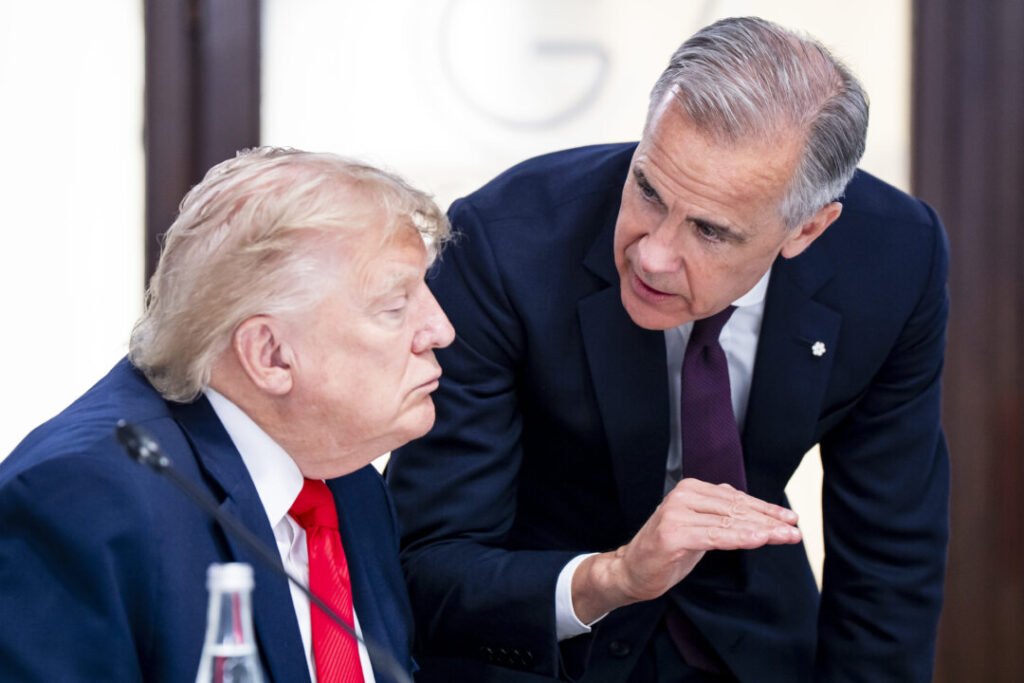

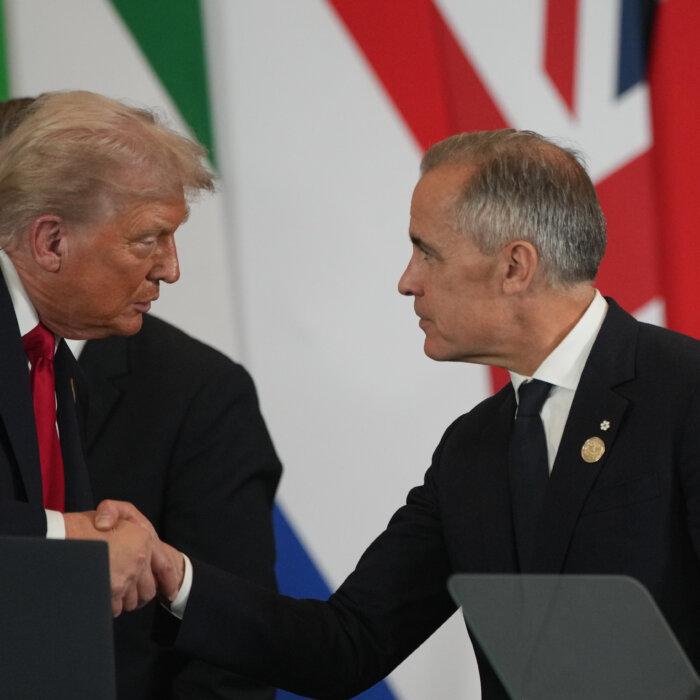
Canada’s Prime Minister Mark Carney and U.S. President Donald Trump speak at the G7 working luncheon, during the G7 summit in Evian-les-Bains, France, on June 16, 2026. The Canadian Press/Christopher Katsarov
Prime Minister Mark Carney has addressed comments made by U.S. President Donald Trump that a trade deal could be reached “fairly soon,” saying that Canada is “ready to sit down and negotiate.”
Carney was questioned during a recent interview about Trump’s weekend comments that Canada wants to reach a deal with the United States “very badly.” The president suggested an agreement could come “fairly soon,” but that it would be contingent upon Ottawa’s willingness to address his concerns about agricultural trade.
Carney told Bloomberg that he still believes there is a “mutually advantageous agreement that’s possible” between his country and the United States—a statement he has reiterated throughout the 18-month trade dispute. He also emphasized that any future negotiations must respect national sovereignty and cultural protections while maintaining independent trade policies.
“We’re ready to sit down and negotiate that and move it forward,” Carney said during the Sept. 14 television interview. “So I welcome the president’s comments.”
Carney was also asked which country should take the first step toward resuming dialogue after Canada withdrew from a proposed trade agreement with the United States at the 11th hour late last month.
The prime minister said it isn’t “a pride thing” and that his team is “ready to sit down” with the White House.
Related Stories

“From our perspective, we’re practical people that know what our bottom lines are, what our red lines are for sovereignty, for culture, not being restricted on our ability to sign other trade deals,” Carney said. “I think our American colleagues may perhaps understand those red lines a little more clearly now, given what’s happened.”
Trump also mentioned his own red lines while visiting Ireland over the weekend. He said agricultural trade continues to be a matter of concern for him and criticized the tariffs imposed by Canada on certain American products.
“Canada has to treat our farmers better and they can’t charge our farmers tariffs,” he told reporters. “When those things go away, and they’re willing to get rid of all of them, you’ll probably see a deal with Canada fairly soon.”
The current round of trade tensions between Canada and the United States dates to March 2025, when the Trump administration imposed a 25 percent tariff on Canadian goods not covered by the Canada-United States-Mexico Agreement (CUSMA).
Formal talks over the future of CUSMA broke down this summer after the United States declined to extend the agreement for another 16 years and instead sought to renegotiate it. Canada and the United States failed to reach a deal by Aug. 21, with Prime Minister Mark Carney saying last-minute U.S. demands raised concerns about Canadian policies related to the French language and culture, as well as Canada’s ability to pursue trade agreements with other countries.
Carney noted that the two countries have a long history of intermittent trade disputes dating back generations but have always managed to find solutions.
“Canada and the U.S. have a very long relationship,” he said during the interview. “We sometimes go through periods where there are tensions in that relationship. We’ll come to some agreement at some point.”